Amid the dissolution of Borders bookstores in urban centers, Chuck Wolfe urges policymakers and the private market to assure "no let loss" in the spirit of natural resource protection to assure third places remain available in American cities.


Wolfe posits that many forms of dynamic activities in urban centers, including the loss of congregating bookstores like Borders, raise questions about the need to preserve downtown "third places" and how to make a more livable city. While sensitive to the opportunity for the reestablishment of independent booksellers, he argues that the loss of a large congregating place, even if part of chain merchandising, may be replaced by a use that is not a third place. He suggests that a "no net loss" approach is appropriate for such square footage:
"Both the private market and public policymakers should work together on the potential prize of livability: assuring the sustainable, no net loss of square footage devoted to urban third places."
Thanks to Chuck Wolfe
Read the full story: Assuring Sustainable Third Places in the City
The Myth of the Urban Core
Question: What do Keybank Tower in Cleveland, the Kettering Tower in Dayton, and One Seagate in Toledo have in common? Answer: They are their respective city’s tallest buildings, and they were built after their city’s population peaked.
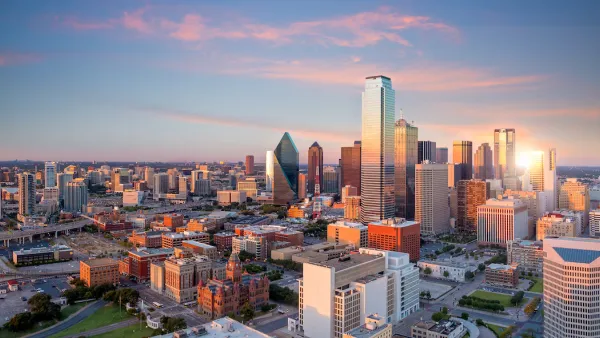
How the Post-Covid Reality Is Reshaping Central Business Districts and Urban Centers
U.S. cities are working to redefine their downtowns in response to the “donut effect:” people and businesses abandoning city centers and flocking to suburban areas and beyond.
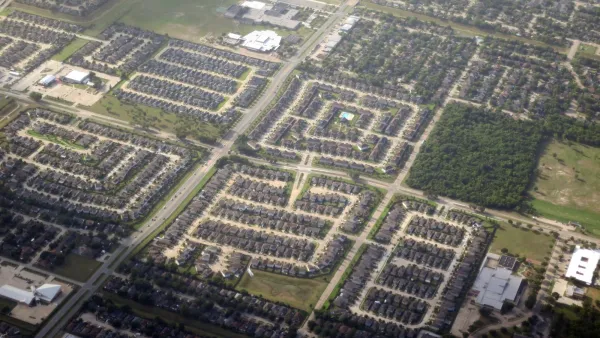
Houston Area's Center of Gravity Shifts Outside the Loop
The population center of Harris County is now outside central Houston, a shift that occurred over the last two decades as the region's suburbs blossomed.

Planetizen Federal Action Tracker
A weekly monitor of how Trump’s orders and actions are impacting planners and planning in America.

Eastern Nebraska is running out of electricity
Data centers and electrification are straining eastern Nebraska’s grid, throttling economic development.

Study reveals best places in the U.S. for cycling, walking
New research from Streetlight Data examines bicycle and pedestrian miles per capita in the 100 largest U.S. cities by population.

Next-generation nuclear reactors are coming to Texas
The reactors will not require towering containment structures thanks to new safety features.

California distributes $1.3 billion to prevent transit service cuts, bolster projects
Twenty-eight projects across California received a portion of the funding.

Pennsylvania Democrats have 15 affordability, clean energy bills for flipped state Senate
Bills in consideration include a bill supporting geothermal energy and a bill supporting solar on warehouses.

FREE Course: Walkable City 1: Why Walkability?
After describing his path towards focusing on walkability as the essence of good planning, Jeff Speck marches through his five principal reasons for making more walkable places.
Reinventing Malls: Planning Alchemy—Turning Gray Fields Into Gold
The course focuses on the opportunities and imperatives that shape reinvention of mall sites.

City of Charlotte
City of Rosemead
Rutgers University, Edward J. Bloustein School of Planning and Public Policy
University of Michigan School for Environment and Sustainability (SEAS)
Hunter College, City University of New York (CUNY)
The Architects Foundation
City of Cambridge
The Pocatello Development Authority
The Urban Renewal Agency of the City of Pocatello