Rust Belt poster child Youngstown, Ohio made waves almost a decade ago with its revolutionary plan for "controlled shrinkage." But progress has been slow in a political system still wired for growth.


Angie Schmitt reports in Youngstown's struggles. Formerly a steel town, the city lost almost half its residents in the last 30 years. Schmitt says the main problem in Youngstown is that it can't support its built infrastructure:
"The starkest example is its excess housing stock. At last count, demolition crews were slogging through some 3,300 vacant houses. But sewers, streets, even stoplights: all of these former amenities linger at a scale meant for the days when the mills were still turning the skies orange and filling the pockets of workers who, in turn, filled the gambling houses.
Now these physical amenities have become liabilities. A diminished tax base limits the city's ability to maintain its aging streets and sewers."
The city developed a plan in 2010 for managing shrinkage, but Schmitt says things are moving slowly.
Thanks to Angie Schmitt
Read the full story: In Growth-Oriented System, Youngstown, Ohio Struggles to Shrink


Study: There's a Lot of Vacant Land in Texas Cities
All that empty acreage means that these big, rapidly developing cities don’t really have to sprawl.
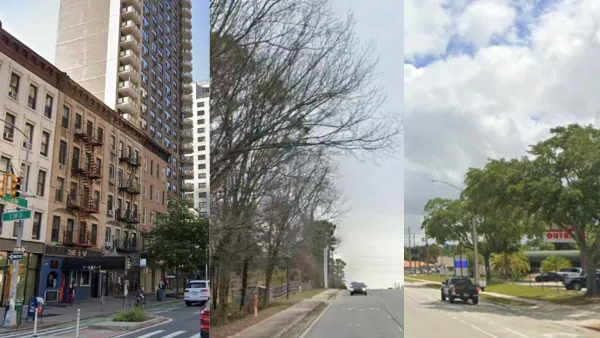
A Transect of sprawl
A development pattern this lifestyle-defining deserves its whole own classification system.

What the fall of earth's largest pre-industrial city can teach us about urban sprawl
Angkor was a low-density metropolis. It lasted six centuries, until it could no longer maintain its infrastructure in a changing climate. Today, it offers planners a sobering warning about the risks of dispersed urban living.

Planetizen Federal Action Tracker
A weekly monitor of how Trump’s orders and actions are impacting planners and planning in America.

Amtrak, CN end decades-long dispute with eight-year agreement
The new operating agreement establishes an updated framework for the companies to work together, including processes to resolve disputes.

Northwest rail fans eager for Sept. 30 debut of Amtrak’s Airo fleet
Get ready for that new train smell and more seats. But they won’t go faster or run more frequently on the Cascades route in Washington and Oregon.

NYC to turn city-owned property into thousands of homes
The city has scheduled a public hearing regarding the development for October.

Buses travel at 5mph along this route in NYC. The Bronx's first-ever busway looks to change that
Prior to the busway, buses on the Bx36 route traveled as slowly as 5 miles per hour.

Pittsburg launches 'EZ permits,' aims for one-day turnaround for low-risk permits
The pilot ‘fast lane’ for permits is part of a bundle of modernization efforts for Pittsburg’s permitting process.

FREE Course: Walkable City 1: Why Walkability?
After describing his path towards focusing on walkability as the essence of good planning, Jeff Speck marches through his five principal reasons for making more walkable places.
Reinventing Malls: Planning Alchemy—Turning Gray Fields Into Gold
The course focuses on the opportunities and imperatives that shape reinvention of mall sites.

City of Thousand Oaks
City of Wisconsin Rapids
Harvard University Graduate School of Design
The Architects Foundation
University of Cincinnati Online
The Pocatello Development Authority
The Urban Renewal Agency of the City of Pocatello