Officials in Malaysia and Singapore have high hopes for the high speed rail link planned between the two countries.


"It was reported at the Conference of Mayors that the benefits of travelling between 110 mph and 220 mph will mean better connectivity, shorter travel times and new development around train stations. The changes will create 150,000 new jobs and some US$19bil in new businesses by 2035. The rail network is also expected to spur tourism, give businesses a wider pool of workers to choose from and help grow technology clusters in cities.
Similar to experiences in other countries, in Malaysia, HSR will also generate substantial economic benefit to both countries, particularly Kuala Lumpur City Centre and the Iskandar region. The availability of HSR will shorten the distance between Malaysia and Singapore in terms of travelling time, hence attracting a larger pool of market catchment to stay in Malaysia and work in Singapore or vice versa."
Rail travel times would be cut from about 7 hours to 90 minutes.
Thanks to The Overhead Wire
Read the full story: High-speed rail will spur growth in hub cities

New Toolkit for Walkability Presented at the World Urban Forum
At the ninth session of the World Urban Forum held earlier in Kuala Lumpur, Malaysia, the Institute for Transportation and Development Policy introduced their new "Pedestrian First" toolkit to measure and promote walkability in urban environments.
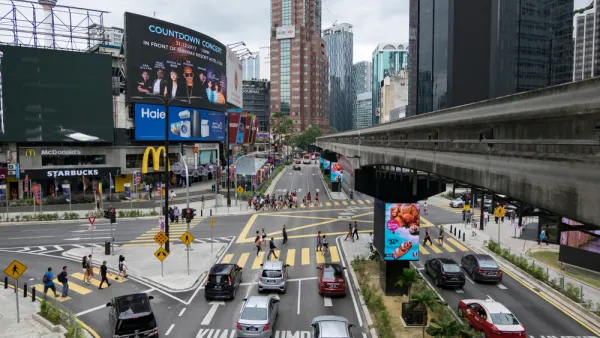
China's Largest Online Retailer Using Artificial Intelligence to Tackle Congestion
A subsidiary of Alibaba, the massive online retailer, will deploy cloud computing and artificial intelligence to help relieve congestion in Kuala Lumpur, Malaysia.
Singapore Planning a 24-Kilometer-Long Version of the High Line
A plan in Singapore to transform the former Keretapi Tanah Melayu railway will create a linear park ten times longer than the High Line.

Planetizen Federal Action Tracker
A weekly monitor of how Trump’s orders and actions are impacting planners and planning in America.

California plans to bury El Niño’s downpour
If the state plays its cards right, it may be able to store a billion acre-feet of El Niño’s water in aquifers.

Desperate measures: Advocates weigh draining Lake Powell to fill Colorado River
Draining the reservoir could reduce evaporation losses by a couple hundred thousand acre-feet.

Los Angeles just elected an urban planner as its mayor
Transportation analysts are optimistic that Raman will be more aggressive in addressing transit issues than Bass.

Mamdani’s pied-à-terre tax survives legal challenge
A panel of judges found that the plaintiffs failed to demonstrate injury as a result of New York City's implementation of the tax.

Eastern Nebraska is running out of electricity
Data centers and electrification are straining eastern Nebraska’s grid, throttling economic development.

FREE Course: Walkable City 1: Why Walkability?
After describing his path towards focusing on walkability as the essence of good planning, Jeff Speck marches through his five principal reasons for making more walkable places.
Reinventing Malls: Planning Alchemy—Turning Gray Fields Into Gold
The course focuses on the opportunities and imperatives that shape reinvention of mall sites.

City of Rosemead
Rutgers University, Edward J. Bloustein School of Planning and Public Policy
One Hundred Miles
University of Michigan School for Environment and Sustainability (SEAS)
Hunter College, City University of New York (CUNY)
The Architects Foundation
City of Cambridge
Montrose County
The Pocatello Development Authority