As green spaces and public areas increase in demand, more and more projects are being awarded to landscape architects rather than architects, some foresee a potential professional turf war.


"The recent surge in prestigious commissions going to and being completed by landscape architects has fuelled a fiery discourse over the ether as well as in academic circles as to what this means for the way cities will be made in the future. Traditionally, the architect was the master builder with landscape designers as mere ancillaries. Today that relationship is fast being reversed.
'Traditional roles have flipped," said architect Stephen Cassell of ARO, who believes landscape architects should have equal footing on design projects because of their specialized training. 'A lot of these landscape architecture firms have started to think about green spaces in a synthetic way. How landscape architects analyze a problem is very specific; it is about looking at experience within the city.'"
The element of usable landscape has grown in importance in a variety of high profile projects, pulling the formerly side-kicking field of landscape architecture into the spotlight.
Read the full story: Feature> Contested Ground

‘Grätzloasen’: The Urban Oases Vienna Pays its Citizens to Build
The Austrian capital offers grants of up to 5,000 Euros to residents who want to build their own parklets in curbside parking spaces.

How South LA Green Spaces Power Community Health and Hope
Green spaces like South L.A. Wetlands Park are helping South Los Angeles residents promote healthy lifestyles, build community, and advocate for improvements that reflect local needs in historically underserved neighborhoods.
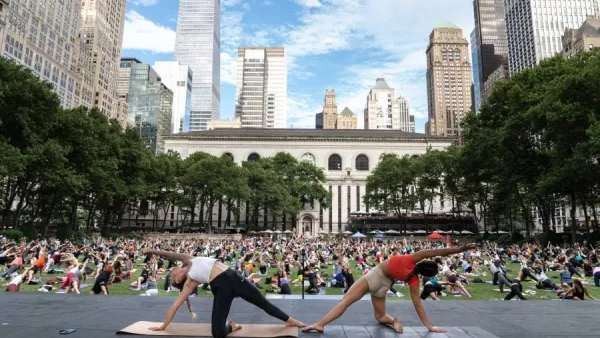
The Panacea of Outdoor Human Movement
Humans relish in over-complicating things, but the sweetest and healthiest things in life are the simplest.

Washington state to charge fee to drivers with fuel-efficient cars
Revenue from the fee will go towards supporting the state’s highways.

Illinois considers spending $1 billion in taxpayer money on data center
A quantum computing campus and data center are currently under construction in Chicago.

Trump to blast ‘hydrocarbon highway’ through ‘world’s longest art gallery’
Environmental and historic preservation groups are suing to stop the project.

Boston City Council votes to no longer mandate parking in residential developments
The Boston Zoning Commission still needs to approve the proposal.

Passengers in New York, California lift off in air taxis
Two air taxi companies have received a Special Airworthiness Market Survey Certificate, which allows them to service passengers.

MTA to upgrade subway signals for entire network by 2050
This is the first time New York City has planned to modernize subway signals in the Bronx.

FREE Course: Walkable City 1: Why Walkability?
After describing his path towards focusing on walkability as the essence of good planning, Jeff Speck marches through his five principal reasons for making more walkable places.
Reinventing Malls: Planning Alchemy—Turning Gray Fields Into Gold
The course focuses on the opportunities and imperatives that shape reinvention of mall sites.

City of Charlotte
City of Rosemead
Rutgers University, Edward J. Bloustein School of Planning and Public Policy
University of Michigan School for Environment and Sustainability (SEAS)
Hunter College, City University of New York (CUNY)
The Architects Foundation
University District Partnership