Grist's Dave Roberts chats with Cary Moon, one of the key opponents to Seattle's version of the Big Dig, a tunnel to replace the Alaskan Way Viaduct. Moon, urbanists, and environmentalists are supporting a multi-modal, surface boulevard alternative.


"One of the major forces behind the surface option is a rising star in Seattle progressive politics, Cary Moon, whose People's Waterfront Coalition has done more than any other group to demonstrate that there is a viable alternative to car-centric madness," writes Roberts.
Moon lays out the history of the movement to "replace Seattle's crumbling Alaskan Way Viaduct, a two-mile-long elevated stretch of State Route 99 running along the city's waterfront", starting with the 2001 earthquake. He points to The Embarcadero in San Francisco and a freeway replacement in Seoul, Korean as examples to emulate.
"DR: That's always been Seattle Mayor Mike McGinn's ace in the hole against the tunnel, right? Cost overruns? [McGinn was elected in November 2009 on an anti-tunnel platform.]
CM: Politically, that is what gets people the most irritated, that WSDOT picked this project and then said they're only going to pay a certain amount and the citizens of Seattle will pick up the rest."
Thanks to Grist
Read the full story: Seattle’s impending car-centric mega-tunnel: a chat with urbanist Cary Moon

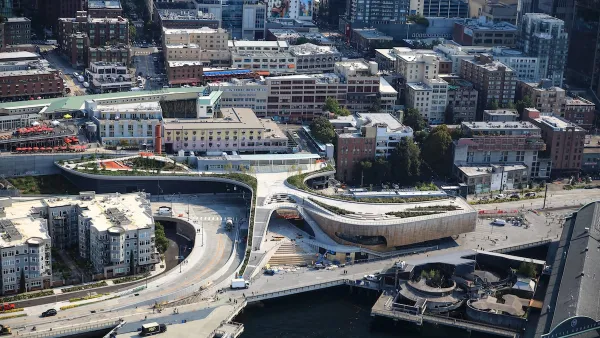
Seattle’s New Overlook Walk Offers Ample Park Space Near Pike Place Market
The elevated park and event space replaces part of the demolished Alaskan Way Viaduct, connecting the city’s famous Pike Place Market to the waterfront.
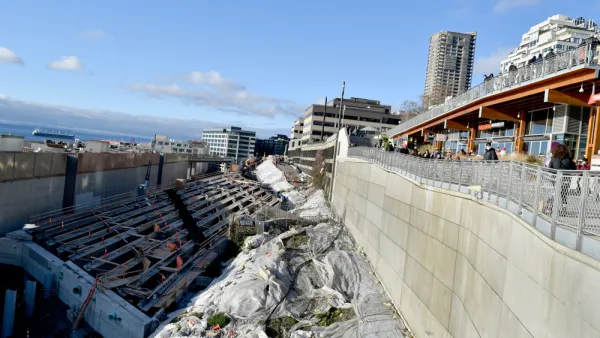
A Permanent Decline in Revenue Forecasted for the Tunnel Bertha Built in Seattle
Public transit isn't the only mode struggling to attract the expected number of users in 2022. State Route 99 in Downtown Seattle is also failing to live up to expectations and struggling to make ends meet.
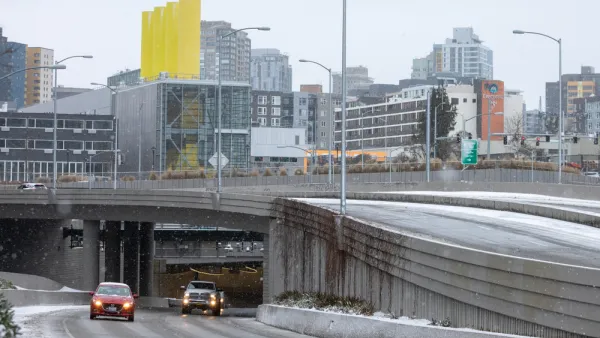
Seattle Emerges From Tolled Tunnel Unscathed
Promises of congestion and thousands of cars spilling on to quiet residential streets proved unfounded after the first week with tolls on the Highway 91 tunnel in Seattle.

Planetizen Federal Action Tracker
A weekly monitor of how Trump’s orders and actions are impacting planners and planning in America.

Amtrak, CN end decades-long dispute with eight-year agreement
The new operating agreement establishes an updated framework for the companies to work together, including processes to resolve disputes.

Northwest rail fans eager for Sept. 30 debut of Amtrak’s Airo fleet
Get ready for that new train smell and more seats. But they won’t go faster or run more frequently on the Cascades route in Washington and Oregon.

Boston sues Trump administration over revoked infrastructure grant
The Trump administration withdrew the infrastructure grant because less than 1% of the money would go to electric vehicle charging infrastructure.

NYC to turn city-owned property into thousands of homes
The city has scheduled a public hearing regarding the development for October.

Buses travel at 5mph along this route in NYC. The Bronx's first-ever busway looks to change that
Prior to the busway, buses on the Bx36 route traveled as slowly as 5 miles per hour.

FREE Course: Walkable City 1: Why Walkability?
After describing his path towards focusing on walkability as the essence of good planning, Jeff Speck marches through his five principal reasons for making more walkable places.
Reinventing Malls: Planning Alchemy—Turning Gray Fields Into Gold
The course focuses on the opportunities and imperatives that shape reinvention of mall sites.

City of Thousand Oaks
City of Wisconsin Rapids
Harvard University Graduate School of Design
The Architects Foundation
University of Cincinnati Online
The Pocatello Development Authority
The Urban Renewal Agency of the City of Pocatello