The City of London - the financial district comprised of one square mile of London's Roman boundary has erected a new shopping center that planners hope will stimulate the area's development as a competitor to the busier West End.


"The new mall, which takes Cheapside back to its roots ("cheap" means market), is expected to put pressure on other shops to extend their opening hours and could transform the Square Mile with its 10,000 residents from a ghost town at weekends into a tourist mecca," writes Julia Kollewe.
Peter Rees, the City of London's planning officer, says: "You've got to keep rebranding in terms of making a place better all the time." He is convinced the City is becoming more fun, noting, for example, that the nightclubs clustered in Cornhill are busy well into the early hours.
One of Rees' buzzwords is "place-making", by which he means the art of linking up the spaces between buildings with pedestrian routes – 90% of all journeys in the City are made on foot – and providing places where people can relax, such as small parks and fountains.
He sees the City as a "collection of beehives on top of a compost heap" and stresses the importance of having alleyways, pubs and coffee shops where people can linger and gossip. "That's very difficult to codify and plan for, but very easy to kill with bad planning."
Read the full story: City Hoping To Rival West End With New Shopping Centre
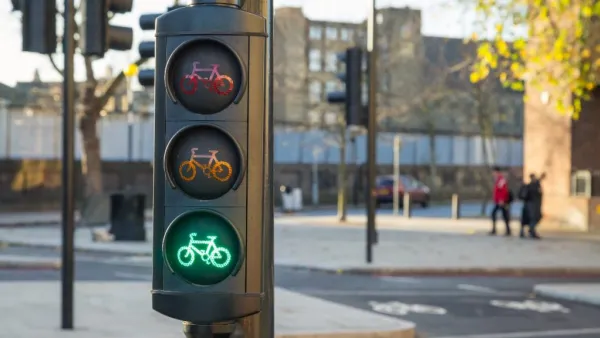
People on Bikes Outnumber Drivers in the City of London
The City of London’s efforts to increase biking and reduce driving has finally achieved a long-term goal: a preference for biking over driving.
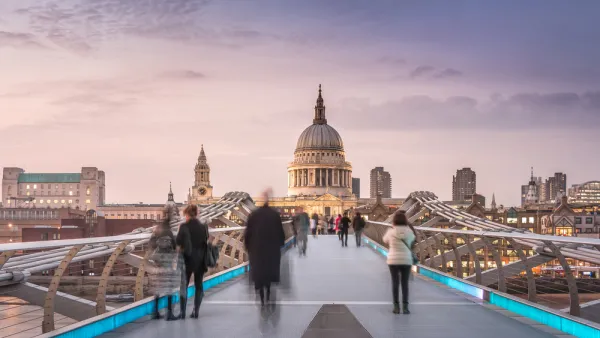
City of London Could Set Speed Limits at 15 MPH
The City of London (not to be confused with the larger area of Greater London) will consider a plan to reduce speed limits throughout the "Square Mile" that outlines its boundaries.
Unusual Arrangement Unites Local London Government, Finance Industry
Not many non-Londoners know what the City of London is. Even fewer know about its political ties to the finance industry.

Planetizen Federal Action Tracker
A weekly monitor of how Trump’s orders and actions are impacting planners and planning in America.

Washington state to charge fee to drivers with fuel-efficient cars
Revenue from the fee will go towards supporting the state’s highways.

Trump to blast ‘hydrocarbon highway’ through ‘world’s longest art gallery’
Environmental and historic preservation groups are suing to stop the project.

Minnesota Gold Line extension now has launch date
Plans to extend the Gold Line have existed since 2025.

Data centers need power – lower income, rural residents pay the price
In 2025, data centers paid only 38% of the energy infrastructure costs linked to their growth, with households, especially rural and low-income residents, bearing the remaining burden.

MBTA Green Line project moved to next phrase of CIG program
The modernization effort will cost $4.08 billion.

FREE Course: Walkable City 1: Why Walkability?
After describing his path towards focusing on walkability as the essence of good planning, Jeff Speck marches through his five principal reasons for making more walkable places.
Reinventing Malls: Planning Alchemy—Turning Gray Fields Into Gold
The course focuses on the opportunities and imperatives that shape reinvention of mall sites.

City of Charlotte
City of Rosemead
Rutgers University, Edward J. Bloustein School of Planning and Public Policy
University of Michigan School for Environment and Sustainability (SEAS)
Hunter College, City University of New York (CUNY)
The Architects Foundation
University District Partnership