Redeveloping the slums of Rio de Janeiro has been on the city's agenda for decades. Despite the many challenges, some new efforts seem to be paying off.


"Sao Paulo government resettled 120 poor families to at the outskirts of the city in 1971. And unexpectedly this area fast became a colony of migrant persons. More and more wooden houses form a 100-square-meter slum with 125,000 living there. Since 2005, the Sao Paulo government has invested 135 million Real (about 76.7 million US dollars) to reconstruct the district.
They built municipal infrastructures, public schools and hospitals. Some roads are even paved with asphalt. Around 1,700 low-cost houses benefited many poor families. The mayor of Sao Paulo Gilberto Kassab said 'this district is no longer a slum but a well-organized city community.'"
And as the city prepares to host the 2014 World Cup and the 2016 Summer Olympics, officials at the local and federal level are hoping to make big strides in reducing extreme poverty in this and other urban areas within the decade.
Read the full story: Brazil struggles to transform slums into new communities

Rio de Janeiro Residents Protest Olympics Projects
As the city of Rio de Janeiro prepares to host the 2016 Summer Olympics, residents there say many of the projects underway are violating their rights.
Rio's Slums to See Massive Redesign
Ahead of the 2014 World Cup and 2016 Olympics, officials in Rio de Janeiro are taking on a massive upgrade project in the city's slums.
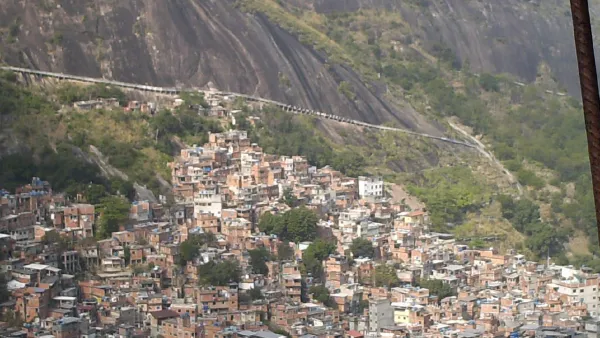
Rio's Pricey Sky Gondola Goes Full Stop
The sky gondola system built prior to the Rio Olympics has ground to a halt, leaving residents of the city's favelas with little to show for such a grand investment in infrastructure.

Planetizen Federal Action Tracker
A weekly monitor of how Trump’s orders and actions are impacting planners and planning in America.

Amtrak, CN end decades-long dispute with eight-year agreement
The new operating agreement establishes an updated framework for the companies to work together, including processes to resolve disputes.

Judges permit Denver to divert 77,000 acre feet from the Colorado River for reservoir expansion
Overuse and climate change have caused the Colorado River’s water levels to plummet.

NYC DOT wants faster, more permanent street upgrades
The city is examining ways to build more concrete infrastructure without getting entangled in 'decades-long' projects.

'Something we’ve never seen before:' rising utility rates could strain city finances nationwide
Data centers, climate change and other factors have caused utility rates in the United States to increase by 38% since 2020.

Trump to overrule local leaders, lease millions of acres of America’s Pacific Island territories’ seafloors to mining companies
International law says that the Indigenous people of America’s territories have a right to prior and informed consent regarding projects that impact their countries.

FREE Course: Walkable City 1: Why Walkability?
After describing his path towards focusing on walkability as the essence of good planning, Jeff Speck marches through his five principal reasons for making more walkable places.
Reinventing Malls: Planning Alchemy—Turning Gray Fields Into Gold
The course focuses on the opportunities and imperatives that shape reinvention of mall sites.

Harvard University Graduate School of Design
KFH Group Inc.
Greater Baltimore Committee
The Architects Foundation
University of Cincinnati Online
The Pocatello Development Authority
The Urban Renewal Agency of the City of Pocatello