The suburbanization of business headquarters may be coming to an end.


More businesses are ditching their suburban office park headquarters and moving back into the city, according to this piece from Harvard Business Review.
"The change is about more than evolving tastes; it's at least partly a reaction to real problems created by suburbs. Their damage to quality of life is well chronicled. For instance, studies in 2003 by the American Journal of Public Health and the American Journal of Health Promotion linked sprawl to rising obesity rates. (By contrast, new research in Preventive Medicine demonstrates, people living in more urban communities reap health benefits because they tend to walk more.) Car culture hurts mental health as well. Research by behavioral economist Daniel Kahneman and his team shows that out of a number of daily activities, commuting has the most negative effect on people's moods. And economists Bruno S. Frey and Alois Stutzer have found that commuters who live an hour away from work would need to earn 40% more money than they currently do to be as satisfied with their lives as noncommuters."
Read the full story: Back to the City

Companies Ditch Suburban Office Parks
Suburban areas were once strongholds of corporate campuses and office parks. But there's a shift underway that's drawing companies back to cities.
If You Lived In This Inner-Ring Suburb, You'd Be Home By Now
This week, a few stories circulated around our office that generated some discussion. One was a piece in The New Yorker by Nick Paumgarten on commuting in America entitled "There and Back Again". The tease at the beginning sums up the entire piece: "People may endure miserable commutes out of an inability to weigh their general well-being against quantifiable material gains."In this story, the writer accompanies commuters in Manhattan and Atlanta while attempting to understand the life of an "extreme commuter."
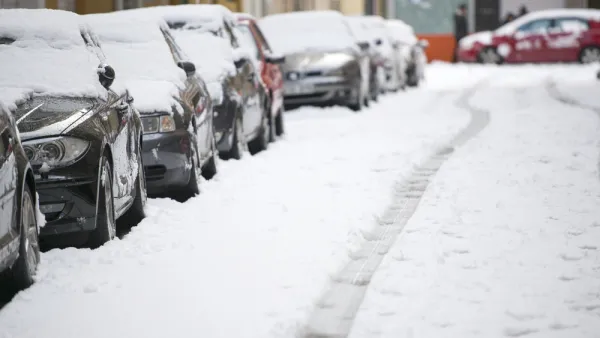
Snowstorm That Stranded Thousands Prompts Questions About Auto-Centric Development
After thousands of motorists spent over a day on a snowbound Virginia highway, experts are warning that auto-centric sprawl will worsen the impacts of extreme weather events.

Planetizen Federal Action Tracker
A weekly monitor of how Trump’s orders and actions are impacting planners and planning in America.

Amtrak, CN end decades-long dispute with eight-year agreement
The new operating agreement establishes an updated framework for the companies to work together, including processes to resolve disputes.

Judges permit Denver to divert 77,000 acre feet from the Colorado River for reservoir expansion
Overuse and climate change have caused the Colorado River’s water levels to plummet.

NYC DOT wants faster, more permanent street upgrades
The city is examining ways to build more concrete infrastructure without getting entangled in 'decades-long' projects.

'Something we’ve never seen before:' rising utility rates could strain city finances nationwide
Data centers, climate change and other factors have caused utility rates in the United States to increase by 38% since 2020.

Trump to overrule local leaders, lease millions of acres of America’s Pacific Island territories’ seafloors to mining companies
International law says that the Indigenous people of America’s territories have a right to prior and informed consent regarding projects that impact their countries.

FREE Course: Walkable City 1: Why Walkability?
After describing his path towards focusing on walkability as the essence of good planning, Jeff Speck marches through his five principal reasons for making more walkable places.
Reinventing Malls: Planning Alchemy—Turning Gray Fields Into Gold
The course focuses on the opportunities and imperatives that shape reinvention of mall sites.

Harvard University Graduate School of Design
KFH Group Inc.
Greater Baltimore Committee
The Architects Foundation
University of Cincinnati Online
The Pocatello Development Authority
The Urban Renewal Agency of the City of Pocatello