Fortunately for the unrelated roommates, that is, because in NYC the housing code prohibits more than three to live under the same roof. By one estimate, that would make at least 15,000 units illegal. This article looks at several of them.


NYC is not alone in occupancy codes that are designed to prevent crowding, a measurement of residents per rooms in a dwelling unit (as opposed to density, which is units per acre). However, these laws may be arcane in cities of exceedingly high housing costs that attract young people as well as immigrants of limited income.
"New York, home to some of the nation's highest rents and more than eight million people, many of them single, it is illegal for more than three unrelated people to live in an apartment or a house. The law, for decades part of the city's Housing Maintenance Code, is little known, widely broken and infrequently enforced.
The lax enforcement might not be a bad thing, since a sizable number of the city's denizens. According to the Census Bureau's 2008 American Community Survey, nearly 15,000 dwellings in the city housed three or more roommates who were unrelated to the head of the household. Experts say that number is almost certainly underreported.
Jerilyn Perine, a former city housing commissioner and the executive director of the nonprofit Citizens Housing and Planning Council, said occupancy laws should be determined not by whether people were related, but by whether a unit was safely inhabited, whether by four people or more."
Read the full story: In New York, Breaking a Law on Roommates

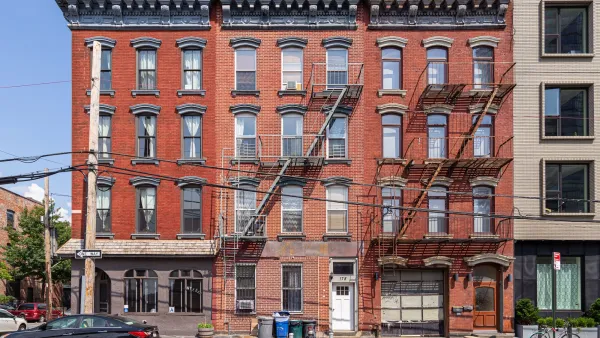
NYC Puts 250 Most Distressed Apartment Buildings on Enhanced Oversight List
The city’s Alternative Enforcement Program prioritizes buildings with the most unaddressed code violations, allowing the city to make repairs where needed.

The Consequences of Sprawl: Overcrowded Housing and Covid Deaths
Los Angeles is the nation's capital of both crowding and sprawl. A feature published by the Los Angeles Times provides the history of how the metropolis achieved this contradiction.

Disneyland Is Too Crowded. Is More Capacity Needed?
Disneyland has a plan to create more supply to meet contemporary demand, a strategy reminiscent of contemporary debates surrounding housing and transportation.

Planetizen Federal Action Tracker
A weekly monitor of how Trump’s orders and actions are impacting planners and planning in America.

The state-sanctioned urbicide of Austin
People don’t kill cities. Freeways do.

US to reduce Colorado River water deliveries to Mexico
A new Colorado Treaty amendment reduces Mexico’s Colorado River water allocation by 250,000 acre feet.

Nation's most wind-powered state turns to coal as data centers increase energy demand
For the first time in decades, Iowa has increased its generation of coal power.

NYC cools commuters with city's first rain garden above a bus stop
New York City officials say the plants in the rain garden can absorb 16 gallons of rainwater during heavy storms.

Brightline West’s future may rely on $6 billion federal loan
The company has until Nov. 2 to make a $400 million equity investment into its proposed high-speed rail line.

FREE Course: Walkable City 1: Why Walkability?
After describing his path towards focusing on walkability as the essence of good planning, Jeff Speck marches through his five principal reasons for making more walkable places.
Reinventing Malls: Planning Alchemy—Turning Gray Fields Into Gold
The course focuses on the opportunities and imperatives that shape reinvention of mall sites.

Greater Baltimore Committee
Eagle County Government
Harvard University Graduate School of Design
The Architects Foundation
University of Cincinnati Online
The Pocatello Development Authority
The Urban Renewal Agency of the City of Pocatello
Journal of the American Planning Association