Detroit may have been the Motor City, but New York City was where the car became king, according to a new book and exhibit which look at the history of the automobile in New York in the early 1900s.


The exhibit is now open at the Museum of the City of New York, accompanied by the book "Cars, Culture and the City," by Phil Patton and museum curator Donald Albrecht.
"'Taking a look at what Park Avenue looked like with the horse and buggies, the car really transformed a lot, and you realize there's this amazing love affair with freedom of mobility - and the car really gave that to the average person,' said Mark Schienberg, president of the Greater New York Automobile Dealers Association.
But the book by Mr. Albrecht and Mr. Patton makes clear that the automobile caught on first with upper-crust types. 'And since a lot of rich people lived in New York, the car was a New York thing,' Mr. Albrecht said.
He said that of the 8,000 cars in the United States in 1900, nearly a third were owned by New Yorkers. They raced them at City Hall Park and built getaway roads. William K. Vanderbilt II, a great-grandson of the railroad magnate Cornelius Vanderbilt, built a parkway on Long Island."
FULL STORY: Cars and the City, Imperfect Together

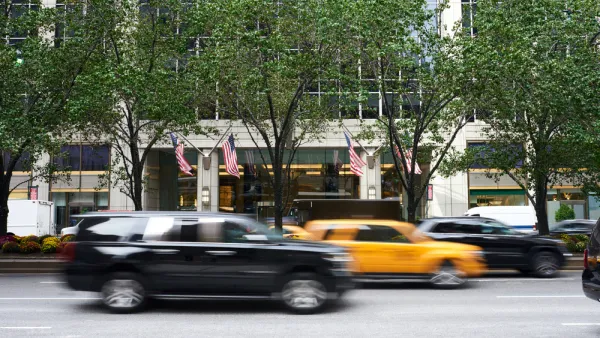
Owning a Car in N.Y.C. More Appealing Than Ever Before
In the past, owning a car in New York City made little sense for most people. But the pandemic has many residents reconsidering their transportation options.
Cyclists, Pedestrians, and Drivers Clash
With over 8 million people sharing the streets and sidewalks of New York City, there is bound to be a clash between transportation modes. Who's to blame? Lyndsey Scofield says that there is bad behavior on all sides.
A Different Kind of New York Street Conversion 100 Years Ago
While New York City is currently taking space away from automobiles and giving it to pedestrians and cyclists, the New York City of 100 years ago was doing exactly the opposite. And it was a popular idea.

Planetizen Federal Action Tracker
A weekly monitor of how Trump’s orders and actions are impacting planners and planning in America.

The state-sanctioned urbicide of Austin
People don’t kill cities. Freeways do.

US to reduce Colorado River water deliveries to Mexico
A new Colorado Treaty amendment reduces Mexico’s Colorado River water allocation by 250,000 acre feet.

5 New England states march closer to 800 megawatt wind energy project
Securing federal approval for the project may be complicated under the Trump administration, which has historically been hostile towards domestic wind power.

Baltimore to break ground on $50 million Transit Priority Project
The project will bring faster bus trips, safer streets and better bike connections to Baltimore.

Airbnb launches $250 million 'last-dollar financing' housing accelerator, makes first investment in Austin
The company will put $6.4 million towards affordable housing development in Texas’ capital.

FREE Course: Walkable City 1: Why Walkability?
After describing his path towards focusing on walkability as the essence of good planning, Jeff Speck marches through his five principal reasons for making more walkable places.
Reinventing Malls: Planning Alchemy—Turning Gray Fields Into Gold
The course focuses on the opportunities and imperatives that shape reinvention of mall sites.

Eagle County Government
Harvard University Graduate School of Design
Nashville Planning Department
The Architects Foundation
University of Cincinnati Online
The Pocatello Development Authority
The Urban Renewal Agency of the City of Pocatello
Journal of the American Planning Association