In a recent piece in Wired, Clive Thompson suggests that the solution to the problem of texting while driving is not to stop texting, but to stop driving. The popularity of texting is a good reason to support public transit.


"From 2003 to 2008, the number of texts sent monthly by Americans surged from 2 billion to 110 billion," Thompson writes. Given how ubiquitous texting has become, he argues that it is futile to attempt to ban the behavior while people are behind the wheel.
Instead, we should promote safer texting with safer travel, discouraging driving and encouraging public transit use. Comparing American travel patterns to those in other tech-friendly cities, he notes, "You don't endanger anyone's life while quietly tapping out messages during your train ride to work in Tokyo or Berlin."
He concludes:
"Texting while driving is, in essence, a wake-up call to America. It illustrates our real, and bigger, predicament: The country is currently better suited to cars than to communication. This is completely bonkers."
Thanks to Anna Brawley
Read the full story: Clive Thompson to Texters: Park the Car, Take the Bus

More Terrifying Than Texting?
In this survey, drivers 'fess up to twelve distracting things they do while driving; and some are even more distracting than texting.
LA Metro is paying Angelenos up to $600 to leave their car at home
Metro will pay around 2,000 households to participate in a program designed to shift travel modes away from private car trips to transit, biking, walking and shared mobility.
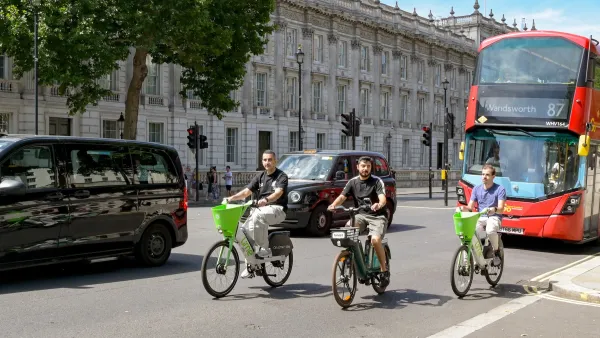
Bike use in London grew by 43% since 2019, but car use remains roughly the same
The city's efforts to reduce car use have stalled despite ambitious programs like congestion pricing and low-traffic neighborhoods.

Planetizen Federal Action Tracker
A weekly monitor of how Trump’s orders and actions are impacting planners and planning in America.

California plans to bury El Niño’s downpour
If the state plays its cards right, it may be able to store a billion acre-feet of El Niño’s water in aquifers.

Chicago breaks ground on $3 billion megadevelopment
The new neighborhood, titled Foundry Park, will one day host 3,700 residences.

California High-Speed Rail Authority CEO resigns after $600,000 scandal
Under Ian Choudri, the authority used taxpayer dollars to fund first class flights and trips to nightclubs.

Want to study the Missouri River? Soon, you may need unanimous approval from 10 states
Legislation would require 10 governors’ permission to study or build projects moving water outside the basin.

Desperate measures: Advocates weigh draining Lake Powell to fill Colorado River
Draining the reservoir could reduce evaporation losses by a couple hundred thousand acre-feet.

FREE Course: Walkable City 1: Why Walkability?
After describing his path towards focusing on walkability as the essence of good planning, Jeff Speck marches through his five principal reasons for making more walkable places.
Reinventing Malls: Planning Alchemy—Turning Gray Fields Into Gold
The course focuses on the opportunities and imperatives that shape reinvention of mall sites.

City of Rosemead
Rutgers University, Edward J. Bloustein School of Planning and Public Policy
One Hundred Miles
Hunter College, City University of New York (CUNY)
The Architects Foundation
University of Cincinnati Online
City of Cambridge
Montrose County
The Pocatello Development Authority