This post from GOOD looks at how a street can become a bicycle corridor.


As a case study, this article looks at 4th Street in Los Angeles, where activists and local cyclists have been working for years to spread the message about the street's bikeability.
"A movement has been afoot for years to remake 4th Street as a "Bike Blvd," a bike-friendly street with various road improvements (such as traffic diverters, signage, or lane markings) that help bikes, cars, and pedestrians safely share the road. (To get an idea of how Bike Blvds work, take a look at this example from Portland, Oregon.) By posting temporary signs and road stencils along the route and organizing group rides, activists have in the past drawn attention to the potential of 4th Street as a biking resource. The efforts of the organizer Ingrid Peterson have led to city council member Tom LaBonge, whose district encompasses 4th Street, joining group rides along 4th Street in 2007 and 2008. If you're interested in learning more of the history of these efforts, Peterson maintains a website that is a clearinghouse of information for all things relating to the 4th Street Bicycle Blvd (or 4SBB) movement."
Read the full story: Better Bikeways: Turning a City Street Into a Bike Corridor
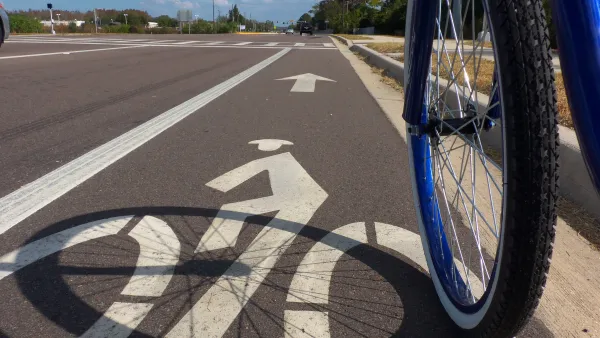
Road Diets and Bike Lanes in the Works in South Los Angeles
Urbanize.LA has the scoop on the first indications of plans in South L.A. to give more space in the road to bikers.

Los Angeles just elected an urban planner as its mayor
Transportation analysts are optimistic that Raman will be more aggressive in addressing transit issues than Bass.
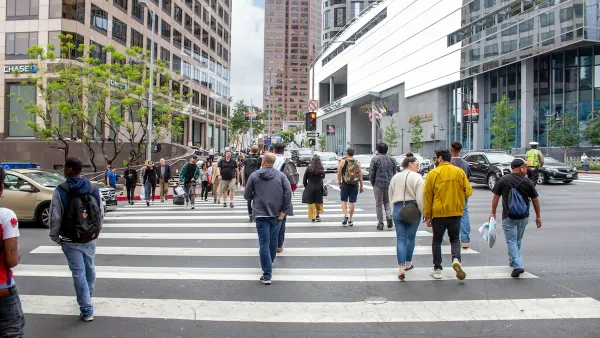
LA residents may be allowed to paint their own crosswalks
Councilwoman Katy Yaroslavsky put out a motion instructing the Los Angeles Department of Public Transportation to study the feasibility of allowing volunteers to paint crosswalks.

Planetizen Federal Action Tracker
A weekly monitor of how Trump’s orders and actions are impacting planners and planning in America.

California plans to bury El Niño’s downpour
If the state plays its cards right, it may be able to store a billion acre-feet of El Niño’s water in aquifers.

Desperate measures: Advocates weigh draining Lake Powell to fill Colorado River
Draining the reservoir could reduce evaporation losses by a couple hundred thousand acre-feet.

Los Angeles just elected an urban planner as its mayor
Transportation analysts are optimistic that Raman will be more aggressive in addressing transit issues than Bass.

Mamdani’s pied-à-terre tax survives legal challenge
A panel of judges found that the plaintiffs failed to demonstrate injury as a result of New York City's implementation of the tax.

Eastern Nebraska is running out of electricity
Data centers and electrification are straining eastern Nebraska’s grid, throttling economic development.

FREE Course: Walkable City 1: Why Walkability?
After describing his path towards focusing on walkability as the essence of good planning, Jeff Speck marches through his five principal reasons for making more walkable places.
Reinventing Malls: Planning Alchemy—Turning Gray Fields Into Gold
The course focuses on the opportunities and imperatives that shape reinvention of mall sites.

City of Rosemead
Rutgers University, Edward J. Bloustein School of Planning and Public Policy
One Hundred Miles
University of Michigan School for Environment and Sustainability (SEAS)
Hunter College, City University of New York (CUNY)
The Architects Foundation
City of Cambridge
Montrose County
The Pocatello Development Authority