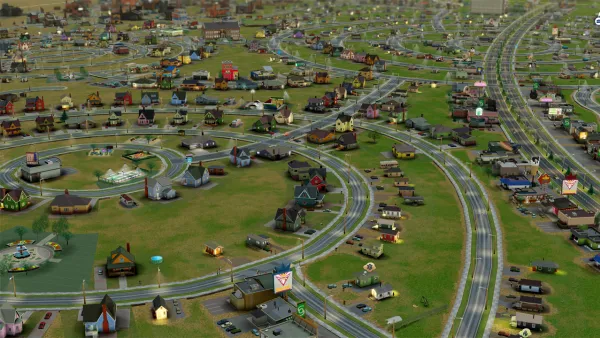
New video game-like programs are enabling the U.S. military to train for deployment in the middle east. One program is modeled off the urban planning computer game SimCity.


"As part of their training, Peltier, Payne, Moore, Mindak, and five other lieutenant colonels in the Army's School for Command Preparation, at Fort Leavenworth, Kansas, were wrestling with Sadiq in a new computer game called UrbanSim. Rolled out last May, UrbanSim allows U.S. officers to practice counterinsurgency without suffering real-world consequences.
As the men hunched over their computers trying to decide how to handle Sadiq and a range of other problems, Matthew Bosack, his crisp blue shirt a sharp contrast to the officers' combat fatigues, peered over their shoulders with a slight smile. 'The cocktail-party explanation: I say I make SimCity Baghdad,' said Bosack, a project manager at the University of Southern California's Institute for Creative Technologies, which developed the game. 'You're basically the mayor. But instead of tornados, earthquakes, and Godzilla running around your city, it's insurgents.'"
The simulation is being used to prepare soldiers for deployment in a variety of places, including Iraq and Afghanistan.
Read the full story: SimCity Baghdad

10 urbanist video games that aren’t Sim City
Sim City may have inspired an entire generation of urban planners — but these games have perfected the art of city-building simulation.
SimCity’s Impact and Evolution
The video game has inspired many people to pursue careers in planning. But, the newest version is also trying to better align the simulations with what planners face in the real world.
The New Era of Planning Simulations
The continued improvement of digital technology should benefit evidence-based policy and decision-making. Welcome to a new era of planning simulations.

Planetizen Federal Action Tracker
A weekly monitor of how Trump’s orders and actions are impacting planners and planning in America.

California plans to bury El Niño’s downpour
If the state plays its cards right, it may be able to store a billion acre-feet of El Niño’s water in aquifers.

Desperate measures: Advocates weigh draining Lake Powell to fill Colorado River
Draining the reservoir could reduce evaporation losses by a couple hundred thousand acre-feet.

Bay area voters pass ‘crucial lifeline’ for transit
Proposition RTM, which will fund Bay Area transit, has approval from 61% of voters as of 9:45 p.m. on Nov. 3.

Voters across the country reject data centers
Dozens of communities voted on measures to restrict the buildout of data centers.

US buildings threatened, destroyed by fires set to triple by 2060
Researchers found a high fire risk for socioeconomically vulnerable neighborhoods in the American West.

FREE Course: Walkable City 1: Why Walkability?
After describing his path towards focusing on walkability as the essence of good planning, Jeff Speck marches through his five principal reasons for making more walkable places.
Reinventing Malls: Planning Alchemy—Turning Gray Fields Into Gold
The course focuses on the opportunities and imperatives that shape reinvention of mall sites.

City of Rosemead
Rutgers University, Edward J. Bloustein School of Planning and Public Policy
One Hundred Miles
Hunter College, City University of New York (CUNY)
The Architects Foundation
University of Cincinnati Online
City of Cambridge
Montrose County
The Pocatello Development Authority