Because of the abundance of social interaction and diverse clientele, subways have long been the sites of sociological experiments to understand human behavior.


"The crucial context for many of the 1970s studies was the Queens murder of Kitty Genovese, whose cries for help were purportedly ignored by her neighbors. The Genevose story became the ur-narrative of uncaring urban pathology (even if its details were later called into question). The subway offered a perfect testing ground for the emerging subfield of 'bystander studies.' The aforementioned 'Good Samaritan' paper, for example, had a Columbia University student stagger and collapse on a subway train, 'looking supine at the ceiling.' In some trials, the subject acted drunk; in others, ill. (People were more likely to help in the latter condition.) Interestingly, that study found no support for the so-called 'diffusion of responsibility' effect-the idea, per the Genovese murder, that the more bystanders were present, the less likely it was that any one person would help. In fact, the reverse was found."
Thanks to Streetsblog LA
Read the full story: Underground Psychology
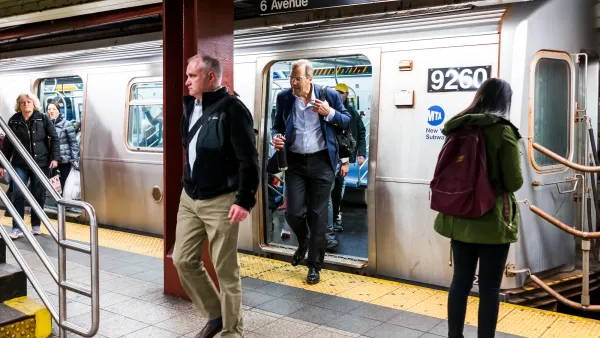
NYC to Upgrade 1/3 of its Subway Car Fleet
The MTA is seeking proposals for up to 2,390 new subway cars to upgrade its aging fleet.
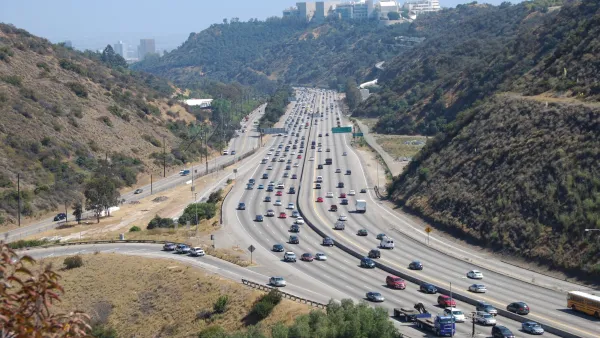
LA Metro Board Approves New Subway for One of Nation’s Busiest Freeway Corridors
The new subway could cut the hour-long trip between west Los Angeles and the San Fernando Valley to 20 minutes.
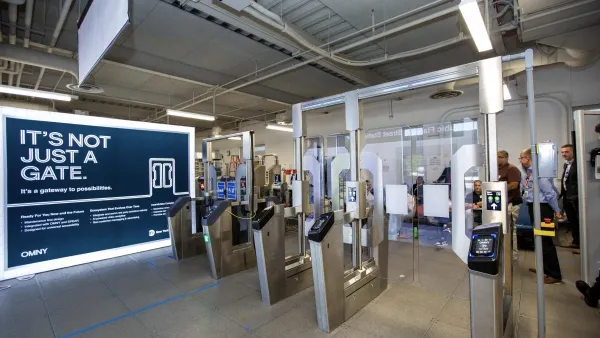
New York MTA Installs ‘Smart’ Fare Gates to Stop Turnstile Hoppers
New fare gates use sensors and higher panels to prevent people from passing without paying, but the tech had a “bumpy rollout” on its first day.

Planetizen Federal Action Tracker
A weekly monitor of how Trump’s orders and actions are impacting planners and planning in America.

California plans to bury El Niño’s downpour
If the state plays its cards right, it may be able to store a billion acre-feet of El Niño’s water in aquifers.

Desperate measures: Advocates weigh draining Lake Powell to fill Colorado River
Draining the reservoir could reduce evaporation losses by a couple hundred thousand acre-feet.

US buildings threatened, destroyed by fires set to triple by 2060
Researchers found a high fire risk for socioeconomically vulnerable neighborhoods in the American West.

LA residents may be allowed to paint their own crosswalks
Councilwoman Katy Yaroslavsky put out a motion instructing the Los Angeles Department of Public Transportation to study the feasibility of allowing volunteers to paint crosswalks.

Dallas moves to overhaul its zoning code
The city's zoning reform will allow more multi-family and mixed-use developments.

FREE Course: Walkable City 1: Why Walkability?
After describing his path towards focusing on walkability as the essence of good planning, Jeff Speck marches through his five principal reasons for making more walkable places.
Reinventing Malls: Planning Alchemy—Turning Gray Fields Into Gold
The course focuses on the opportunities and imperatives that shape reinvention of mall sites.

City of Rosemead
Rutgers University, Edward J. Bloustein School of Planning and Public Policy
One Hundred Miles
Hunter College, City University of New York (CUNY)
The Architects Foundation
University of Cincinnati Online
City of Cambridge
Montrose County
The Pocatello Development Authority