The Danish island of Samso is the poster child of clean energy. Its residents generate more energy than they consume. Now the Danish government wants to export that model back to the mainland.


"Samso is a laboratory where the Danish government launched a social and technological experiment 12 years ago. Before that, heating oil was brought to the island by ship and electricity, mainly from coal-burning power plants, was transmitted through cables. For each Samsinger, 11 tons of the greenhouse gas carbon dioxide were pumped into the atmosphere each year. The goal was to reduce those 11 tons to zero within 10 years, without special subsidies.
The Samsingers joined forces, erecting the wind turbines and attaching solar panels to their roofs. They built central straw burners, and they installed machines to harness geothermal energy and the heat from cow's milk to heat houses, and to extract rapeseed oil from plants grown on the island to produce fuel for their tractors.
Eight years later, they were already producing more energy than they consumed, which made them climate-neutral, and today they produce 40 percent more energy than they consume. Only two questions remain. Can the approach used on the island, which comprises 22 villages, 4,000 residents and a small cannery, work elsewhere? And does the rest of the world even want to emulate the Samsingers?"
FULL STORY: Samso Island Is Face of Danish Green Revolution


How Smart Street Lights Can Help Cities Achieve Sustainability Goals
Switching to energy-efficient LEDs and using tech to program when and how street lighting operates can save cities millions in electricity expenses and bring down carbon emissions.
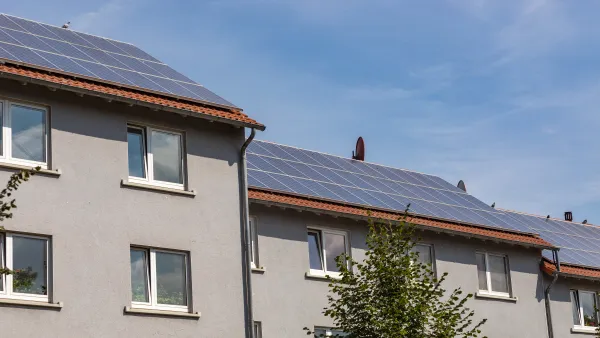
HUD Announces Grants for Efficiency Retrofits in Multifamily Housing
A new program will fund solar panels, heat pumps, and other measures aimed at reducing emissions, improving air quality and resident health, and reducing heating and cooling costs.

Why the Gas Stove Debate Misses the Point
Banning gas-powered appliances is one part of a broader toolkit of changes in building codes that could vastly improve efficiency.

Planetizen Federal Action Tracker
A weekly monitor of how Trump’s orders and actions are impacting planners and planning in America.

The state-sanctioned urbicide of Austin
People don’t kill cities. Freeways do.

US to reduce Colorado River water deliveries to Mexico
A new Colorado Treaty amendment reduces Mexico’s Colorado River water allocation by 250,000 acre feet.

5 New England states march closer to 800 megawatt wind energy project
Securing federal approval for the project may be complicated under the Trump administration, which has historically been hostile towards domestic wind power.

Baltimore to break ground on $50 million Transit Priority Project
The project will bring faster bus trips, safer streets and better bike connections to Baltimore.

Airbnb launches $250 million 'last-dollar financing' housing accelerator, makes first investment in Austin
The company will put $6.4 million towards affordable housing development in Texas’ capital.

FREE Course: Walkable City 1: Why Walkability?
After describing his path towards focusing on walkability as the essence of good planning, Jeff Speck marches through his five principal reasons for making more walkable places.
Reinventing Malls: Planning Alchemy—Turning Gray Fields Into Gold
The course focuses on the opportunities and imperatives that shape reinvention of mall sites.

Eagle County Government
Harvard University Graduate School of Design
Nashville Planning Department
The Architects Foundation
University of Cincinnati Online
The Pocatello Development Authority
The Urban Renewal Agency of the City of Pocatello
Journal of the American Planning Association