Mohamed Atta, one of the 9/11 terrorists, pursued a masters degree in city planning before the attacks. Slate's Daniel Brooks reads Atta's masters thesis, and finds a strain of anti-Western modernism that is revealing.


"The subject of the thesis is a section of Aleppo, Syria's second city. Atta describes decades of meddling by Western urban planners, who rammed highways through the neighborhood's historic urban fabric and replaced many of its once ubiquitous courtyard houses with modernist high-rises. Atta calls for rebuilding the area along traditional lines, all tiny shops and odd-angled cul-de-sacs. The highways and high-rises are to be removed-in the meticulous color-coded maps, they are all slated for demolition. Traditional courtyard homes and market stalls are to be rebuilt."
Thanks to Ariel Ben-Amos
Read the full story: The Architect of 9/11: What Can We Learn About Mohamed Atta From His Work as a Student of Urban Planning?

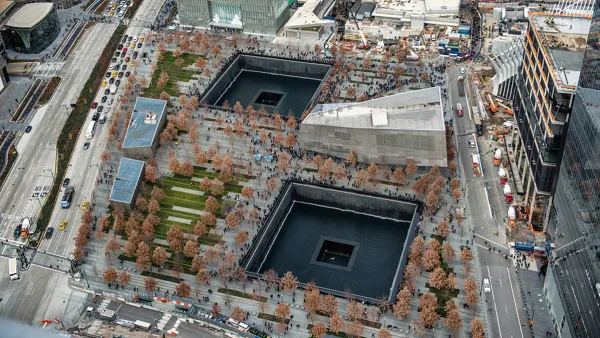
How 9/11 Inspired Public Service as an Urban Planner
The account of how the terror and tragedy of 9/11 led an urban planner from working for a private consulting firm to working in the public sector.
Historic Preservation and 9/11
Erica Stewart of the National Trust for Historic Preservation runs down a few of the ways that rebuilding efforts after the attacks on 9/11 took historic preservation into account.
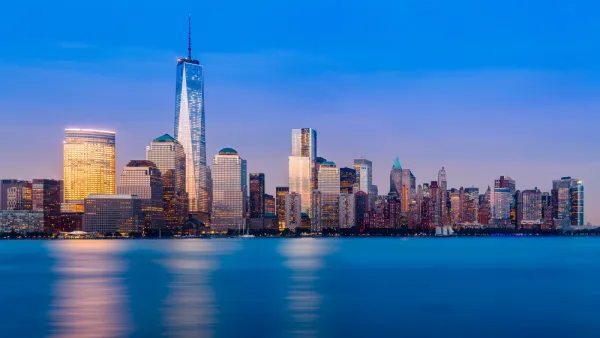
20 Years After 9/11: The 'Age of Skyscrapers' Is Nowhere Near Over
Despite predictions that the events of September 11, 2001 would be the end of skyscrapers, U.S. cities are building more tall buildings than ever.

Planetizen Federal Action Tracker
A weekly monitor of how Trump’s orders and actions are impacting planners and planning in America.

Amtrak, CN end decades-long dispute with eight-year agreement
The new operating agreement establishes an updated framework for the companies to work together, including processes to resolve disputes.

Northwest rail fans eager for Sept. 30 debut of Amtrak’s Airo fleet
Get ready for that new train smell and more seats. But they won’t go faster or run more frequently on the Cascades route in Washington and Oregon.

Trump administration unlawfully slashed $7 billion in clean energy grants, judge rules
The Environmental Protection Agency ended the Solar For All program, which provided the grants, after President Donald Trump’s inauguration.

Record-breaking wildlife overpass in Colorado brings 91% reduction in animal collisions
Prior to the overpass, vehicles were hitting one deer per day on Colorado’s Interstate 25.

California lawmakers approve just 5% of much-needed LA28 transportation funding
State legislators appear just as unwilling as Trump to pay for Olympics-related transportation projects.

FREE Course: Walkable City 1: Why Walkability?
After describing his path towards focusing on walkability as the essence of good planning, Jeff Speck marches through his five principal reasons for making more walkable places.
Reinventing Malls: Planning Alchemy—Turning Gray Fields Into Gold
The course focuses on the opportunities and imperatives that shape reinvention of mall sites.

City of Thousand Oaks
City of Wisconsin Rapids
Harvard University Graduate School of Design
The Architects Foundation
University of Cincinnati Online
The Pocatello Development Authority
The Urban Renewal Agency of the City of Pocatello