Neal Peirce looks at a few examples where regions have pooled their powers to utilize ARRA stimulus funds to create programs and jumpstart regional efforts.


Kansas City, Missouri worked with its regional neighbors to direct its federal stimulus money towards a troubled 150-block area officials are calling the "Green Impact Zone". Cities and counties in the San Francisco Bay Area teamed up to organize how money from the various stakeholders could be bundled to achieve regional goals.
"The Kansas City and Bay Area regions aren't alone. The Brookings Institution's Metropolitan Policy Program has been able to identify several others–among them Memphis, Chicago, even smaller areas like Cape Cod in Massachusetts and Flagstaff, Ariz.–where regions have "gotten their act together" to connect dots and make ARRA funds serve cohesive areawide agendas.
Normally regions wouldn't have the funds for such far-reaching–and one could argue historically long-delayed–initiatives. Which is why the Recovery Act offered such a rare opportunity. Understandably, people are judging the stimulus legislation–celebrating its six-month anniversary this month–on jobs it's created. Estimates are running as high as 1 million, a serious anti-recession move."
Read the full story: Could the Recovery Act Help Reinvent Government?

Historic 'Infrastructure Investment and Jobs Act' Passes Final Hurdle in Congress, Heads to Biden for Signature
Months after the Senate voted to approve the Infrastructure Investment and Jobs Act in a historic moment of bipartisan legislation, the House of Representatives put the finishing touches on a $1.2 trillion bill with $550 million in new spending.
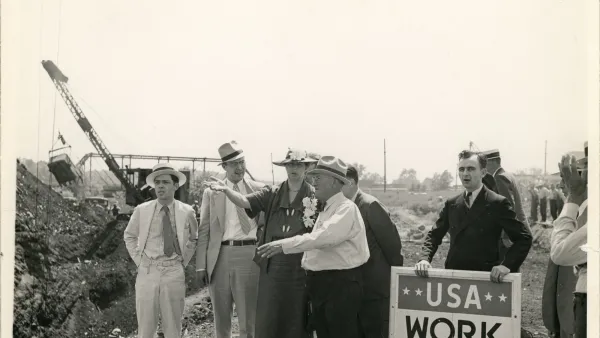
Biden Learning From the Unrealistic Expectations of Past Economic Stimulus Efforts
Taking lessons from his time working in the Obama administration, President Biden is tempering promises of quick job creation with long-term reinvestment.
Looking Back on the 5th Anniversary of the Federal Stimulus
The American Recovery and Reinvestment Act (ARRA) was signed into law on February 17, 2009, less than a month into President Obama's first term. The Council of Economic Advisers recently presented its final quarterly report on ARRA's impacts.

Planetizen Federal Action Tracker
A weekly monitor of how Trump’s orders and actions are impacting planners and planning in America.

Amtrak, CN end decades-long dispute with eight-year agreement
The new operating agreement establishes an updated framework for the companies to work together, including processes to resolve disputes.

Judges permit Denver to divert 77,000 acre feet from the Colorado River for reservoir expansion
Overuse and climate change have caused the Colorado River’s water levels to plummet.

NYC DOT wants faster, more permanent street upgrades
The city is examining ways to build more concrete infrastructure without getting entangled in 'decades-long' projects.

'Something we’ve never seen before:' rising utility rates could strain city finances nationwide
Data centers, climate change and other factors have caused utility rates in the United States to increase by 38% since 2020.

Trump to overrule local leaders, lease millions of acres of America’s Pacific Island territories’ seafloors to mining companies
International law says that the Indigenous people of America’s territories have a right to prior and informed consent regarding projects that impact their countries.

FREE Course: Walkable City 1: Why Walkability?
After describing his path towards focusing on walkability as the essence of good planning, Jeff Speck marches through his five principal reasons for making more walkable places.
Reinventing Malls: Planning Alchemy—Turning Gray Fields Into Gold
The course focuses on the opportunities and imperatives that shape reinvention of mall sites.

Harvard University Graduate School of Design
KFH Group Inc.
Greater Baltimore Committee
The Architects Foundation
University of Cincinnati Online
The Pocatello Development Authority
The Urban Renewal Agency of the City of Pocatello