A new study identifies innovative approaches to efficiently manage San Francisco's curbside parking supply, particularly in neighborhoods.


The San Francisco Transportation Authority's On-Street Parking Management and Pricing Study assesses current parking policies and conditions, and investigate innovative approaches to more efficiently manage curbside parking. The study:
• Reviews San Francisco's existing on-street parking management programs and neighborhood parking conditions.
• Considers various strategies for improved management of on-street spaces.
• Investigates the potential for using innovative technologies and approaches, including variable pricing of on-street parking, more widely to manage demand and increase availability.
• Discusses residential parking management issues and explore the use of potential new parking revenues to support neighborhood transportation enhancements.
• Describes peer city parking management case studies.
• Makes recommendations for comprehensive neighborhood parking management to improve parking conditions and support policy goals.
Read the full story: On-Street Parking Management and Pricing Study

How Cities Can Leverage Financial Data for Smarter Urban Planning
Explore how cities can use financial data to enhance urban planning, improve budget allocation, and boost community services.

ITDP's New On-Street Parking Pricing Guidebook
This report explores strategies for efficient and equitable parking management with an emphasis on pricing. These strategies enable cities to reallocate space for bus lanes, bicycle lanes, wider sidewalks, and pickup zones, and generate revenue.
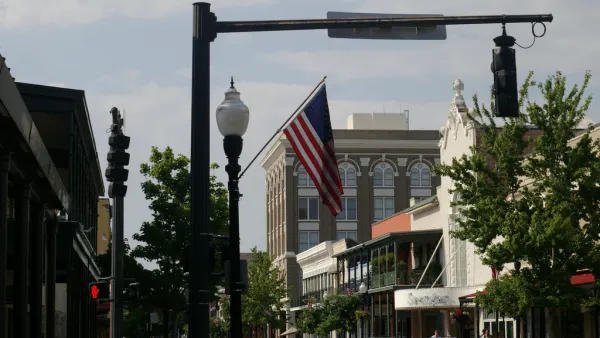
Does Downtown Pensacola Need More Parking? Maybe. Probably Not.
A study funded by the city of Pensacola, Florida found that the city's downtown faces a potential parking deficit in the near future, but recommends that weaning people off their cars could reduce parking demand.

Planetizen Federal Action Tracker
A weekly monitor of how Trump’s orders and actions are impacting planners and planning in America.

Eastern Nebraska is running out of electricity
Data centers and electrification are straining eastern Nebraska’s grid, throttling economic development.

Washington state to charge fee to drivers with fuel-efficient cars
Revenue from the fee will go towards supporting the state’s highways.

Instead of building new housing, LA developers are turning mansions into mega-mansions
In the richest areas, the number of houses valued at $30 million with demolition permits has skyrocketed since 2018.

Illinois considers spending $1 billion in taxpayer money on data center
A quantum computing campus and data center are currently under construction in Chicago.

As development costs rise, Boston moves to lessen affordable housing requirements
The Boston Zoning Commission and the City Council still need to approve Boston Mayor Michelle Wu’s proposed changes

FREE Course: Walkable City 1: Why Walkability?
After describing his path towards focusing on walkability as the essence of good planning, Jeff Speck marches through his five principal reasons for making more walkable places.
Reinventing Malls: Planning Alchemy—Turning Gray Fields Into Gold
The course focuses on the opportunities and imperatives that shape reinvention of mall sites.

City of Charlotte
City of Rosemead
Rutgers University, Edward J. Bloustein School of Planning and Public Policy
University of Michigan School for Environment and Sustainability (SEAS)
Hunter College, City University of New York (CUNY)
The Architects Foundation
University District Partnership
City of Cambridge
The Pocatello Development Authority