Sales in Brooklyn are down, and that's made a ghost town out of the recently booming but now busted Williamsburg neighborhood.


Some condo projects are stalled and a handful of new projects have been forced into foreclosure.
"With sales across Brooklyn down a staggering 57 percent from a year ago, Williamsburg, with its high density of new construction, has taken on an ominous disposition. Walk down virtually any block and you'll come across an amenity-laden building that sits nearly empty: relics of a moment in history that seems, increasingly, like a fever dream. Some developers with iffy financing have quietly been forced to go rental, others have lowered prices to the point where losses are inevitable, and a handful of projects, including two buildings Maundrell had been selling, have gone into foreclosure.
Most unsettling are the cases of the developers who seem to have vanished, leaving behind so many vacant lots and half-completed buildings-eighteen, to be precise, more than can be found in all of the Bronx-that large swaths of the neighborhood have come to resemble a city after an air raid."
Read the full story: The Billyburg Bust
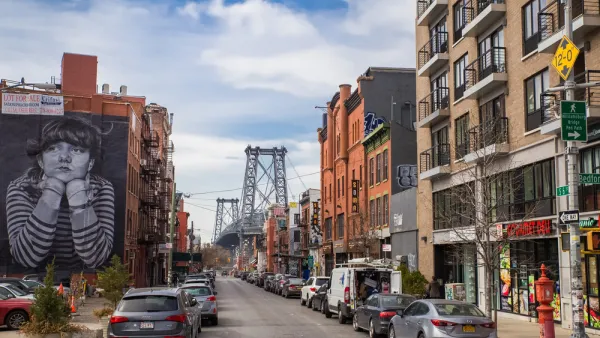
Opinion: Wealthy Residents Are Opposing Brooklyn Development to Protect Their Own Interests
Residents are arguing that a Williamsburg development would negatively affect the neighborhood. But it’s a grassroots effort to protect the status quo in a neighborhood where gentrification benefited them.
Report: Greenpoint-Williamsburg Rezoning Sparked Growth
An editorial cites newly released analysis of changes on the North Brooklyn Waterfront since a 2005 rezoning.
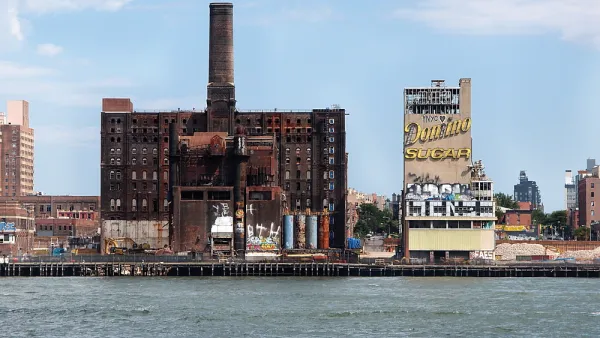
A New Riverfront Park in New York City
A new park on the East River in Williamsburg adds "one hell of an amenity" to Brooklyn.

Planetizen Federal Action Tracker
A weekly monitor of how Trump’s orders and actions are impacting planners and planning in America.

California plans to bury El Niño’s downpour
If the state plays its cards right, it may be able to store a billion acre-feet of El Niño’s water in aquifers.

Desperate measures: Advocates weigh draining Lake Powell to fill Colorado River
Draining the reservoir could reduce evaporation losses by a couple hundred thousand acre-feet.

Eastern Nebraska is running out of electricity
Data centers and electrification are straining eastern Nebraska’s grid, throttling economic development.

Seattle passes record-breaking transit services expansion
Proposition 1 will double the city’s transit tax to add 95,000 more bus trips and preserve 180,000 bus trips annually.

Post election, Texas is no longer Musk’s 'AI oasis'
Elon Musk dolled out $446 million on the 2026 midterms, the most ever spent by a non-canidate.

FREE Course: Walkable City 1: Why Walkability?
After describing his path towards focusing on walkability as the essence of good planning, Jeff Speck marches through his five principal reasons for making more walkable places.
Reinventing Malls: Planning Alchemy—Turning Gray Fields Into Gold
The course focuses on the opportunities and imperatives that shape reinvention of mall sites.

City of Rosemead
Rutgers University, Edward J. Bloustein School of Planning and Public Policy
One Hundred Miles
Hunter College, City University of New York (CUNY)
The Architects Foundation
University of Cincinnati Online
City of Cambridge
Montrose County
The Pocatello Development Authority