This piece looks at a public art project that placed 30 pianos in public places throughout London in an effort to encourage more public interaction.


The project cost the city about $22,000, including the price of a piano tuner who rode around town on a bicycle to maintain the instruments.
"The biggest obstacle was the city's tangled, multilayered bureaucracy, which required him to obtain a separate music license for each location. He used old, unwanted pianos that people had "chucked out," he said - in contrast to São Paolo, where pianos are scarce and so precious that they cost a year's salary. There, some people traveled for hours just to have the chance to play.
The pianos, which are secured to the ground with metal cables and have plastic covers in case of rain, have proved a huge hit. All of them are still there - outside the Natural History Museum, on Portobello Road, in Leicester Square and in the churchyard of St. Paul's Cathedral, among other spots. None has been vandalized. People have tended to relinquish their places courteously after a while to allow others to perform."
Read the full story: All Around London, an Invitation to Make Music

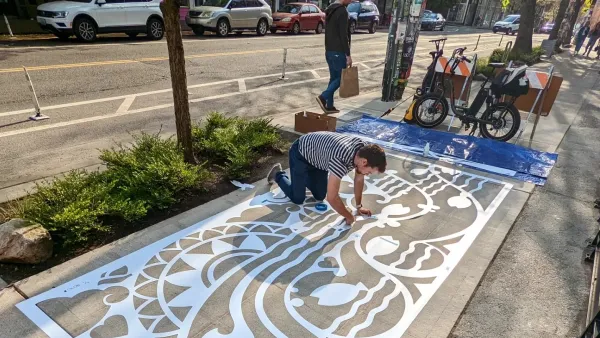
This Seattle sidewalk art only appears when it rains
Prompted to find a silver lining to the gloom of rainy Pacific Northwest days, an artist hit upon a novel solution: water-activated sidewalk paint.

War and Place: The Iran you Don't see in the News
The world is watching Iran right now through the narrow lens of conflict. When governments see the world through a target reticle, smoke fills the frame — and the places people actually live get ignored.
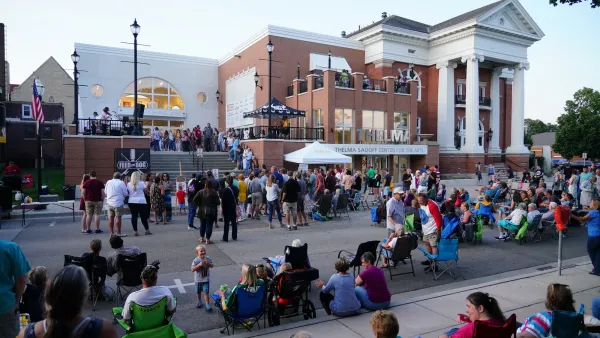
How Placemaking Lost its Way — And How it Can Get Back on Track
The term has often become diluted, getting attached to projects that don’t live up to its lofty aspirations.

Planetizen Federal Action Tracker
A weekly monitor of how Trump’s orders and actions are impacting planners and planning in America.

California plans to bury El Niño’s downpour
If the state plays its cards right, it may be able to store a billion acre-feet of El Niño’s water in aquifers.

Chicago breaks ground on $3 billion megadevelopment
The new neighborhood, titled Foundry Park, will one day host 3,700 residences.

One of Denver’s busiest corridors to gain BRT
The project will span 18 miles and contain 74 bus rapid transit stations.

275,000 bus trips are at stake on Seattle's ballot
If passed, the Seattle Transit Measure would trigger a 0.3% sales tax and raise an average of $138 million per year to maintain and expand Seattle’s bus services.

Texas may pay Israeli company billions to ease water woes
Texas awarded IDE Technologies the contract for its Harbor Island project, which is slated to become the Western Hemisphere's largest desalination plant.

FREE Course: Walkable City 1: Why Walkability?
After describing his path towards focusing on walkability as the essence of good planning, Jeff Speck marches through his five principal reasons for making more walkable places.
Reinventing Malls: Planning Alchemy—Turning Gray Fields Into Gold
The course focuses on the opportunities and imperatives that shape reinvention of mall sites.

City of Rosemead
Rutgers University, Edward J. Bloustein School of Planning and Public Policy
One Hundred Miles
Hunter College, City University of New York (CUNY)
The Architects Foundation
University of Cincinnati Online
City of Cambridge
Montrose County
The Pocatello Development Authority