Vauban, Germany is a new suburb that is part of the 'smart planning movement'. It is car-free, i.e. the streets are car-free, while car ownership is allowed but restricted to two garages, and the cost unbundled. Only 30% of families own cars.


"Street parking, driveways and home garages are generally forbidden in this experimental new district on the outskirts of Freiburg, near the French and Swiss borders. Vauban's streets are completely "car-free"...
Vauban, completed in 2006, is an example of a growing trend in Europe, the United States and elsewhere to separate suburban life from auto use, as a component of a movement called "smart planning."
Car ownership is allowed, but there are only two places to park - large garages at the edge of the development, where a car-owner buys a space, for $40,000, along with a home.
As a result, 70 percent of Vauban's families do not own cars, and 57 percent sold a car to move here."
Automobiles are the linchpin of suburbs, where middle-class families from Chicago to Shanghai tend to make their homes. And that, experts say, is a huge impediment to current efforts to drastically reduce greenhouse gas emissions from tailpipes, and thus to reduce global warming.
Passenger cars are responsible for 12 percent of greenhouse gas emissions in Europe - a proportion that is growing, according to the European Environment Agency - and up to 50 percent in some car-intensive areas in the United States."
Thanks to Gladwyn d'Souza?
Read the full story: Europe Imagines Its Suburbs Without the Car

German Suburbs: Look Familiar?
According to Kirk Rogers, European suburbs are not all that different from American ones--they indulge the need for space, good schools, and cars-- and they're there to stay.
The Greenest City?
With more and more energy-efficient homes being built and environmentally conscious industry sited in the city, Freiburg, Germany may be one of the greenest cities in the world.
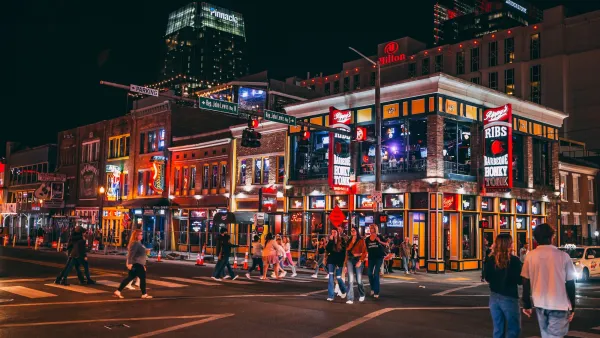
Tennessee DOT weighs making Nashville's Broadway car-free — sometimes
After a crash that killed one person and injured several others, state and city officials are in talks to consider options for closing the popular thoroughfare to cars during certain events.

Planetizen Federal Action Tracker
A weekly monitor of how Trump’s orders and actions are impacting planners and planning in America.

Northwest rail fans eager for Sept. 30 debut of Amtrak’s Airo fleet
Get ready for that new train smell and more seats. But they won’t go faster or run more frequently on the Cascades route in Washington and Oregon.

Record-breaking wildlife overpass in Colorado brings 91% reduction in animal collisions
Prior to the overpass, vehicles were hitting one deer per day on Colorado’s Interstate 25.

Detroit to transform waterfront with $2.2 billion investment
Developers will convert about 18 acres of unused parking lot space into civic spaces.

‘Going backwards:’ Baltimore mayor, students rally against state's transit funding plan
Maryland's proposed six-year plan provides no funding for Baltimore’s BMORE bus program and reduces its road maintenance funding.

Trump wants to cancel nearly 98% of funding for HUD housing support program
Multiple housing groups are suing the administration in an effort to preserve the funding.

FREE Course: Walkable City 1: Why Walkability?
After describing his path towards focusing on walkability as the essence of good planning, Jeff Speck marches through his five principal reasons for making more walkable places.
Reinventing Malls: Planning Alchemy—Turning Gray Fields Into Gold
The course focuses on the opportunities and imperatives that shape reinvention of mall sites.

City of Thousand Oaks
City of Wisconsin Rapids
Harvard University Graduate School of Design
The Architects Foundation
University of Cincinnati Online
Northern Illinois Transit Authority (NITA)
The Pocatello Development Authority
The Urban Renewal Agency of the City of Pocatello