Portland urban designer Arun Jain has released his Urban Design Framework, a vision that requires planners to give themselves more leeway "without giving up core values."


"The framework includes Jain's 'nodes' concept. 'These locations capitalize the convergence of existing and proposed infrastructure to leverage the most out of civic-minded and private development,' he said. 'They strengthen the public realm by acknowledging and improving what is already in place, while laying the ground for city-defining new iconic architecture.'
He envisions, for example, a development at the east end of the proposed Willamette River Crossing, a pedestrian/bus/light rail bridge slightly south of the Oregon Museum of Science and Industry. The development could include mixed-use buildings at the end of the bridge as well as waterfront fairgrounds and a railway museum.
Another node idea is to have a tower at the west end of the Morrison Bridge. The tower could have a 'giant, grand atrium' at its center and be flanked on its north and south sides by east- and west-bound lanes connecting to the Morrison Bridge. 'The building would be an actor on a stage,' said Jain. 'There is something grand and civic-minded about how the building and transit would come together.'"
Read the full story: Are ‘nodes’ next for Portland development?

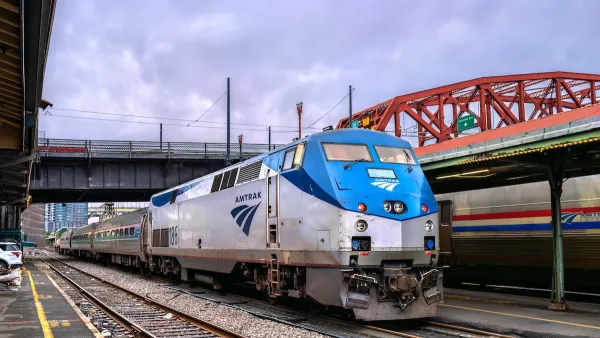
Transit leaders progress high-speed rail from Portland to Vancouver, B.C.
Washington state officials may reveal feasible routes for the high-speed rail in late 2027.
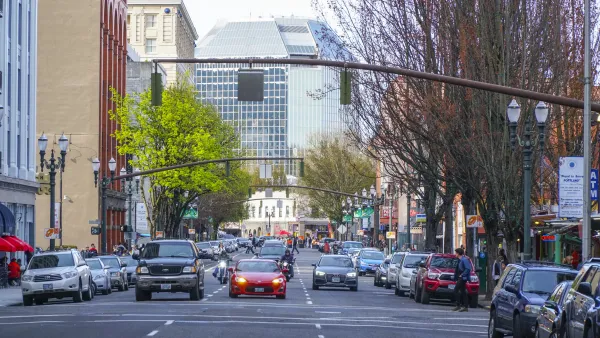
In two U.S. cities, new technology is rewarding slower driving with a quicker commute
Albuquerque, New Mexico and Portland, Oregon have introduced traffic lights that are red by default, and turn green faster if drivers approach while going at or below the speed limit.
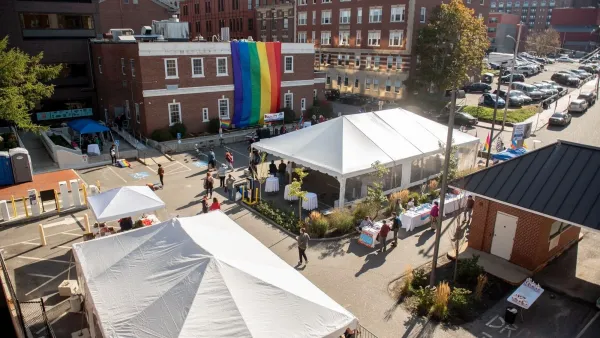
Portland unveils Maine’s first affordable housing complex for LGBTQ+ seniors
The building earmarks 11 units for people with disabilities or living with HIV/AIDS.

Planetizen Federal Action Tracker
A weekly monitor of how Trump’s orders and actions are impacting planners and planning in America.

Data reveals that NYC’s bet on congestion pricing has paid off
After almost two years of the program, reports show positive impacts on traffic and air quality and no disruptions to parking.

HUD modernizes 50-year-old manufactured housing framework
The Next Generation Manufactured Housing Action Plan establishes new energy-efficiency standards for manufactured homes, and new guidelines for anchoring them.

Small single-family homes are illegal in most of MA. Voters can change that
Most land zoned for single-family housing in Massachusetts requires at least 40,000 square feet of land per house.

Public steps inside U.S.’s first battery-powered train
Metra’s groundbreaking train feature modern seats and a futuristic battery car.

Companies show off AI technology, new innovation hubs at APTA Expo
Nearly 700 companies attended the American Public Transportation Association’s Expo last week, which happens once every three years.

FREE Course: Walkable City 1: Why Walkability?
After describing his path towards focusing on walkability as the essence of good planning, Jeff Speck marches through his five principal reasons for making more walkable places.
Reinventing Malls: Planning Alchemy—Turning Gray Fields Into Gold
The course focuses on the opportunities and imperatives that shape reinvention of mall sites.

One Hundred Miles
County of Mendocino
planning NEXT
The Architects Foundation
University of Cincinnati Online
Montrose County
Northern Illinois Transit Authority (NITA)
The Pocatello Development Authority