While auto sales are in the toilet, bicycle shops are having a banner year. The Infrastructurist reports on the pedaling revolution.


"Yes, it's true that those expensive carbon-fiber bikes aren't exactly flying off the shelves these days as the lycra-clad, ectomorphic road warriors decide that maybe they can live with last year's model.
But it's a pretty good business to be selling lights, fenders and even bike bells to people who are hauling their old bikes out of storage or bringing home cheap two-wheelers from Goodwill. Now that dozens of cities around the country are starting to see cycling as a serious form of transportation, it's become more inviting than it used to be to bike to work, the store or the neighborhood pub.
A lot of folks, of course, started picking up the cycling-for-transportation habit a year ago when gas prices shot up to $4 a gallon and keeping your car parked whenever possible took on new cachet.
Filling up with unleaded is not quite so dear now, but since just about everyone is feeling at least a little poorer now, the bike is taking on a new aura of recession chic."
Read the full story: A Vehicle For The Times

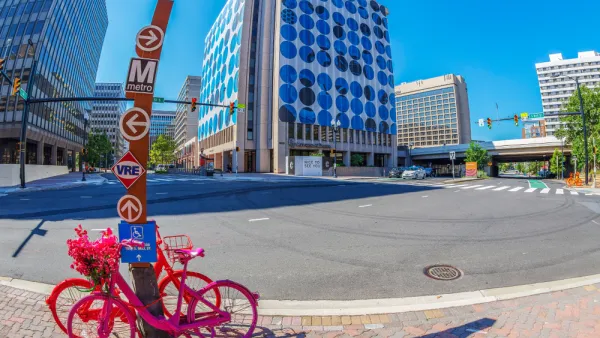
A New Bicycle Master Plan for Arlington County
Arlington County planning staff have worked on a new bicycle master plan for the past two years. The Arlington County Board will consider the new plan this week.
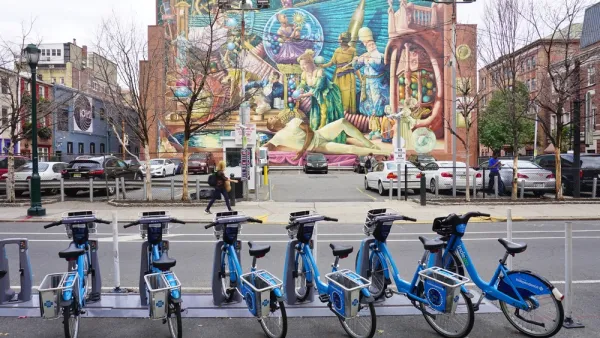
Checking in on Philadelphia's Promised Protected Bike Lanes
Philadelphia Mayor Jim Kinney is discovering on the job that planning is much easier than delivering when it comes to protected bike lanes—as is the case in many cities around the country.
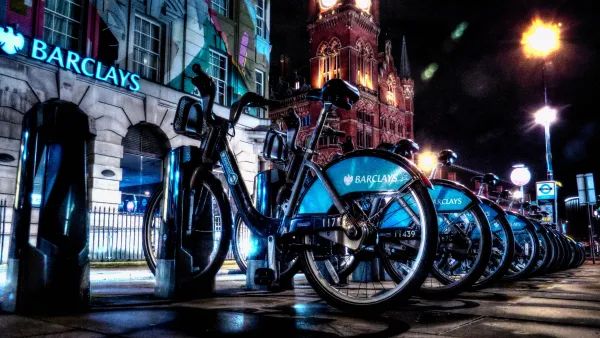
Londoners Taking to Bicycles in Record Numbers
The number of commuters taking to bicycle in the city have tripled since 2000, while commuting by car has been cut in half.

Planetizen Federal Action Tracker
A weekly monitor of how Trump’s orders and actions are impacting planners and planning in America.

Chicago breaks ground on $3 billion megadevelopment
The new neighborhood, titled Foundry Park, will one day host 3,700 residences.

This MA town is drowning in its own sewage — and residents like it that way
Susan Murcott, a waste water expert, said if Carlisle didn't address their leaking sewage, the problem could turn “deadly.”

Feds to more closely scrutinize proposed Amtrak facility’s environmental impact
The Federal Railroad Administration had initially said the facility qualified for a less extensive environmental review.

Boston is hard to build housing in: its chief of planning wants to keep it that way
Chief of Planning Kairos Shen said she would not make changes to Boston’s affordability requirements for new housing, which critics say have slowed down development.

California plans to bury El Niño’s downpour
If the state plays its cards right, it may be able to store a billion acre-feet of El Niño’s water in aquifers.

FREE Course: Walkable City 1: Why Walkability?
After describing his path towards focusing on walkability as the essence of good planning, Jeff Speck marches through his five principal reasons for making more walkable places.
Reinventing Malls: Planning Alchemy—Turning Gray Fields Into Gold
The course focuses on the opportunities and imperatives that shape reinvention of mall sites.

City of Rosemead
Rutgers University, Edward J. Bloustein School of Planning and Public Policy
One Hundred Miles
Hunter College, City University of New York (CUNY)
The Architects Foundation
University of Cincinnati Online
Montrose County
The Pocatello Development Authority
The Urban Renewal Agency of the City of Pocatello