A magnetic levitation train link between Anaheim and Las Vegas has been on the table for 30 years. Now could be the time the project finally gets enough traction to go from idea to reality.


"This past Thursday I went to a conference - presented by UNLV, the Urban Land Institute and the California-Nevada Super Speed Train Commission - that featured the latest update of the proposed maglev train that would be built between Anaheim and Las Vegas."
"I don't remember the first such presentation I attended except that I was a relatively young man who harbored an idea that tourism on both sides of the border could get a big boost from a high-speed train because it traveled very quickly in both directions. As many years passed with very little accomplished, it became apparent that the 3.5 hour drive to Los Angeles in the early days, which became four, then five and many times six hours or more as the traffic counts expanded and the interstate highway system did not, would be the norm because the dream of a magnetic levitation train was just that, and an impossible one at that."
"Fast forward to last week and it was apparent to those in the crowded room at UNLV that the train idea was back on track with a boost by none other than President Barack Obama. Not only did the president follow through on his promise to advance needed technological infrastructure, which means tens of thousands of construction jobs and thousands of permanent ones once the train starts running, but he also made that promise a solid one by providing billions of dollars in the latest stimulus bill for projects just like this."
Read the full story: Let’s get our 30-year-old maglev dream back on track
Federal Mag-Lev Funding Reignites Debate in Las Vegas
Federal authorities recently announced $45 million in support of plans to construct a magnetic levitation train line between Las Vegas and Southern California, re-igniting a debate over two proposed rail connections.
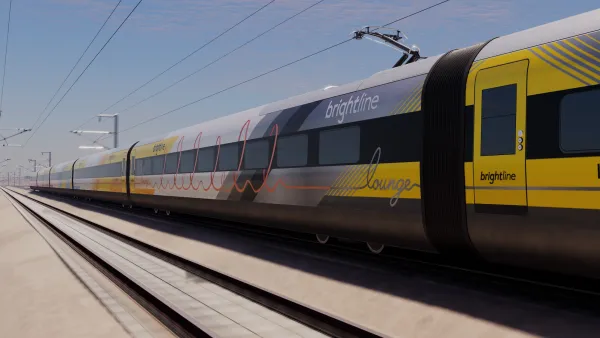
California’s Brightline West High-Speed Rail Announces 2029 Completion Date
The Las Vegas-to-Southern California rail line was originally slated to open for service in time for the 2028 Olympics.
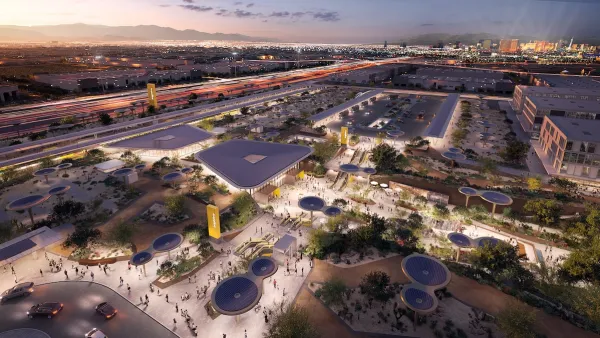
Brightline West Moves Forward With Finalized Federal Funding
The high-speed rail line will connect Southern California and Las Vegas via a two-hour trip along Interstate 15.

Planetizen Federal Action Tracker
A weekly monitor of how Trump’s orders and actions are impacting planners and planning in America.

Eastern Nebraska is running out of electricity
Data centers and electrification are straining eastern Nebraska’s grid, throttling economic development.

Study reveals best places in the U.S. for cycling, walking
New research from Streetlight Data examines bicycle and pedestrian miles per capita in the 100 largest U.S. cities by population.

DSA members accuse Mamdani of 'abandoning values' over housing redevelopment
New York City's mayor plans to replace about 2,000 units of public housing with private, mixed-income housing.

All sides of BRT debate unhappy with CDOT’s most recent move
The Colorado Department of Transportation is no longer considering center-running bus lanes for Colorado Boulevard.

Massachusetts bogs generate both power, and cranberries
Putting solar panels above farmland is one way Massachusetts is advancing toward its goal of net-zero carbon emissions by 2050.

FREE Course: Walkable City 1: Why Walkability?
After describing his path towards focusing on walkability as the essence of good planning, Jeff Speck marches through his five principal reasons for making more walkable places.
Reinventing Malls: Planning Alchemy—Turning Gray Fields Into Gold
The course focuses on the opportunities and imperatives that shape reinvention of mall sites.

City of Rosemead
Rutgers University, Edward J. Bloustein School of Planning and Public Policy
One Hundred Miles
University of Michigan School for Environment and Sustainability (SEAS)
Hunter College, City University of New York (CUNY)
The Architects Foundation
City of Cambridge
The Pocatello Development Authority
The Urban Renewal Agency of the City of Pocatello