New green building projects aimed at low-income residents are popping up across the country, and federal stimulus money is helping.


"Intervale Green doesn't have the glass walls, waterless urinals or ice batteries that the BoA Tower boasts. No one would describe Intervale as cutting edge, but it is green where it counts - with more energy efficient appliances, better window insulation and energy efficient fluorescent lights, all of which will enable its low-income residents to save real money on their utility bills. 'Residents will be paying 30% less for their utilities than in an ordinary building,' says Nancy Biberman founder and president of WHEDCo, during a recent tour of Intervale. 'For them, going green is a survivability issue. It's important for the environment, but it's really important for their pocketbooks.'"
"Intervale is one of a number of new and planned green, low-income housing projects around the country - an enterprise for which the federal stimulus package will include increased funding (it will also provide money for improving the energy efficiency of existing homes). In Miami, the nonprofit Carrfour Supportive Housing is building the 145-unit Verde Gardens Apartment building; the project will use green modular wall systems and aim for LEED certification. In Chicago, the Resurrection Homes project offers affordable green housing, and the soon to be completed Victory Centre will include green apartments for low-income seniors. And nationwide, the nonprofit Enterprise Communities Partners has helped create or preserve more than 320 inexpensive green housing developments, from Portland to Jacksonville. The building momentum shows that you don't have to be rich to go green - which is often accused of being an elitist concern."
Read the full story: Building Green Houses for the Poor
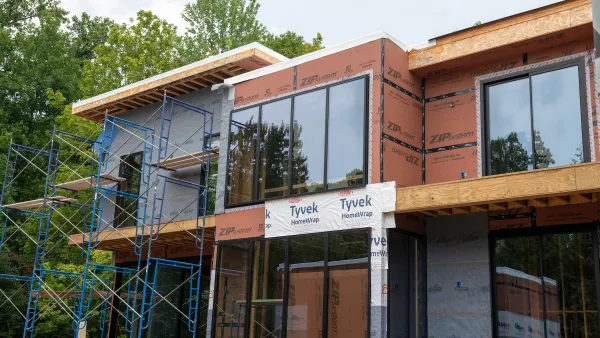
New HUD guidelines call for nixing green building requirements
The newly released 'best practices' advise local governments to streamline permitting processes, cap permitting fees and encourage by-right development of single-family homes.
Mismanagement Leads to Loss of up to $35M for DC Affordable Housing
The District’s housing agency forfeited what would amount to $35 million in federal housing funds over the next decade.

Chicago Approves Green Affordable Housing Plan
The Mayor’s plan calls for creating a nonprofit housing corporation tasked with building affordable housing that meets Green Building standards.

Planetizen Federal Action Tracker
A weekly monitor of how Trump’s orders and actions are impacting planners and planning in America.

California plans to bury El Niño’s downpour
If the state plays its cards right, it may be able to store a billion acre-feet of El Niño’s water in aquifers.

Desperate measures: Advocates weigh draining Lake Powell to fill Colorado River
Draining the reservoir could reduce evaporation losses by a couple hundred thousand acre-feet.

Housing is the top priority of Seattle’s sole new councilmember
Jenks campaigned on building 1,000 new units of affordable housing.

New tax cuts may slash $1.5 billion in funding for Miami transit, public parks
Amendment 3 will save Miami-Dade homeowners $2,700 in 2028.

Arizona, Wisconsin, Pennsylvania hope to finally advance climate goals post-midterms
The three states have spent years under Republican or divided control.

FREE Course: Walkable City 1: Why Walkability?
After describing his path towards focusing on walkability as the essence of good planning, Jeff Speck marches through his five principal reasons for making more walkable places.
Reinventing Malls: Planning Alchemy—Turning Gray Fields Into Gold
The course focuses on the opportunities and imperatives that shape reinvention of mall sites.

City of Rosemead
Rutgers University, Edward J. Bloustein School of Planning and Public Policy
One Hundred Miles
University of Michigan School for Environment and Sustainability (SEAS)
Hunter College, City University of New York (CUNY)
The Architects Foundation
City of Cambridge
Montrose County
The Pocatello Development Authority