A nonprofit organization is promoting the idea of closing Manhattan's 42nd St. to traffic and putting in a 2.5 mile street level light rail line.


"The new report estimates that the light rail line would cost $411.3 million to $582.3 million in 2007 dollars, but generate $704.9 million in annual economic benefits, and yield $175.4 million a year in additional fiscal benefits to the city and state.
By speeding up crosstown travel time, the project would raise commercial property values by $1 billion - a result of ground-floor business revenue, rent and occupancy increases and reduction in accidents - and increase business in retail shops and restaurants by 35 percent, the study estimates.
The report notes that until 1946, streetcars and trolleys ran in New York City over underground utility lines. The new light rail cars could draw power from fuel cells or other advanced technologies. The trip from river to river would take only 21 minutes, even with speeds limited to 15 m.p.h. to keep pedestrians safe."
Read the full story: 42nd Street as a Car-Free Light Rail Corridor
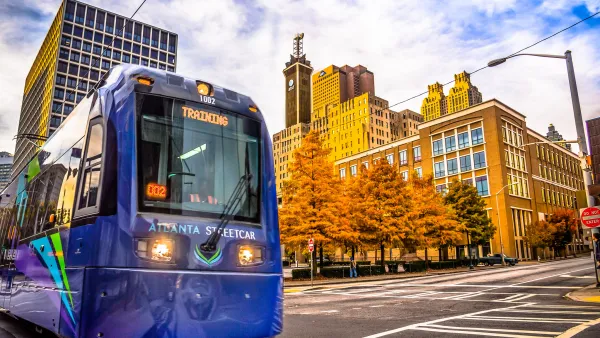
Expansion Planned for Atlanta Streetcar
A proposed expansion of Atlanta's beleaguered downtown streetcar could turn the 'novelty' line into a truly useful transportation option in the car-centric city.
Ridership Drops As Detroit's QLine Streetcar Starts Charging
Since Detroit's new streetcar system started charging, ridership has dropped. Those who are riding aren't necessarily paying anyways.
Leinberger Op-Ed Supports Streetcars as Economic Development Tool
"Opposing streetcars and light rail today would be like opposing the building of freeways, the Beltway and Metrorail in the 20th century," writes Chris Leinberger in an op-ed for the Washington Post.

Planetizen Federal Action Tracker
A weekly monitor of how Trump’s orders and actions are impacting planners and planning in America.

California plans to bury El Niño’s downpour
If the state plays its cards right, it may be able to store a billion acre-feet of El Niño’s water in aquifers.

Desperate measures: Advocates weigh draining Lake Powell to fill Colorado River
Draining the reservoir could reduce evaporation losses by a couple hundred thousand acre-feet.

Los Angeles just elected an urban planner as its mayor
Transportation analysts are optimistic that Raman will be more aggressive in addressing transit issues than Bass.

Mamdani’s pied-à-terre tax survives legal challenge
A panel of judges found that the plaintiffs failed to demonstrate injury as a result of New York City's implementation of the tax.

Eastern Nebraska is running out of electricity
Data centers and electrification are straining eastern Nebraska’s grid, throttling economic development.

FREE Course: Walkable City 1: Why Walkability?
After describing his path towards focusing on walkability as the essence of good planning, Jeff Speck marches through his five principal reasons for making more walkable places.
Reinventing Malls: Planning Alchemy—Turning Gray Fields Into Gold
The course focuses on the opportunities and imperatives that shape reinvention of mall sites.

City of Rosemead
Rutgers University, Edward J. Bloustein School of Planning and Public Policy
One Hundred Miles
University of Michigan School for Environment and Sustainability (SEAS)
Hunter College, City University of New York (CUNY)
The Architects Foundation
City of Cambridge
Montrose County
The Pocatello Development Authority