San Antonio's city council attempts to make it harder for bikini carwashes to attract oglers by forcing them to accept a new zoning category.


"After a nearly yearlong fight over the propriety of scantily clad women washing and waxing cars in public view, the City Council today is likely to vote to make it significantly more difficult for such full-service operations in the future.
"The proposal would require a C-3 zoning designation, one of the hardest for a carwash to secure. It also would require that screens, trees, fencing or other devices block the actual car servicing from public view.
"Development Services Director Rod Sanchez is quick to note the city isn't attempting to legislate businesses out of existence.
"'This ordinance does not prohibit a bikini carwash operation,' he said. 'But what it does require is that the washing, drying, polishing go on out of the public view; basically, that you can't see it from the road. Nor are we telling people how to screen. If they want to put up a fence, or screens, or trees or rearrange an operation so that a building will block the view, they are free to do that.'"
Read the full story: City is moving to cover bikini carwash spots in the future

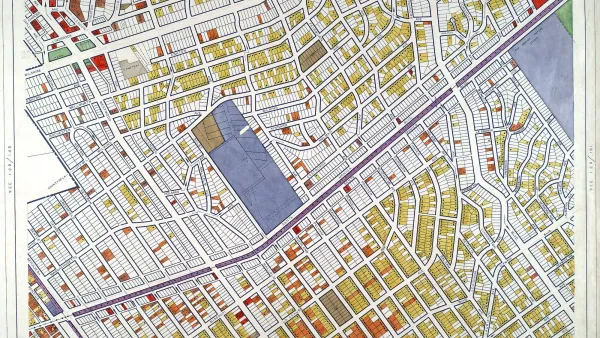
100 Years ago, Zoning Changed how US Cities Grow. Today, it is Ripe for Reform.
Euclidean zoning was enshrined in U.S. town planning by a 1926 Supreme Court decision. Cities are recognizing it’s time for some drastic changes.

Commentary: Growth Without Affordable Housing Requirements is “Hard-wiring Segregating Into the Future”
Development should come with affordability. Here's the case for inclusionary housing, and why opponents aren't seeing the full picture.

Arlington’s New Form-Based Zoning Designed to Guide a Cohesive Public Realm
Form-based zoning focuses on the design of buildings and how they interact with the public realm.

Planetizen Federal Action Tracker
A weekly monitor of how Trump’s orders and actions are impacting planners and planning in America.

California plans to bury El Niño’s downpour
If the state plays its cards right, it may be able to store a billion acre-feet of El Niño’s water in aquifers.

Desperate measures: Advocates weigh draining Lake Powell to fill Colorado River
Draining the reservoir could reduce evaporation losses by a couple hundred thousand acre-feet.

California city breaks ground on transit connector
The project includes three mobility hubs and a pedestrian bridge.

After public outcry, Massachusetts city releases housing development tracker
Cambridge’s tracker currently shows 250 housing projects in various stages of development.

40 years after approval, Chicago breaks ground on new park
The park honors Jean Baptiste Point du Sable, the city’s first permanent non-native settler.

FREE Course: Walkable City 1: Why Walkability?
After describing his path towards focusing on walkability as the essence of good planning, Jeff Speck marches through his five principal reasons for making more walkable places.
Reinventing Malls: Planning Alchemy—Turning Gray Fields Into Gold
The course focuses on the opportunities and imperatives that shape reinvention of mall sites.

City of Rosemead
Rutgers University, Edward J. Bloustein School of Planning and Public Policy
One Hundred Miles
Hunter College, City University of New York (CUNY)
The Architects Foundation
University of Cincinnati Online
City of Cambridge
Montrose County
The Pocatello Development Authority