President-Elect Barack Obama is seen by many urbanists as a great opportunity for improving the built environment of the U.S. Anthony Flint sees big plans brewing but wonders how they'll be funded and if Obama will be able to handle them all.


"President-elect Barack Obama has vowed to act on climate change, bringing the U.S. in from the sidelines after eight long years. He has promised to end dependence on oil and support renewable energy. And he seems to recognize that cities and metropolitan regions will play a crucial role, in these challenges but also as centers of innovation, economic activity, and housing opportunities, and that they deserve support."
"But everyone at this conference and all environmentalists and urbanists everywhere have the same question shared by so many Americans: how in the world is he going to do it all?"
"It's clear the new president and his team intend to walk and chew gum at the same time. Any economic stimulus plan will include investments in cities and infrastructure and the new energy economy that is envisioned in our post cheap-oil, post-carbon future–the so-called 'green New Deal.'"
"But it's also the point where one has to ask: where is the money going to come from?"
Read the full story: A President for Cities, But Where’s the Money?
Treading Lightly into a New 'New Deal'
Many are arguing for a new "New Deal" under President-Elect Obama. Economist Paul Krugman says there are many lessons -- good and bad -- Obama should learn from the first "New Deal" before taking the plunge.
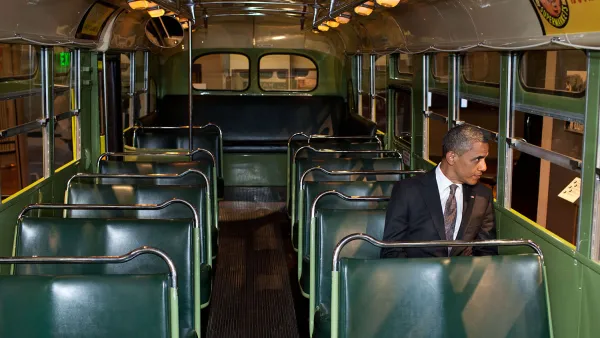
Obama on the Record Against Sprawl, Inequality by Design
Former President Barack Obama was at the AIA’s national conference in Chicago earlier this month. His presentation included some strong words about the effects of sprawl.
Biden Proposes Gas Tax Holiday to Reduce Gas Prices
President Biden asked Congress on June 22 to suspend federal fuel taxes, unchanged since 1993, for three months to provide motorists 'relief' at the pump. Additionally, he asked states to follow suit and for oil companies to increase refining.

Planetizen Federal Action Tracker
A weekly monitor of how Trump’s orders and actions are impacting planners and planning in America.

Eastern Nebraska is running out of electricity
Data centers and electrification are straining eastern Nebraska’s grid, throttling economic development.

Study reveals best places in the U.S. for cycling, walking
New research from Streetlight Data examines bicycle and pedestrian miles per capita in the 100 largest U.S. cities by population.

DSA members accuse Mamdani of 'abandoning values' over housing redevelopment
New York City's mayor plans to replace about 2,000 units of public housing with private, mixed-income housing.

All sides of BRT debate unhappy with CDOT’s most recent move
The Colorado Department of Transportation is no longer considering center-running bus lanes for Colorado Boulevard.

Massachusetts bogs generate both power, and cranberries
Putting solar panels above farmland is one way Massachusetts is advancing toward its goal of net-zero carbon emissions by 2050.

FREE Course: Walkable City 1: Why Walkability?
After describing his path towards focusing on walkability as the essence of good planning, Jeff Speck marches through his five principal reasons for making more walkable places.
Reinventing Malls: Planning Alchemy—Turning Gray Fields Into Gold
The course focuses on the opportunities and imperatives that shape reinvention of mall sites.

City of Rosemead
Rutgers University, Edward J. Bloustein School of Planning and Public Policy
One Hundred Miles
University of Michigan School for Environment and Sustainability (SEAS)
Hunter College, City University of New York (CUNY)
The Architects Foundation
City of Cambridge
The Pocatello Development Authority
The Urban Renewal Agency of the City of Pocatello