'Fringe Benefits: Cosmopolitan Dynamics of a Multicultural City' is the name of an exhibit open now at the Design Exchange in Toronto. Urban designer Ian Chodikoff explains his inspiration for the show.


"'It started in 2001, when I decided to go back to school to study urban design at Harvard,' Mr. Chodikoff said. 'A couple of teachers there really sparked my interest in how all the social activities in our urban environment link up into making progressive cities. Back home, I started to see peculiar things and mutations happening in our own cities. The suburbs in the Greater Toronto Area allow ethnic and cultural groups with links all over the world to manifest their ways of doing business, of living, or recreating, of socializing - things that I had not been aware of.'
Following his curiosity into Toronto's suburban settlements, Mr. Chodikoff found new immigrants using the previously orphaned lawns around apartment blocks for picnicking, families gathering by day and by night in ravines long derelict, people creating an active street life in high-rise neighbourhoods widely believed to be dangerous and forbidding.
'I went wow! Something is going on here. Then you start digging deeper, and you discover this Sri Lankan draftsman in Scarborough, designing the first Tamil mall in North America. Ostensibly, it's a strip mall. It's not going to win a Governor-General's award for architecture. But his dream is to create a night market in Scarborough, where families can gather, bringing their parents and grandparents to eat food and have a nice time. All of a sudden, you're introducing something very meaningful into the great indigestible landscape of the suburbs.'
But the novel uses of public space by immigrants, Mr. Chodikoff found, are still little understood by official planners.
Read the full story: Development needs to reflect new social fabric
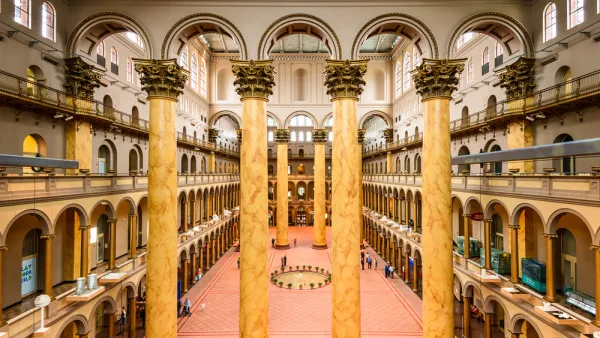
An 'Evicted' Exhibit Planned for the National Building Museum
The critically acclaimed and Pulitzer Prize-winning book Evicted by Mathew Desmond will serve as the inspiration for an "immersive" exhibition at the National Building Museum.
Minnesota History Center Exhibit Makes Room for Suburban Romance
"Suburbia," opening today at the new Minnesota History Center in St. Paul, allows a portrait of suburban living that goes well beyond the mundane. By redefining the history suburbia, the exhibit also tracks the contemporary evolution of suburbs.
Designing the Built Environment With Information Technology
A new project at the National Building Museum is collecting information to better understand the built environment. Next American City talks with the program's curator, Susan Piedmont-Palladino.

Planetizen Federal Action Tracker
A weekly monitor of how Trump’s orders and actions are impacting planners and planning in America.

California plans to bury El Niño’s downpour
If the state plays its cards right, it may be able to store a billion acre-feet of El Niño’s water in aquifers.

Desperate measures: Advocates weigh draining Lake Powell to fill Colorado River
Draining the reservoir could reduce evaporation losses by a couple hundred thousand acre-feet.

In Texas, data centers are swallowing promised parkland
Residents who moved to Taylor, Texas for a rural community now have to contend with three data centers in their backyard.

How a Chicago-sized wind farm beat the odds and powered on
The project spanned five presidential administrations and a standoff with a U.S. military base.

MTA gives itself 30 days to transform pit into basketball court
The site has been under construction since 2022; the city originally estimated it would finish the court in 2024.

FREE Course: Walkable City 1: Why Walkability?
After describing his path towards focusing on walkability as the essence of good planning, Jeff Speck marches through his five principal reasons for making more walkable places.
Reinventing Malls: Planning Alchemy—Turning Gray Fields Into Gold
The course focuses on the opportunities and imperatives that shape reinvention of mall sites.

City of Rosemead
Rutgers University, Edward J. Bloustein School of Planning and Public Policy
One Hundred Miles
Hunter College, City University of New York (CUNY)
The Architects Foundation
University of Cincinnati Online
City of Cambridge
Montrose County
The Pocatello Development Authority