Despite efforts by politicians to enact policies that reduce congestion, the biggest improvements in traffic reduction appear to be tied to rising gas prices and tolls, according to data from New York.


"Soaring gas prices and higher tolls seem to be doing for traffic in New York what Mayor Michael R. Bloomberg's ambitious congestion pricing was supposed to do: reducing the number of cars clogging the city's streets and pushing more people to use mass transit."
"In May, with gasoline at more than $4 a gallon, traffic at the Metropolitan Transportation Authority's bridges and tunnels dropped 4.7 percent compared with the same month the previous year."
"Preliminary data for June shows a similar decrease in traffic, and officials say the change is largely because of higher prices at the pump."
"At the same time, subway, bus and commuter rail ridership has increased."
Read the full story: Politics Failed, but Fuel Prices Cut Congestion
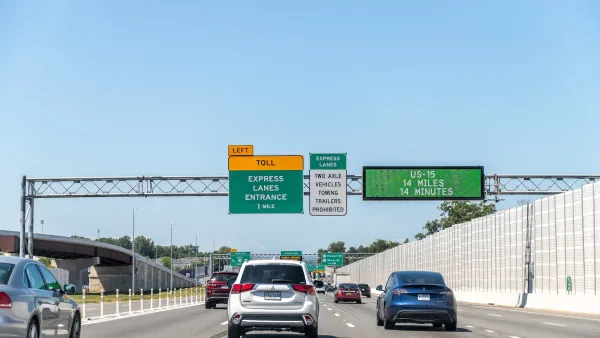
Congestion Costing Reality Check, Part 2: A congestion costing critique
There are good reasons to be skeptical of highway industry claims that traffic congestion is a growing problem. Their analysis is often incomplete and biased. Let’s pull back the curtain on some major congestion cost studies.
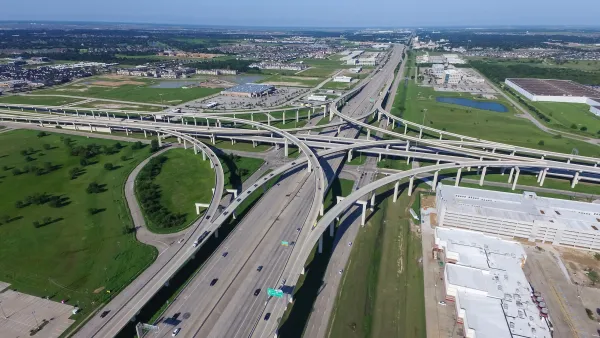
Induced demand is real: Commutes on Houston's 26-lane freeway take 51% longer after expansion
A massive freeway expansion only led to longer drive times, showing that building more lanes won't solve congestion.
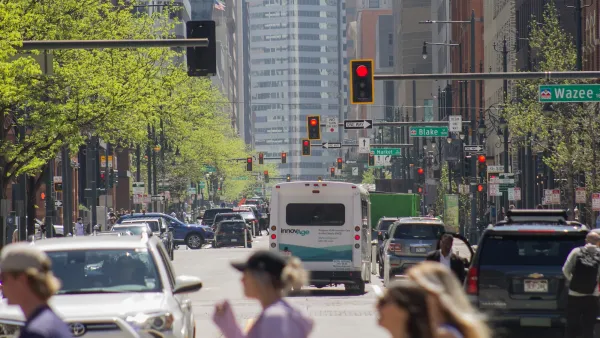
Congestion Costing Reality Check, Part 1: Congestion evaluation best practices
Widely cited studies claim that traffic congestion is a huge and growing problem. They exaggerate. Let’s examine how to correctly calculate congestion costs and roadway expansion benefits.

Planetizen Federal Action Tracker
A weekly monitor of how Trump’s orders and actions are impacting planners and planning in America.

Eastern Nebraska is running out of electricity
Data centers and electrification are straining eastern Nebraska’s grid, throttling economic development.

Study reveals best places in the U.S. for cycling, walking
New research from Streetlight Data examines bicycle and pedestrian miles per capita in the 100 largest U.S. cities by population.

As Texas embraces carbon storage, a Black community questions the risks
Texas now issues permits for companies to store carbon dioxide underground. East Texas residents fear safety risks, and skeptics doubt the climate benefits.

New BLM proposal would slash public comment periods, environmental protections
The proposed rewrite would also strip legal leverage from Tribal nations and state governments.

DSA members accuse Mamdani of 'abandoning values' over housing redevelopment
New York City's mayor plans to replace about 2,000 units of public housing with private, mixed-income housing.

FREE Course: Walkable City 1: Why Walkability?
After describing his path towards focusing on walkability as the essence of good planning, Jeff Speck marches through his five principal reasons for making more walkable places.
Reinventing Malls: Planning Alchemy—Turning Gray Fields Into Gold
The course focuses on the opportunities and imperatives that shape reinvention of mall sites.

City of Rosemead
Rutgers University, Edward J. Bloustein School of Planning and Public Policy
One Hundred Miles
University of Michigan School for Environment and Sustainability (SEAS)
Hunter College, City University of New York (CUNY)
The Architects Foundation
City of Cambridge
The Pocatello Development Authority
The Urban Renewal Agency of the City of Pocatello