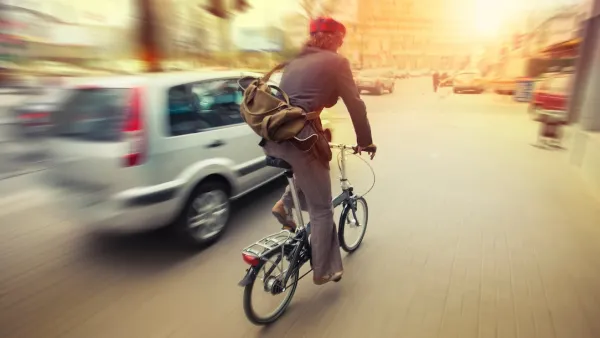
Toronto environmental lawyer Albert Koehl believes that Canada's Conservative government should embark on a national bicycle strategy.


"Our transportation system is a cycle of dependency. We get up Monday ready to devote a full day or more of the week to covering the cost of owning and operating a car, importing oil from people who don't even like us (it's not just Alberta - Ontario oil mostly comes from other foreign sources) and, at the end of the week, are left with a deteriorating climate that makes us more dependent on air conditioners to fight the heat, irrigation to fight the drought, and hip waders to fight the rising seas.
[Prime Minister Stephen] Harper could give a whole new meaning to the moniker "master of spin" by promoting the bicycle. His government, which currently spends virtually nothing on cycling (unless health-care costs to repair the broken bodies of cyclists are counted) could go zero-to-60 very quickly by funding a national bike strategy. Better yet, Mr. Harper would be able to show up Toronto Mayor David Miller, who reigns over a city bike plan that is still stuck closer to zero.
Mr. Harper, too, could be clever, in this case by breaking our cycle of car dependency without spending much taxpayer money. By promoting bicycles - the world's most energy efficient transportation vehicles - for Canadian cities, he would be recognized as a climate-change leader by millions of North Americans, instead of just by his communications staff.
Cyclists don't always obey traffic rules, it's true; in a world where we are told we must accept cars and their pollution as a reality, most of us cyclists are still going the wrong way. Mr. Harper has a chance to lead all of us in a wiser direction."
Read the full story: The PM can help break the cycle of energy dependency – with bicycles
Why Culture Matters: Do as Others Do, Whether In Eating or Cycling
Why Americans don't cycle in the cold and rain, and why they do in Amsterdam.
How the ‘Big Beautiful Bill’ Impacts Transportation
Five ways the bill negatively impacts U.S. transportation policy.
Presidential Transportation Innovations
A detailed list of each U.S. president’s contributions to transportation.

Planetizen Federal Action Tracker
A weekly monitor of how Trump’s orders and actions are impacting planners and planning in America.

California plans to bury El Niño’s downpour
If the state plays its cards right, it may be able to store a billion acre-feet of El Niño’s water in aquifers.

Desperate measures: Advocates weigh draining Lake Powell to fill Colorado River
Draining the reservoir could reduce evaporation losses by a couple hundred thousand acre-feet.

US buildings threatened, destroyed by fires set to triple by 2060
Researchers found a high fire risk for socioeconomically vulnerable neighborhoods in the American West.

LA residents may be allowed to paint their own crosswalks
Councilwoman Katy Yaroslavsky put out a motion instructing the Los Angeles Department of Public Transportation to study the feasibility of allowing volunteers to paint crosswalks.

Dallas moves to overhaul its zoning code
The city's zoning reform will allow more multi-family and mixed-use developments.

FREE Course: Walkable City 1: Why Walkability?
After describing his path towards focusing on walkability as the essence of good planning, Jeff Speck marches through his five principal reasons for making more walkable places.
Reinventing Malls: Planning Alchemy—Turning Gray Fields Into Gold
The course focuses on the opportunities and imperatives that shape reinvention of mall sites.

City of Rosemead
Rutgers University, Edward J. Bloustein School of Planning and Public Policy
One Hundred Miles
Hunter College, City University of New York (CUNY)
The Architects Foundation
University of Cincinnati Online
City of Cambridge
Montrose County
The Pocatello Development Authority