Washington, D.C. police decide to stop everyone entering a neighborhood that has seen 22 killings so far this year, including a recent triple homicide.


"Officials said police will stop all cars driving in the 1400 block of Montello Avenue, between Penn Street and Oates Street and about a block east of Gallaudet University.
Drivers will have to show identification proving they live in the neighborhood, or explain why they are in the area. Valid reasons would include 'attending church, a doctor's appointment or visiting friends or relatives,' the city said in a statement. Those lacking identification or a reason to be in the neighborhood will be forced to leave.
Similar efforts may be made in other neighborhoods as well, if local police commanders request them, officials said.
'In certain areas, we need to go beyond the normal methods of policing.' Mayor Adrian Fenty said. 'We're going to go into an area and completely shut it down to prevent shootings and the sale of drugs.'
Police Chief Cathy L. Lanier said the approach is modeled after a program used in New York City."
Thanks to Larry Schooler
Read the full story: In D.C.'s Trinidad, Police to Set Up Checkpoints
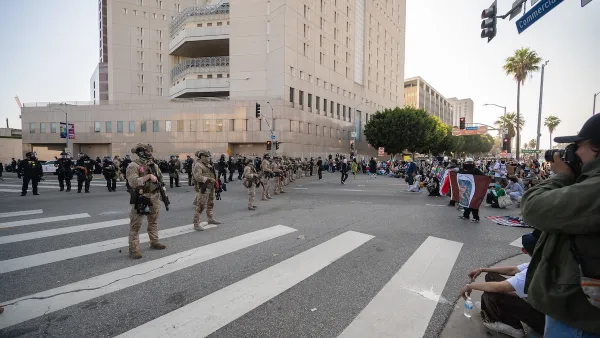
Opinion: Far From Cauldrons of Violence, Cities are Anti-Crime Innovators
Rather than funding the performative militarization of law enforcement, the federal government could instead support programs that prevent poverty and crime before it happens.
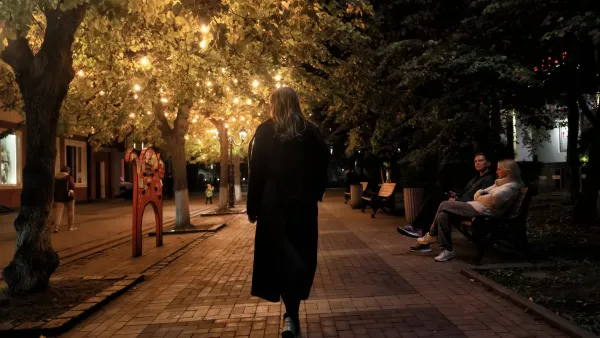
How urban design can deter crime
Well-designed public spaces and good lighting can prevent crime and make residents feel safer.
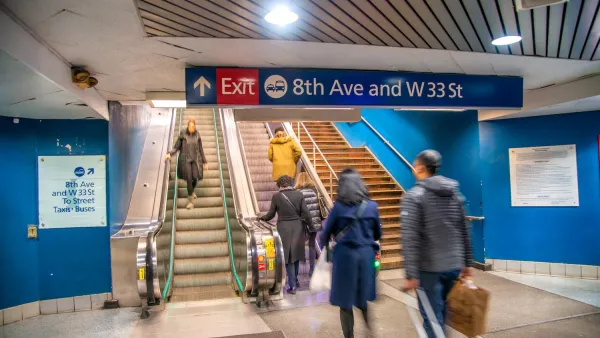
In Both Crashes and Crime, Public Transportation is Far Safer than Driving
Contrary to popular assumptions, public transportation has far lower crash and crime rates than automobile travel. For safer communities, improve and encourage transit travel.

Planetizen Federal Action Tracker
A weekly monitor of how Trump’s orders and actions are impacting planners and planning in America.

California plans to bury El Niño’s downpour
If the state plays its cards right, it may be able to store a billion acre-feet of El Niño’s water in aquifers.

Desperate measures: Advocates weigh draining Lake Powell to fill Colorado River
Draining the reservoir could reduce evaporation losses by a couple hundred thousand acre-feet.

In Texas, data centers are swallowing promised parkland
Residents who moved to Taylor, Texas for a rural community now have to contend with three data centers in their backyard.

How a Chicago-sized wind farm beat the odds and powered on
The project spanned five presidential administrations and a standoff with a U.S. military base.

MTA gives itself 30 days to transform pit into basketball court
The site has been under construction since 2022; the city originally estimated it would finish the court in 2024.

FREE Course: Walkable City 1: Why Walkability?
After describing his path towards focusing on walkability as the essence of good planning, Jeff Speck marches through his five principal reasons for making more walkable places.
Reinventing Malls: Planning Alchemy—Turning Gray Fields Into Gold
The course focuses on the opportunities and imperatives that shape reinvention of mall sites.

City of Rosemead
Rutgers University, Edward J. Bloustein School of Planning and Public Policy
One Hundred Miles
Hunter College, City University of New York (CUNY)
The Architects Foundation
University of Cincinnati Online
City of Cambridge
Montrose County
The Pocatello Development Authority