Scholar and Brookings Fellow Christopher B. Leinberger says Vancouver provides an accessible model for American cities as they look for examples of sustainable development done right.


"An April 21 article in The Tyee by Canadian Murray Dobbin ended with this advice to his country about your relationship to the U.S.: "Better for both of us that we Canadians strengthen our own country. Let us enhance our communitarian approach, build on our social programs, reverse the decline in education spending, take the lead in fighting climate change, and revive our tradition of progressive international engagement and leadership. That way, if and when, in desperation, our neighbours look for a model to follow, there will still be one. Just next door."
I second that opinion. Over the past two years or so, Americans have been awakening to the fundamentally wrong approach we have pursued for the past generation and more regarding the environment, our health, the built environment and the impact of oil dependency on foreign policy. The unprecedented 80 per cent of the electorate who currently feel the country is "heading in the wrong direction" is just one sign of this questioning.
Having models of an alternative approach is crucial to get us back on track; seeing is believing. We Americans only have a few places, like Portland, Oregon, where we can learn about an alternative to how to build our metropolitan areas . . . and most Americans are tired of endlessly hearing about Portland. We need additional models. Europe is too alien for most Americans (remember that only 20 per cent of us have passports). Canada is so close and you have been exporting friendly images and personalities to us for years; who can't relate to Red Green?"
Read the full story: US Needs Vancouver as Model

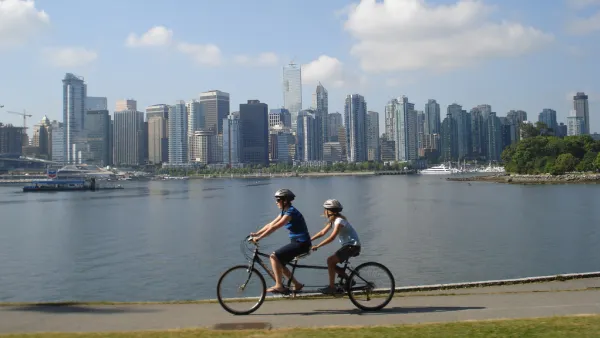
Well Done Vancouver! Well Done Planners!
In Vancouver, British Columbia, dramatic reductions in automobile travel and resulting benefits demonstrate that integrated TDM and smart growth policies can help create cities that are healthy, wealthy, and wise.
"No Net Loss" for Third Places?
Amid the dissolution of Borders bookstores in urban centers, Chuck Wolfe urges policymakers and the private market to assure "no let loss" in the spirit of natural resource protection to assure third places remain available in American cities.
Urbanism and Kids
Scott Doyon, a parent and an urbanist, argues that the suburban model isn't doing kids any favors. But, he says, designing urban areas that are kid-friendly is still a challenge.

Planetizen Federal Action Tracker
A weekly monitor of how Trump’s orders and actions are impacting planners and planning in America.

Amtrak, CN end decades-long dispute with eight-year agreement
The new operating agreement establishes an updated framework for the companies to work together, including processes to resolve disputes.

Judges permit Denver to divert 77,000 acre feet from the Colorado River for reservoir expansion
Overuse and climate change have caused the Colorado River’s water levels to plummet.

NYC DOT wants faster, more permanent street upgrades
The city is examining ways to build more concrete infrastructure without getting entangled in 'decades-long' projects.

'Something we’ve never seen before:' rising utility rates could strain city finances nationwide
Data centers, climate change and other factors have caused utility rates in the United States to increase by 38% since 2020.

Trump to overrule local leaders, lease millions of acres of America’s Pacific Island territories’ seafloors to mining companies
International law says that the Indigenous people of America’s territories have a right to prior and informed consent regarding projects that impact their countries.

FREE Course: Walkable City 1: Why Walkability?
After describing his path towards focusing on walkability as the essence of good planning, Jeff Speck marches through his five principal reasons for making more walkable places.
Reinventing Malls: Planning Alchemy—Turning Gray Fields Into Gold
The course focuses on the opportunities and imperatives that shape reinvention of mall sites.

Harvard University Graduate School of Design
KFH Group Inc.
Greater Baltimore Committee
The Architects Foundation
University of Cincinnati Online
The Pocatello Development Authority
The Urban Renewal Agency of the City of Pocatello