Sprawl around Budapest has created a major smog problem for the Hungarian capital.


"Indeed, 19 years after the collapse of communism, Budapest's air quality has become a problem again. Pollution exceeded recommended levels 115 days last year, 80 days more than permitted under European Union (EU) guidelines. In late December and early January, the capital experienced one of its most prolonged smog events in a decade."
"When communism imploded in 1989, Budapest's air was atrocious. With their two-cycle engines, fleets of Trabant automobiles spewed black clouds of lead-laden exhaust, while city busses and industrial facilities pumped eye-stinging emissions into the air. During the 1990s the air cleared as factories installed pollution controls, leaded gasoline was banned, and newer, cleaner Western cars replaced dirty Soviet ones."
"But in recent years, those gains have been reversed as many Hungarians now drive to work from increasingly far-flung suburban areas. Lead and sulfur dioxide have been replaced by dangerous concentrations of tiny exhaust particles."
Read the full story: Suburban sprawl pollutes Hungary

Budapest To Encourage Cycling
Thick congestion has politicians in Budapest looking at ways to improve mobility -- mainly by encouraging bicycle use.
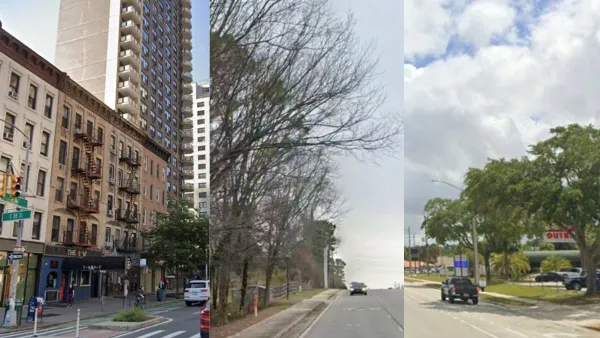
A Transect of sprawl
A development pattern this lifestyle-defining deserves its whole own classification system.

What the fall of earth's largest pre-industrial city can teach us about urban sprawl
Angkor was a low-density metropolis. It lasted six centuries, until it could no longer maintain its infrastructure in a changing climate. Today, it offers planners a sobering warning about the risks of dispersed urban living.

Planetizen Federal Action Tracker
A weekly monitor of how Trump’s orders and actions are impacting planners and planning in America.

California plans to bury El Niño’s downpour
If the state plays its cards right, it may be able to store a billion acre-feet of El Niño’s water in aquifers.

Desperate measures: Advocates weigh draining Lake Powell to fill Colorado River
Draining the reservoir could reduce evaporation losses by a couple hundred thousand acre-feet.

California city breaks ground on transit connector
The project includes three mobility hubs and a pedestrian bridge.

After public outcry, Massachusetts city releases housing development tracker
Cambridge’s tracker currently shows 250 housing projects in various stages of development.

40 years after approval, Chicago breaks ground on new park
The park honors Jean Baptiste Point du Sable, the city’s first permanent non-native settler.

FREE Course: Walkable City 1: Why Walkability?
After describing his path towards focusing on walkability as the essence of good planning, Jeff Speck marches through his five principal reasons for making more walkable places.
Reinventing Malls: Planning Alchemy—Turning Gray Fields Into Gold
The course focuses on the opportunities and imperatives that shape reinvention of mall sites.

City of Rosemead
Rutgers University, Edward J. Bloustein School of Planning and Public Policy
One Hundred Miles
Hunter College, City University of New York (CUNY)
The Architects Foundation
University of Cincinnati Online
City of Cambridge
Montrose County
The Pocatello Development Authority