Making roads safe for all users takes policy and cultural changes that go beyond small behavioral interventions.


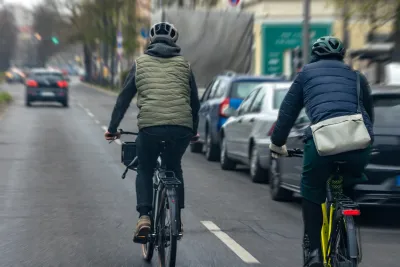
In a guest op-ed in Streetsblog Chicago, Chris Ridgeway argues that, in the wake of the deaths of two transportation planners while biking, admonishing drivers to use the "Dutch reach" when they exit their car into a bike lane is a misplaced effort that doesn't address the root of road safety issues.
Ridgeway writes that making roads safer requires broader policy and cultural shifts. "On-street bike infrastructure is more than just cyclist protection: it also serves as a visible part of the cultural shift. Design researcher Don Norman would call these affordances—the physical environments that, if designed properly, human psychology understands how to use without instruction. From doorknobs to protected bike lanes, humans need to perceive possibility before action."
Summarizing his arguments, Ridgeway reminds the reader that the Netherlands is safe for cyclists for myriad reasons, the "Dutch reach" being just one small tool in a much larger toolbox.
Read the full story: The “Dutch Reach” is not the answer to Chicago’s bike safety problems

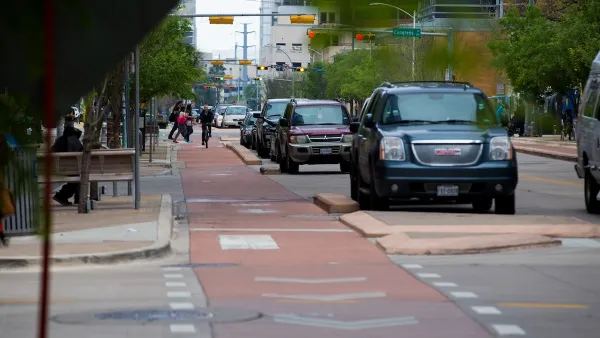
Austin Outlaws Blocking Bike Lanes
Drivers who park in bike lanes will receive citations of up to $300.
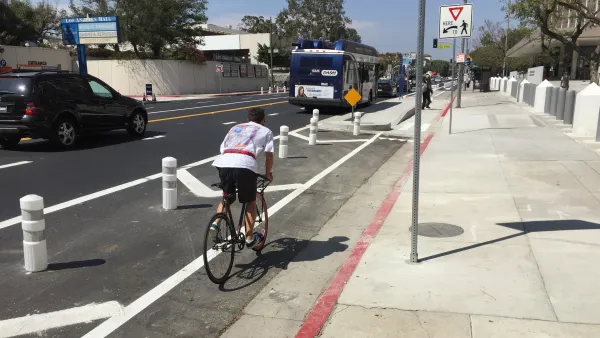
Less Paint, More Barriers, Make for Better Urban Cycling
New research from the University of Colorado Denver and the University of New Mexico sheds light on how to make cities safer for cyclists and other road users and refutes some assumptions about bike safety, such as "safety-in-numbers."

Lawsuit Delays DC Bike Lane Closure Until at Least April
Crashes on 15th Street dropped by 46% since the bike lanes were added.

Planetizen Federal Action Tracker
A weekly monitor of how Trump’s orders and actions are impacting planners and planning in America.

Chicago breaks ground on $3 billion megadevelopment
The new neighborhood, titled Foundry Park, will one day host 3,700 residences.

Denver is solving homelessness. Why aren't the rest of us?
Since 2023, Denver's street homeless population has decreased by 64%, proving that effective tools exist to support those in need of housing.

LA accused of breaching $1.4 billion sidewalk repair settlement
The city faces a backlog of nearly 5,000 street repair requests.

MTA kicks off six-year, $1 billion transit upgrade project
The authority is replacing the roughly 90-year-old train signals on the A and C line with modern technology.

Developers may expand largest gas pipeline network in Northwest
Pipeline giant Williams has proposed new expansions for its Northwest Pipeline from the Colorado Rockies through Idaho, Oregon and Washington.

FREE Course: Walkable City 1: Why Walkability?
After describing his path towards focusing on walkability as the essence of good planning, Jeff Speck marches through his five principal reasons for making more walkable places.
Reinventing Malls: Planning Alchemy—Turning Gray Fields Into Gold
The course focuses on the opportunities and imperatives that shape reinvention of mall sites.

City of Rosemead
Rutgers University, Edward J. Bloustein School of Planning and Public Policy
One Hundred Miles
The Architects Foundation
University of Cincinnati Online
Montrose County
Northern Illinois Transit Authority (NITA)
The Pocatello Development Authority