Pipeline giant Williams has proposed new expansions for its Northwest Pipeline from the Colorado Rockies through Idaho, Oregon and Washington.


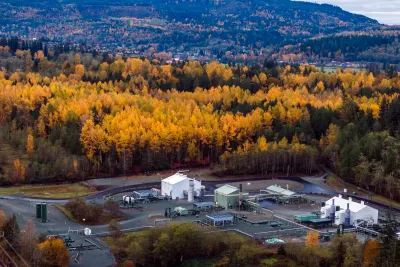
The Oklahoma-based company that owns one of the largest gas pipeline networks in the Northwest is beginning to pursue permits to expand that network, and to pump more gas to the region to meet rising electricity demand.
Pipeline company Williams, owner of the 4,000-mile long Northwest Pipeline system that brings fracked gas from Rocky Mountain states to Idaho, Washington and Oregon, last month submitted to the Federal Energy Regulatory Commission paperwork to build a new pipeline called the Silver Spur between two existing gas transmission lines in Idaho and Nevada. The news was first reported by the nonprofit gas industry watchdog group Oil and Gas Watch.
If approved, the 88-mile pipeline would carry up to 275 million additional standard cubic feet of natural gas per day to the Northwest, while states like Oregon and Washington simultaneously try to drive down gas consumption through policies and pollution caps meant to slow the growing threat of climate change. Environmental advocates say Williams’ claims that the pipeline is meant to meet overall demand for electricity growing in the region masks that the demand is being driven almost entirely by data centers.
The Hood River-based nonprofit environmental organization is raising alarms about the proposed expansion with state officials and earlier this year led 20 organizations in calling on Washington and Oregon leaders to block fossil fuel expansion in the region.
Two analyses from Columbia Riverkeeper and the Seattle-based think tank Sightline Institute show that a growing number of Northwest utility companies are spending on new gas-powered energy infrastructure or buying gas-powered energy from other states to power new demand coming almost exclusively from data centers.
A recent analysis by ECOnorthwest found data centers today are responsible for nearly one-quarter of all power consumption in Oregon.
A spokesperson for Williams on Thursday said the company does not disclose information about its customers, and that analyses show the Northwest will continue to need natural gas and more of it.
“Natural gas remains a critical part of maintaining reliability as renewable energy and demand continues to grow,” they wrote.
As part of the permitting process, FERC and other federal agencies will review the Silver Spur project, and eventually hold public meetings and comment periods. The company has said in interviews it plans to complete the pipeline in 2030.
The pipeline expansion would be significantly more than the 150 million cubic feet per day that Canadian pipeline company TC Energy was approved to add to its Gas Transmission Northwest Express pipeline in 2023, and that got major pushback from the region’s Democratic leaders, including U.S. Sens. Ron Wyden and Jeff Merkley of Oregon and then-Gov. Jay Inslee of Washington.
A spokesperson for Wyden said he was not able to comment Wednesday while the senator was in Bend following the school shooting at Silver Rail Elementary, and a spokesperson for Merkley did not respond to a request for comment Wednesday afternoon.
Silver Spur is one part of Williams’ proposed larger Rockies Columbia Connector system, which would eventually include a nearly 160-mile pipeline expansion along the Washington side of the Columbia River, and another 137-mile pipeline called Valley Trail, in eastern Washington’s Grant County and the state’s data center hub in Quincy, according to reportingfrom The Seattle Times.
Williams has not yet filed for permits for the Rockies Columbia Connector or the Valley Trail pipelines, but altogether the expansion could bring nearly 1 billion cubic feet more natural gas to the region per day. The company has said it hopes to have the Rockies Columbia Connector complete by late 2030.
In a March earnings call, company executives described the projects as part of one of the largest gas pipeline expansions in the Northwest in more than two decades.
Read the full story: Largest gas pipeline network in Northwest could grow as Oklahoma-based owners pursue expansion

Developers sue Mississippi landowners who object to pipeline through their land
Because the Federal Energy Regulatory Commission approved the pipeline project, the developer can use private land without the consent of the owner.
Gas Pipelines Through Neighborhoods Are A Difficult Proposition
Fort Worth, Texas officials try to tackle the thorny issue of gas pipelines snaking through residential neighborhoods.

A gas leak in NYC is costing residents $300 million
More than 90% of NYC’s electricity is from natural gas. About 2% of that gas is leaking and escaping into the air.

Planetizen Federal Action Tracker
A weekly monitor of how Trump’s orders and actions are impacting planners and planning in America.

Chicago breaks ground on $3 billion megadevelopment
The new neighborhood, titled Foundry Park, will one day host 3,700 residences.

Denver is solving homelessness. Why aren't the rest of us?
Since 2023, Denver's street homeless population has decreased by 64%, proving that effective tools exist to support those in need of housing.

MTA kicks off six-year, $1 billion transit upgrade project
The authority is replacing the roughly 90-year-old train signals on the A and C line with modern technology.

Developers may expand largest gas pipeline network in Northwest
Pipeline giant Williams has proposed new expansions for its Northwest Pipeline from the Colorado Rockies through Idaho, Oregon and Washington.

MBTA is using AI to catch drivers who park illegally
The transit agency is working in partnership with Hayden AI, and hopes the technology will improve transit safety across its network.

FREE Course: Walkable City 1: Why Walkability?
After describing his path towards focusing on walkability as the essence of good planning, Jeff Speck marches through his five principal reasons for making more walkable places.
Reinventing Malls: Planning Alchemy—Turning Gray Fields Into Gold
The course focuses on the opportunities and imperatives that shape reinvention of mall sites.

City of Rosemead
Rutgers University, Edward J. Bloustein School of Planning and Public Policy
One Hundred Miles
The Architects Foundation
University of Cincinnati Online
Montrose County
Northern Illinois Transit Authority (NITA)
The Pocatello Development Authority