Wherever you're going (or staying) this summer, here are some suggestions for books to bring along.


This review is part of a special collaboration between Planetizen and Booked on Planning, a biweekly podcast where AICP planners Stephanie Rouse and Jennifer Hiatt chat with authors of the latest books shaping urban planning today. Listen to the episode with today’s author in the player below.
Whether you are headed on a long trip, day at the beach or a staycation this summer, make sure to pack a good book (or two) to pass the time. With so many great urban planning and design books coming out every month, it’s hard to narrow down the list. Here are 10 great summer reads you should consider covering a wide variety of topics, from affordable housing and transportation to gentrification and community engagement.
-
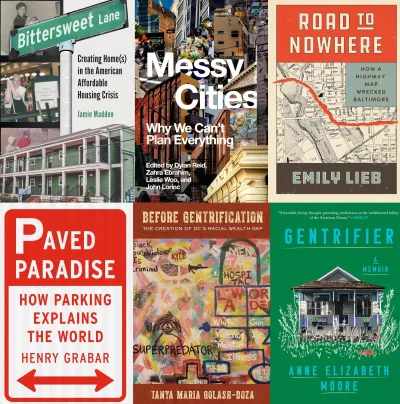
Road to Nowhere by Emily Lieb
Cities rarely break all at once; more often they fray through policy choices that seem technical, neutral, even benevolent. Historian Emily Lieb traces how Baltimore’s "Road to Nowhere," which never reached a ribbon-cutting, still carved deep wounds into Rosemont, a Black middle-class neighborhood. The damage began with a pencil stroke: A highway alignment shifted in the late 1950s to run through Rosemont just as school board actions accelerated racial transition. That line chilled mortgages, repairs and sales of homes, turning sturdy daylight rowhouses into liabilities. The lesson is stark for planners, engineers and civic leaders: A plan can harm even when no bulldozer rolls, because markets and institutions react to expectations and uncertainty.
-
Messy Cities: Why We Can’t Plan Everything by Zahra Ebrahim, Dylan Reid, John Lorinc, Leslie Woo
"Messy Cities" offers a series of essays organized by topic, making it a great book to take on a road trip and read between activities. The essays explore the multifaceted concept of messiness in urban environments, challenging our typical notions of order and chaos. The editors aim to provide diverse perspectives on urban messiness, bringing together voices not typically highlighted in urban design discourse. Through exploration of cities like Toronto, Mexico City and Tokyo, the book redefines mess not as something negative but as an opportunity for inclusivity and connection.
Part memoir and part educational guide (one reason this is such a great summer read), the book offers a rare look at the housing crisis from someone who grew up in affordable housing and now spends his career building it. Madden’s unique background allows him to bridge the gap between resident needs and developer realities. He emphasizes that successful housing requires understanding the "chain of consequences" behind every decision — from laundry room placement to the complex certification processes residents must navigate. He also reflects on the wisdom of his late mentor, MIT Professor Tunney Lee, who taught that planning is a reactionary force, not a driving one. Madden argues that planners must acknowledge the history of a place — who lived there, why they left and the prejudices that often shape interventions — to create truly impactful housing.
-
Paved Paradise: How Parking Explains the World by Henry Grabar
Parking sounds mundane until you realize that it acts like an operating system for the modern city. Journalist and author Henry Grabar traces how a space designed for storing cars came to shape housing, transit, budgets, safety, climate resilience and even what kinds of buildings are legal to construct. From early street management to mid‑century mandates, parking policy filters into everything residents notice: congestion, taxes, where businesses thrive and whether a neighborhood feels walkable. Grabar takes a topic overlooked by most and makes it fascinating, weaving in stories that tie parking garages to mob activity, making this a great book to take on your summer travels.
-
Before Gentrification: The Creation of DC's Racial Wealth Gap by Tanya Maria Golash-Boza
"Before Gentrification" challenges the common misconception that the racial wealth gap in Washington D.C. primarily stems from Black families' inability to access homeownership. The critical factor that prevents wealth building wasn't lack of property ownership but rather systemic disinvestment in Black neighborhoods after white residents departed. Through meticulous research and her personal connection to the city where she grew up, Golash-Boza presents a more nuanced understanding of how systematic disinvestment and federal policies created and perpetuated racial wealth disparities that continue to shape the nation's capital today. More than an outside look into the issues, the book includes stories of families Golash-Boza knew that were impacted by gentrification and the ramifications it has had through generations.
-
Gentrifier: a memoir by Anne Elizabeth Moore
An easy-to-read book to add to your summer reading list, "Gentrifier" is a memoir offering a uniquely personal window into the process of gentrification, chronicling author Anne Elizabeth Moore’s experience after winning a "free house" in Detroit through a writer’s residency program. What initially seemed like a dream opportunity quickly unraveled into a web of ethical dilemmas, institutional failures and the real human cost of housing policies. What makes "Gentrifier" so valuable is how it reminds us that urban planning isn’t just about policy papers and zoning — it’s about real people’s lives. Moore’s story forces us to confront uncomfortable questions about who benefits from "revitalization" and whose voices are silenced in the process. As cities across America grapple with housing crises, her experience provides a crucial perspective on how seemingly well-intentioned programs can perpetuate harm when they fail to address underlying systemic issues.
-
Meet Me by the Fountain: An Inside History of the Mall by Alexandra Lange
"Meet Me by the Fountain" is an exploration of the mall as both a physical structure and a cultural phenomenon, providing unexpected insights into how we might better design our communities. This nostalgic walk down memory lane offers stories of the mall’s origins: how its name derived from the Italian lawn game "Palla Maglio" (similar to bocce and croquet), which became "Pall Mall" in 18th century London, and finally just "Mall" in mid-century America. One of Lange’s most compelling arguments challenges the assumption that online shopping killed the mall. She identifies three key factors in mall decline: online shopping, the 2008 recession devastating anchor department stores and simple oversaturation. As we reimagine our suburbs, downtown districts and community gathering spaces, the humble mall — often dismissed by architects and planners, myself included, as beneath serious consideration — offers surprisingly relevant insights into human behavior and social needs.
-
Second Order Preservation by Erica Avrami
Historic preservation has long followed a binary approach: Is a building historically significant enough to be listed, or isn’t it? This seemingly simple question forms the foundation of preservation policy across the United States and has shaped our built environment for decades. But what if this framework is fundamentally limiting our ability to create a more just, sustainable and representative society? This is the provocative question at the heart of Erica Avrami’s groundbreaking book, "Second Order Preservation: Social Justice and Climate Action Through Heritage Policy." As we face escalating climate impacts and continue to reckon with issues of social justice, preservation stands at a crossroads. By embracing second order thinking — considering who benefits, who is burdened, and what broader outcomes we seek — preservation can become a more powerful tool for creating communities that are not just historically rich, but equitable, sustainable and resilient for generations to come.
-
Killed by a Traffic Engineer: Shattering the Delusion that Science Underlies Our Transportation System by Wes Marshall
If you are looking for a summer read that is both informative and witty, using pop culture to lighten a topic that can range from technical to emotional, look no further than "Killed by a Traffic Engineer." Traffic engineering has a somewhat false image as a field that has been around forever, and that all the manuals and guidance are steeped in centuries of research and practice. In fact, the field is barely one hundred years old, and much of it is founded on questionable research. Marshall points this out over the course of eighty-eight short chapters, shattering the illusion that traffic engineering is as methodical as it seems. Marshall is not implying that traffic engineers are maliciously killing road users, but that the underlying foundations of traffic engineering have made it a deadly form of transportation planning.
-
The Cities We Need: Essential Stories of Everyday Places by Gabrielle Bendiner-Viani
This may not be the best book to carry to the beach, but the beautifully designed book is worthy of your summer reading list. Bendiner-Viani introduces the concept of "place work" and offers insights into how everyday spaces shape our communities and individual identities. Bendiner-Viani’s work, which spans decades, began with a simple question: What places matter to people in their neighborhoods? Rather than photographing neighborhoods from her perspective alone, she invited residents to give her tours, showing her the places that held meaning for them. This approach revealed something powerful — that places we might overlook as outsiders often contain rich histories and social significance for community members. "The Cities We Need" documents these tours and the lessons they provide for planners.

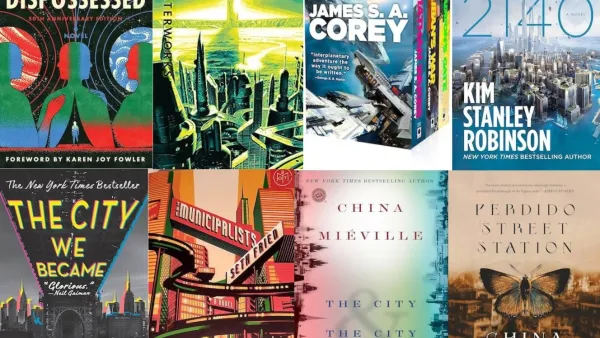
Eight Sci-Fi Books That Teach Urbanists the Dos and Don’ts of the Future
Science fiction has long painted a picture of the city of the future. What if it’s our roadmap out of dystopia?
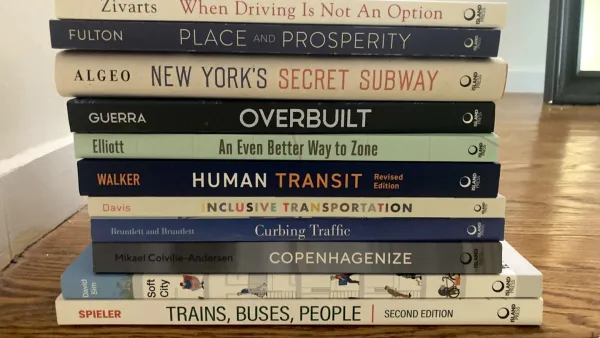
Publishing for Planners: A New Era for Island Press
As the legendary legacy publisher transitions into a new life phase, publisher Heather Boyer and senior editor Stacy Eisenstark reflect on the past and the future of creating books for planners.
Planetizen’s Top Urban Planning Books of 2024
Top of mind in 2024 were the far-reaching impacts of climate displacement, zoning as a solution to the housing crisis, and the potential for safer roads and better public transit in American cities.

Planetizen Federal Action Tracker
A weekly monitor of how Trump’s orders and actions are impacting planners and planning in America.

Amtrak, CN end decades-long dispute with eight-year agreement
The new operating agreement establishes an updated framework for the companies to work together, including processes to resolve disputes.

Northwest rail fans eager for Sept. 30 debut of Amtrak’s Airo fleet
Get ready for that new train smell and more seats. But they won’t go faster or run more frequently on the Cascades route in Washington and Oregon.

Brightline Florida files for bankruptcy
The transit company is over $5 billion in debt.

St. Louis Metro to test if single-car trains can reduce operating costs, maintain rider satisfaction
The pilot program will run from October to spring 2027, and begin with one single-car train operating on Metrolink’s Red and Blue lines.

Pennsylvania is building data centers in abandoned mines
Housing data centers in mines provides an alternative to destroying local forests and may spare residents from data centers’ noise and air pollution.

FREE Course: Walkable City 1: Why Walkability?
After describing his path towards focusing on walkability as the essence of good planning, Jeff Speck marches through his five principal reasons for making more walkable places.
Reinventing Malls: Planning Alchemy—Turning Gray Fields Into Gold
The course focuses on the opportunities and imperatives that shape reinvention of mall sites.

City of Thousand Oaks
City of Wisconsin Rapids
Harvard University Graduate School of Design
The Architects Foundation
University of Cincinnati Online
The Pocatello Development Authority
The Urban Renewal Agency of the City of Pocatello

