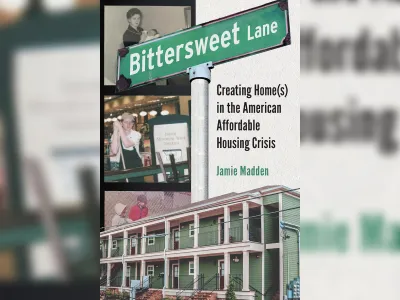
Book Review: In “Bittersweet Lane: Creating Home(s) in the American Affordable Housing Crisis,” affordable housing developer Jamie Madden blends memoir with a manifesto for a new era of affordable housing in America.



This review is part of a special collaboration between Planetizen and Booked on Planning, a biweekly podcast where AICP planners Stephanie Rouse and Jennifer Hiatt chat with authors of the latest books shaping urban planning today. Listen to the episode with today’s author in the player below.
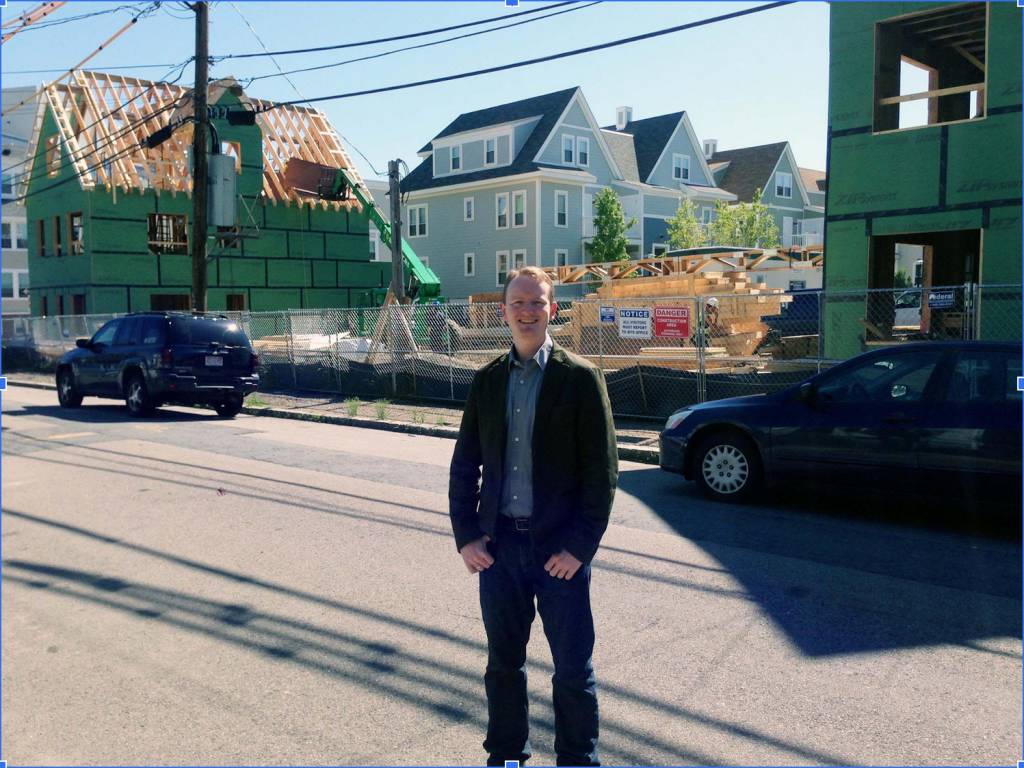
Author and affordable housing developer Jamie Madden grew up in the Bittersweet Lane Apartments, a Massachusetts Chapter 40B, SHARP, and 221(d)(3) financed, private affordable housing development in Randolph, MA. In his new book, Jamie demonstrates all the ways that affordable housing projects must navigate this mindboggling alphabet soup to make projects viable by stacking dozens of funding sources together.
The book is part memoir, part education on affordable housing in America and a really interesting read. In Jaime’s words: “This book is about how we create homes, once we’ve decided to. It’s a book about how we lose homes, because we haven’t. This book is about what affordable housing is, how we build it, and the things we’ve tried in the past.” Alongside childhood stories of his family’s struggle to find and retain housing they could afford on his single mom’s wages are demonstrations of what this means in terms of housing policy at the local, state, and national level.
Reframing perspectives is woven throughout the book, from understanding what it’s like to live one incident away from homelessness to seeing how we value our community members based on what we fund. For example, the potential cost of housing someone in an affordable housing project making slightly higher than the maximum stated income is not nearly as high as the cost to the public of ensuring strict compliance. It’s also well documented that housing individuals in shelters, extended hospital stays, or in jail is much more expensive than subsidizing their housing in an apartment or other housing development.
By Jaime’s account, a one-time investment of $260 billion would cover the projected existing unhoused households and a $266.4 billion annual investment in universal housing vouchers would maintain a functional end to homelessness. Phasing out the Home Mortgage Interest Deduction would provide about $30 billion in savings to achieve this investment.
While not an exhaustive analysis of how to fix our broken housing system, Jaime leaves readers with a few paths to improve it ranging from implementing an unearned wealth tax to “end[ing] zoning as we know it.” Other great books dive deep into the ladder approach, including “The Color of Law” by Richard Rothstein and “Arbitrary Lines” by M. Nolan Gray. As Jamie points out “zoning takes from the young, from people who move, and from impoverished people for the benefit of capital investors and older, weather owners through artificially high rents and artificially high sales price appreciation.” More needs to be done to make it easier to build more housing, and especially more affordable housing.

Review: "An Even Better Way to Zone"
Don Elliot’s sophisticated and much-anticipated follow up to "A Better Way to Zone" tackles equity, affordability and provides a better blueprint from theory to application.
To upzone or not to upzone? Two views on the housing crisis
Allowing more density can increase the housing supply, but does the attendant rise in land prices cancel out the benefits?
Controversial Texas housing law has 'directly facilitated' over 1,250 new homes
SB 840 allows developers to build multifamily housing by-right on lots zoned for commercial use without applying to a zoning change.

Planetizen Federal Action Tracker
A weekly monitor of how Trump’s orders and actions are impacting planners and planning in America.

The state-sanctioned urbicide of Austin
People don’t kill cities. Freeways do.

US to reduce Colorado River water deliveries to Mexico
A new Colorado Treaty amendment reduces Mexico’s Colorado River water allocation by 250,000 acre feet.

5 New England states march closer to 800 megawatt wind energy project
Securing federal approval for the project may be complicated under the Trump administration, which has historically been hostile towards domestic wind power.

Baltimore to break ground on $50 million Transit Priority Project
The project will bring faster bus trips, safer streets and better bike connections to Baltimore.

Airbnb launches $250 million 'last-dollar financing' housing accelerator, makes first investment in Austin
The company will put $6.4 million towards affordable housing development in Texas’ capital.

FREE Course: Walkable City 1: Why Walkability?
After describing his path towards focusing on walkability as the essence of good planning, Jeff Speck marches through his five principal reasons for making more walkable places.
Reinventing Malls: Planning Alchemy—Turning Gray Fields Into Gold
The course focuses on the opportunities and imperatives that shape reinvention of mall sites.

Eagle County Government
Harvard University Graduate School of Design
Nashville Planning Department
The Architects Foundation
University of Cincinnati Online
The Pocatello Development Authority
The Urban Renewal Agency of the City of Pocatello
Journal of the American Planning Association

