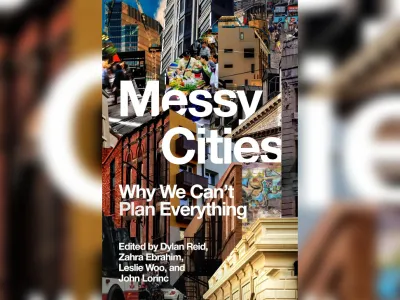
In “Messy Cities: Why We Can’t Plan Everything” 43 writers from around the world sing the praises the gentle chaos that exemplifies a thriving metropolis.



This review is part of a special collaboration between Planetizen and Booked on Planning, a biweekly podcast where AICP planners Stephanie Rouse and Jennifer Hiatt chat with authors of the latest books shaping urban planning today. Listen to the episode with today’s author in the player below.
In an era of hyper-curated smart cities and glass-tower developments that look the same from Dubai to Denver, “Messy Cities: Why We Can’t Plan Everything” arrives like a breath of fresh, slightly chaotic air. Throughout its 42 essays, it provides a multifaceted defense of the unplanned elements that actually make urban life worth living.
Rather than viewing urban mess such as graffiti, makeshift kiosks, unkempt parks, or the jumble of old signage as a problem to be solved, each contributor argues that these are the vital signs of a city’s pulse. The book serves as a necessary corrective to the sterile city syndrome. It reminds us that when we over-sanitize our surroundings, we often scrub away the very diversity and spontaneity that foster community.
The book editors break the essays out into six categories - Reflections, Localities, Ecologies, Built Forms, Global Cities, and Urban systems. The essays in each category lay out their arguments about the superiority of a city designed for and used by its people or in some instances, not designed at all, but left to grow organically.
The editors ask the reader to consider rebranding “messy” and asking questions such as is a meadow messy? If not, why do we consider natural yards in a residential development a mess? Or why do we view Tokyo’s jumble of land uses and signage as interesting, but strictly regulate both in North American cities? Who gets to decide what a mess is? Whose messiness is it anyway?
A messy city is a readable city. A clean city is hard to decipher, hard to get to know. To wander through messy urbanism is to walk through a city that can be negotiated and understood along the way, where details big and small, underground or popular, can be gleaned from the streets themselves.
Shawn Micallef, “Messy Cities”
“Messy Cities” is more than just a book for urban planners; it’s for anyone who has ever felt more at home in a bustling, cluttered neighborhood than in a pristine shopping mall. It’s written with warmth, wit, and a deep affection for the desire lines we carve through the world. This is an essential read for anyone who wants to understand why the most successful neighborhoods are often the ones that the planners forgot to polish. It’s a celebratory, insightful, and deeply human look at the places we call home.


Are cities at risk of losing squirrels?
Book review: A common backyard forager could be in decline, but without the proper data we may not know until it’s too late. Nancy Castaldo’s "Squirrel" urges us to find out.
10 great urban planning summer reads
Wherever you're going (or staying) this summer, here are some suggestions for books to bring along.
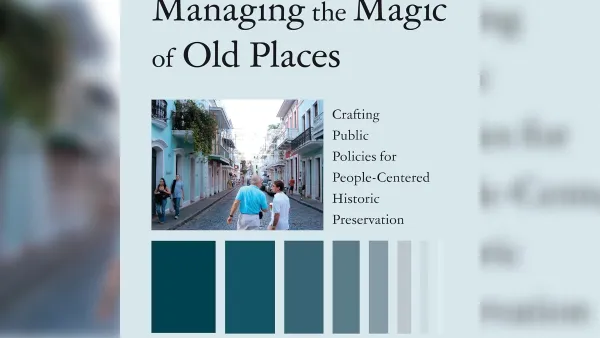
A call for people-centered historic preservation
'Managing the Magic of Old Places' offers a new vision for preservation that maintains its relevance while prioritizing the lived experience of residents of historic places.

Planetizen Federal Action Tracker
A weekly monitor of how Trump’s orders and actions are impacting planners and planning in America.

The state-sanctioned urbicide of Austin
People don’t kill cities. Freeways do.

US to reduce Colorado River water deliveries to Mexico
A new Colorado Treaty amendment reduces Mexico’s Colorado River water allocation by 250,000 acre feet.

5 New England states march closer to 800 megawatt wind energy project
Securing federal approval for the project may be complicated under the Trump administration, which has historically been hostile towards domestic wind power.

Baltimore to break ground on $50 million Transit Priority Project
The project will bring faster bus trips, safer streets and better bike connections to Baltimore.

Airbnb launches $250 million 'last-dollar financing' housing accelerator, makes first investment in Austin
The company will put $6.4 million towards affordable housing development in Texas’ capital.

FREE Course: Walkable City 1: Why Walkability?
After describing his path towards focusing on walkability as the essence of good planning, Jeff Speck marches through his five principal reasons for making more walkable places.
Reinventing Malls: Planning Alchemy—Turning Gray Fields Into Gold
The course focuses on the opportunities and imperatives that shape reinvention of mall sites.

Eagle County Government
Harvard University Graduate School of Design
Nashville Planning Department
The Architects Foundation
University of Cincinnati Online
The Pocatello Development Authority
The Urban Renewal Agency of the City of Pocatello
Journal of the American Planning Association

