Excessive costs of living force many people to work more than optimal hours, leaving less time for family and fun. Local policies that favor affordable housing and transportation increase freedom, opportunity and happiness.




Annual income twenty pounds, annual expenditure nineteen and six, result happiness. Annual income twenty pounds, annual expenditure twenty pounds ought and six, result misery. — Charles Dickens
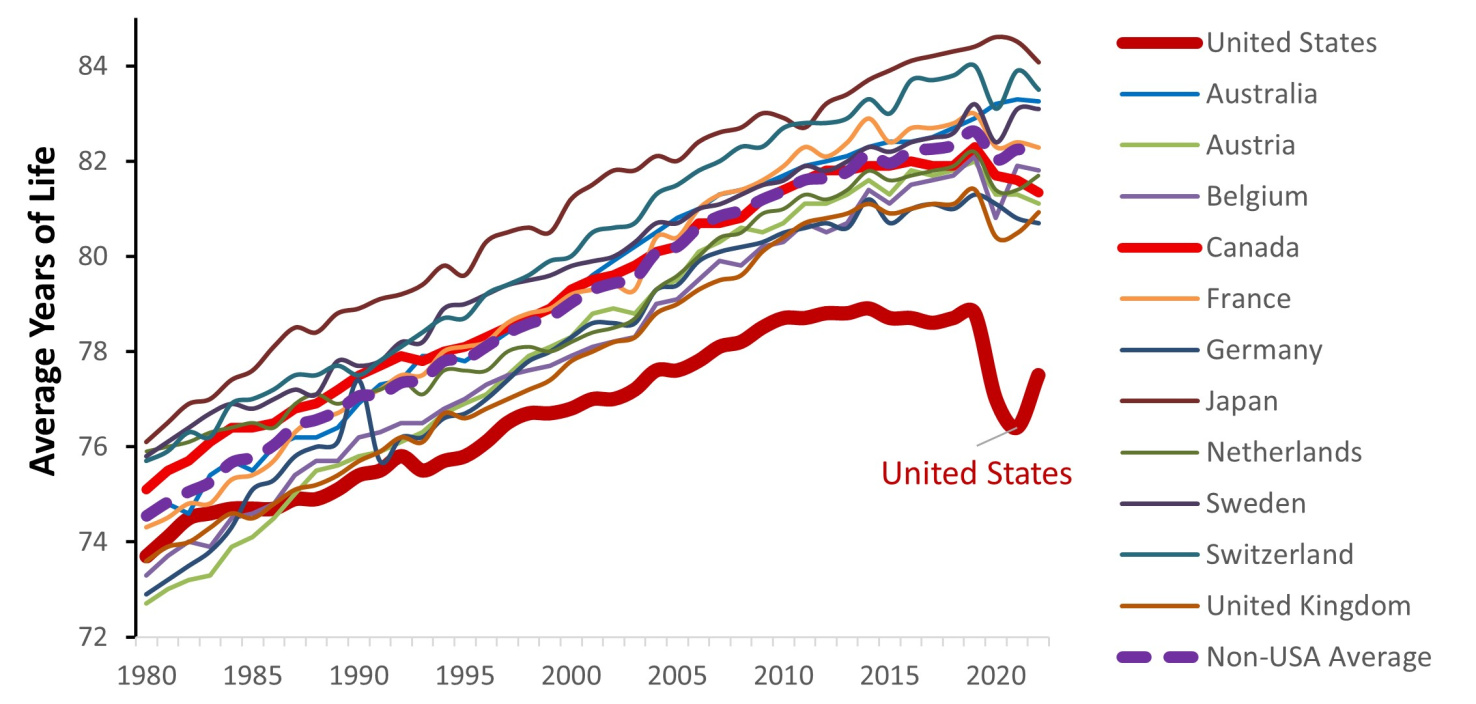
My new study, Live Long and Prosper: Local Policies for Improving Children’s Health, Success and Happiness shows that the United States is inefficient at providing health, opportunity and happiness. Although the United States has higher Gross Domestic Product (an indicator of economic productivity and wealth) than most other countries, Americans have significantly shorter lifespans, less economic mobility and are less happy than people in most peer countries with lower incomes, as illustrated below.
Life expectancy at birth
Life satisfaction vs. linear GDP
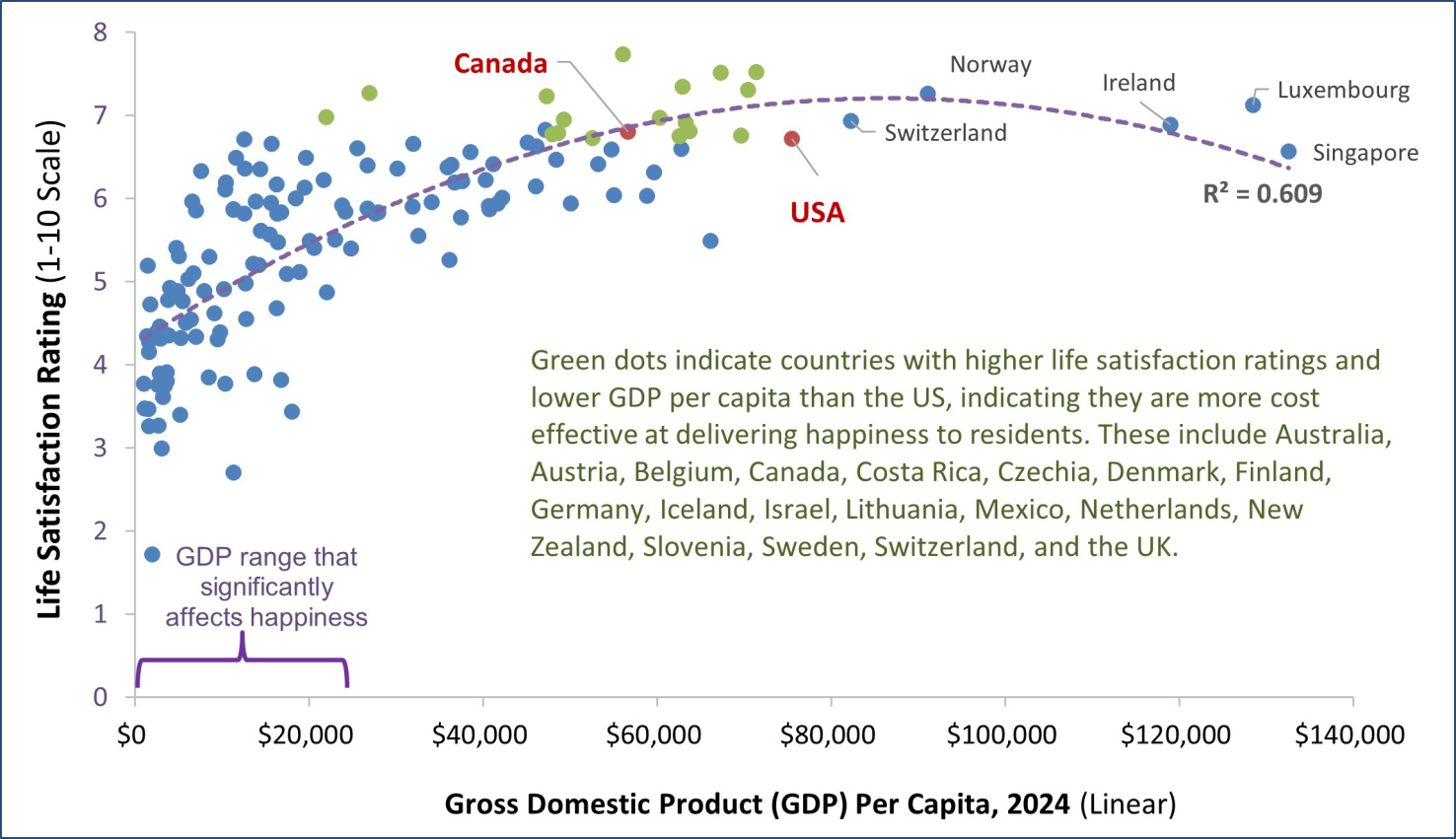
Why? My research suggests that this results to a large degree from local policies that favor expensive housing and transportation over lower cost and healthier alternatives. This ratchets up the cost of living, causing many people to feel inadequate, stressed and to work too much, leaving insufficient time for family and fun.
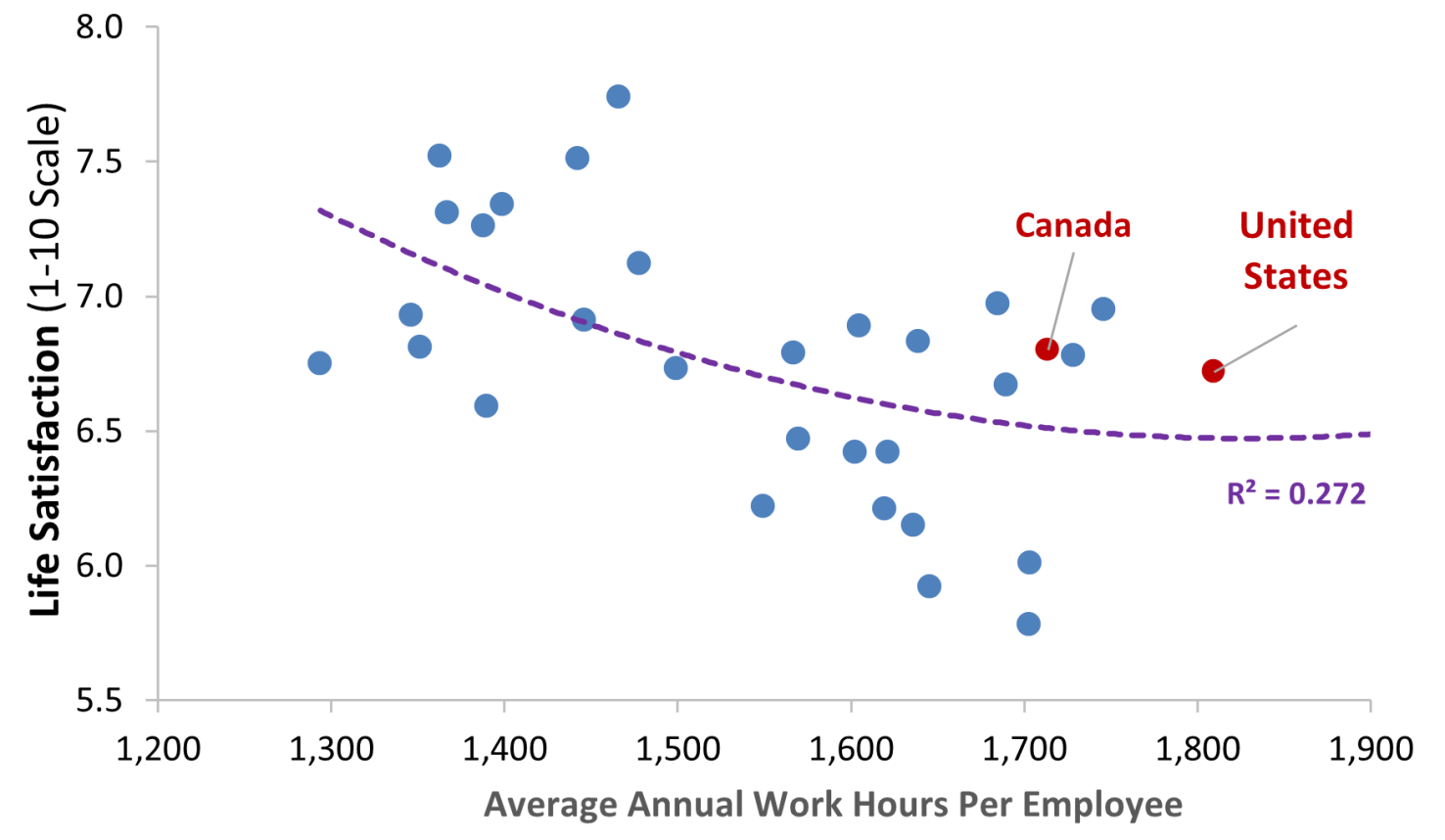
The graph below shows the negative relationship between life satisfaction and working hours. The United States and Canada have high working hours which helps explain their relatively low life satisfaction relative to income: people work more than is optimal. This is not to deny that many of us, particularly professionals with control over our working conditions, find work satisfying, but many workers have less satisfying jobs and long work hours, indicating a competitive, materialistic society that overvalues income relative to quality of life factors. We need a new approach that maximizes happiness.
Life satisfaction vs. average annual work hours
An affordability perspective inverts the conventional perspective. It assumes that the goal is to maximize the health and happiness achieved per dollar of spending. This has important implications; it means that policies should strive to minimize household costs in order to maximize residents’ quality of life. Let’s investigate.
An internet search for “What does it cost to raise a family in America?” finds various estimates including $113,101 by MIT’s Living Wage Calculator, $132,400 from the Urban Institute’s Measuring the True Cost of Economic Security, and $104,658 for Ohio (a typical state) by the Smart Assets investment corporation. These estimates assume that families live in suburbs where every adult needs a personal vehicle, homes need multi-car garages, parents work full time and need paid childcare, and households directly bear substantial healthcare and retirement savings costs. These estimates are based on household expenditure survey data which treats average household spending levels as minimum requirements, ignoring wasteful purchases. For example, average U.S. households spend almost two thousand dollars annually on tobacco, alcohol and gambling; it is ridiculous to consider such expenditures necessities.
The following figure compares household incomes with sprawl-based estimates of minimum costs of living for a family of four.
Annual incomes and estimated family costs

Many families earn less than what experts claim is needed, leaving them feeling inadequate and stressed. Expensive housing and transportation also increase financial risks. In automobile dependency communities, many hard-luck stories begin with a vehicle failure, crash or traffic citation that cascades into debt and legal problems; this explains why home foreclosure rates are higher in sprawled areas.
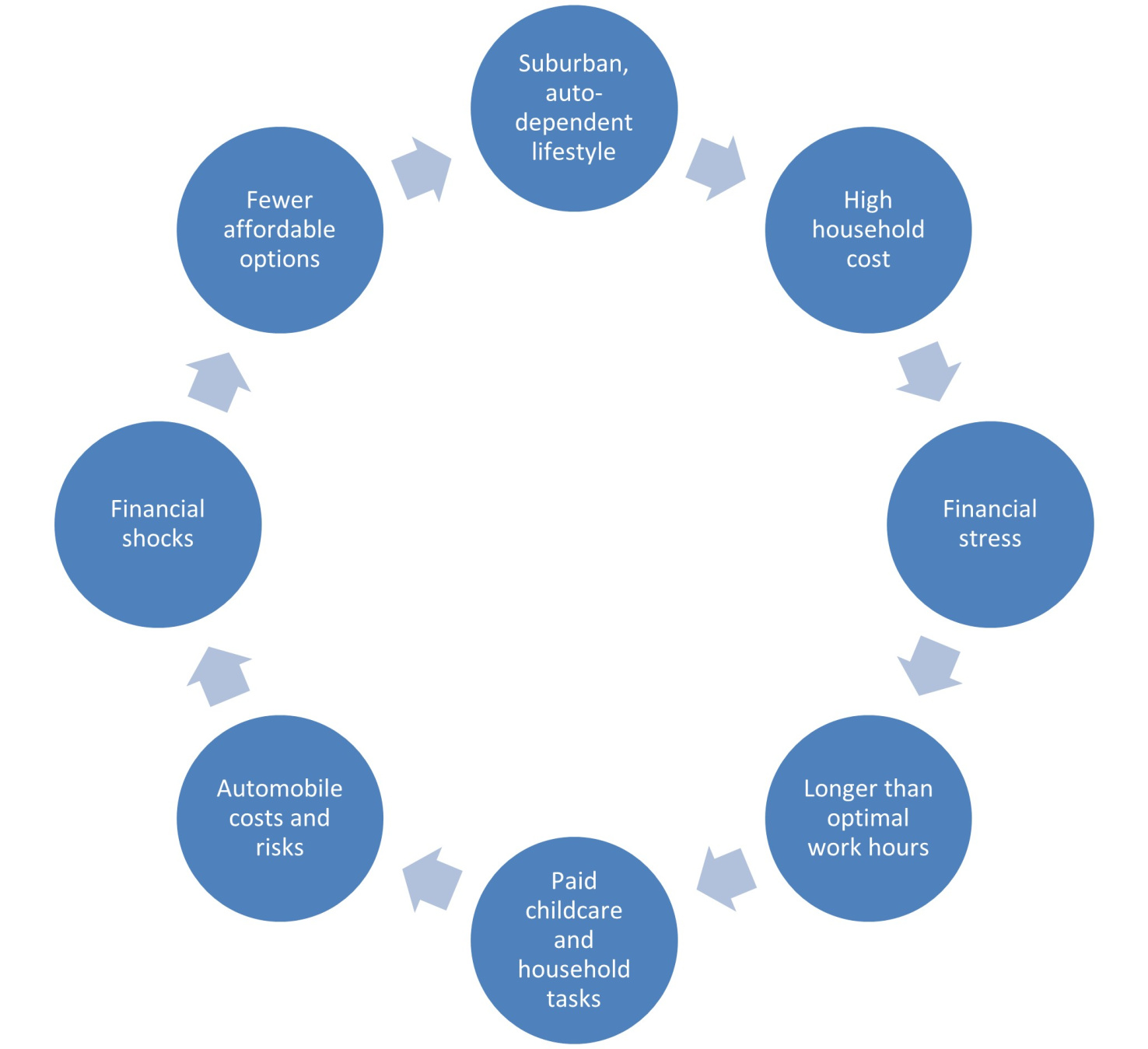
High living costs increase financial stress, which causes many parents to work harder than is optimal, leaving insufficient time for family. This creates a rat race in which responsible parents work more than optimal hours to pay for expensive cars for commuting, childcare and high taxes, as illustrated below.
Rat race cycle
Experts have various reasons to exaggerate the costs of living. Investment firms want to encourage households to maximize their incomes, savings and investments. Advocacy organizations like the Urban Institute and the Economic Policy Institute want to encourage governments to provide more financial support to families. They all reflect a consumerist perspective which assumes that people’s health, success and happiness depend primarily on the goods they can purchase and therefore their incomes. It implies that children need homes with private yards and cars for every parent, with all the ancillary costs involved, so lower-income parents are irresponsible. It also perpetuates the myth that cities are dangerous and suburbs are safe. The result is fearmongering that reinforces automobile dependency and sprawl.
In contrast, an affordability perspective recognizes that once our basic material needs are met – a family has adequate food, healthcare, housing, transportation and clothing – other factors such as our health and safety, control over our time and the quality of our community, friendships and family relationships become more important. Affordability analysis recognizes the inherent economic efficiencies and potential savings of cities. New research indicates that well-planned urban neighborhoods also provide more safety, health and economic opportunities than conventional sprawl.
This challenges consumerist narratives. For example, many children would be better off if their parents worked less so they had more time for child-raising, even if this reduced their incomes and so required lower-cost homes and travel options. Affordability policies allow families to choose the lifestyle they prefer, which often improves health, opportunity and happiness.
The graph below compares the Urban Institute study’s cost of living estimates, which reflect conventional sprawl-based housing and transportation, with the lower costs achievable with affordability-based policies. For example, the Urban Institute assumes that every parent needs a personal vehicle, so transportation costs total $16,000 per year and homes need multicar garages. Affordability analysis assumes that families living in compact, multimodal neighborhoods only need one car, cutting transportation costs in half, or can become car-free, reducing annual transportation costs to just $4,000, and that attached housing (townhouses) with unbundled parking can reduce housing costs by 20%, and multifamily housing with no garage reduces housing expenses by 40%. It also assumes that lower household incomes qualify families for lower health insurance premiums, that these savings allow parents to work fewer hours which reduces childcare costs, and that they provide proportional reductions in taxes and retirement savings requirements.
Potential savings from affordability policies
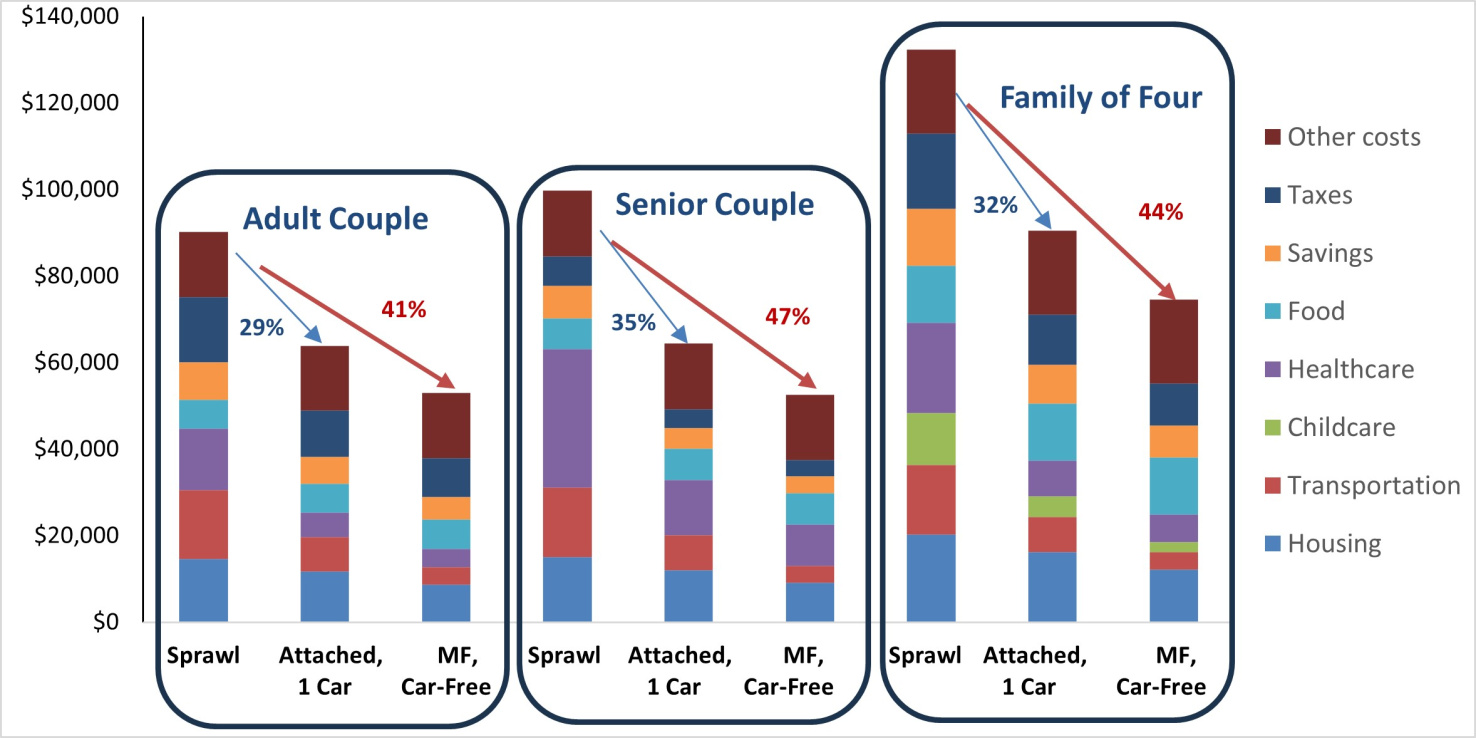
This analysis does not include other potential savings and benefits provided by reduced working hours, such as more home cooking instead of commercially prepared meals and more DIY home and garden maintenance. That parents can reduce childcare costs by working less does not require traditional domestic roles with full-time working fathers and stay-at-home mothers; it can involve working mothers and stay-at-home fathers, two part-time parents, and childcaring cooperatives in which parents pay with time rather than money.
Improving affordability increases families’ economic resilience, their ability to respond effectively to financial shocks such as higher expenses or lower incomes. For example, families in auto-dependent areas often face crises when their vehicles fail or a parent cannot drive, while those in compact, multimodal neighborhoods have convenient and affordable alternatives. Similarly, diverse and affordable housing options allow families to remain in their neighborhood so their children can continue attending the same school, participate in community activities and maintain friendships if their incomes decline or parents experience disability, which is often infeasible in expensive and auto-dependent suburbs.
Affordability provides freedom. It allows people to accept lower paying but more satisfying jobs, to live in preferred but lower wage communities, or to save more money for other priorities. Not all families will take advantage of all potential savings; some people want personal vehicles and single-family homes with garages despite their high costs. Affordability-based planning gives families the freedom to choose their best lifestyles.
I can report from personal experience that living in compact homes in mixed, multimodal neighborhoods provides many benefits. We live in a central walkable neighborhood; we owned a car when our children were young, but it broke down when they were teenagers and we’ve been car-free since. What we’ve saved on vehicle expenses helped finance their university educations and now provides economic freedom. We walk and bike daily, which is healthy and makes us more connected to our neighborhood. It’s a better quality of life.
Contrary to popular beliefs, residents, particularly children in lower-income households, tend to be safer, healthier and more successful in cities compared with suburbs and rural areas. For example, residents of the sprawled communities common in the U.S. have much higher traffic death rates, and are less likely to achieve physical activity and healthy weight targets than if they live in compact, multimodal neighborhoods.
Some readers may be skeptical that multimodal neighborhoods can have the low housing costs assumed in this analysis. Can local affordability policies really provide the low housing and transportation costs assumed in this analysis? Montreal, Canada proves it is possible.
The figure below compares average asking rents for two-bedroom apartments in various Canadian cities converted to U.S. dollars. In Montreal, half of all apartments currently rent for less than US$1,200 per month.
Average monthly rent for two-bedroom apartment
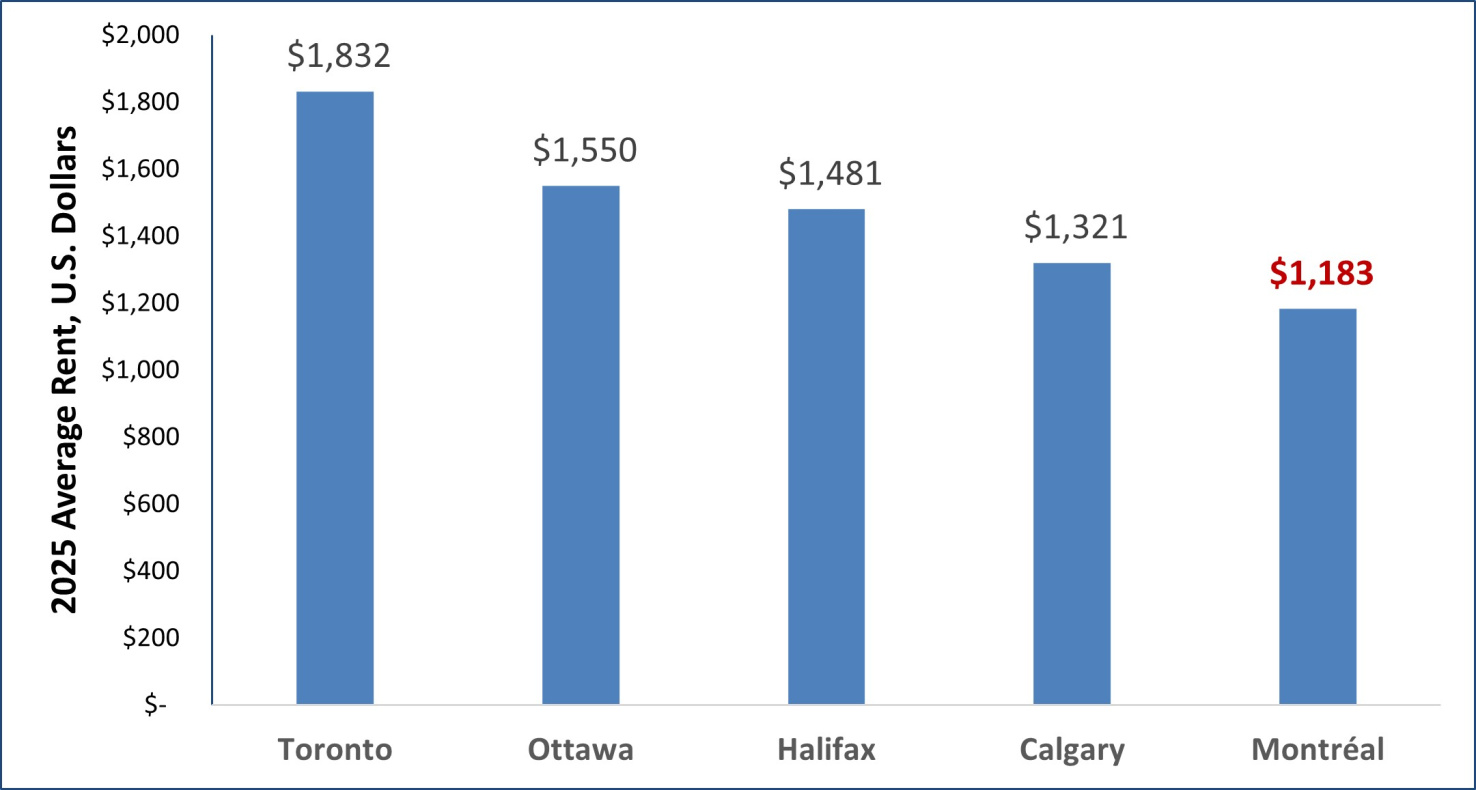
Montreal is affordable because it has long favored compact housing types such as three-decker townhouses and low-rise apartments. About two-thirds of Montreal households live in multifamily housing, twice the proportion in most North American cities. As a result, Montreal neighborhoods are compact, mixed and multimodal, making it easy to live car-free.
There is plenty of evidence that such housing can succeed in other regions. National Association of Realtors surveys find that most families searching for homes prefer living in compact, multimodal neighborhoods. Even in Phoenix, one of America’s most auto-dependent cities, the car-free Culdesac development is popular and financially successful with moderate prices. However, current development policies often fail to maximize affordability. For example, many jurisdictions continue to restrict where multifamily housing can be developed, impose parking minimums that force households to pay for costly garages they don’t need and underinvest in affordable travel modes.
Planners to the rescue! Rather than accepting high living costs as a given, we can show how they are contingent. For example, every time somebody claims that a family of four needs a $132,400 annual income, based on the Urban Institute’s estimate, we can point out that these cost burdens can drop to $90,512 in urban neighborhoods with plenty of townhouses or just $74,581 in a multimodal neighborhoods with abundant apartments, resulting in more health, opportunity and happiness.


Yes, another thing that car dependency makes worse: DUIs
In the land of the free (and the cars), design incites drinking and driving.

Houston More Expensive Than New York? Not So Fast
A recent study claiming that transportation costs in Houston, among other expenses, raise the cost of living almost to the same level as living in New York City. Some took exception to the study's methodology.

Houston Just as Expensive as New York City, Study Says
The extra costs of automobile dependency turn assumptions about affordability on their head, according to a recently published report by the Citizens Budget Commission.

The state-sanctioned urbicide of Austin
People don’t kill cities. Freeways do.

US to reduce Colorado River water deliveries to Mexico
A new Colorado Treaty amendment reduces Mexico’s Colorado River water allocation by 250,000 acre feet.

New Jersey’s second-largest city bans standalone data centers
Jersey City will continue to allow co-location facilities, such as those meant for research institutions that store their own data.

Amtrak not solely to blame for New Jersey commuter rail's unreliability, report finds
A new study from the Garden State Initiative found that NJ Transit’s budget grew 20% across a 4 year period, but reliability declined significantly over the same period.

EPA erases limits on planet-warming pollution from power plants
Under Monday’s plan, power plants would still have some limits on how much mercury, arsenic and other contaminants they can emit.

Phoenix announces new on-demand transit service, more frequent RAPID buses
Both new services will launch in October, and are part of Phoenix's Project Effective Access Solutions for Easing Congestion.

FREE Course: Walkable City 1: Why Walkability?
After describing his path towards focusing on walkability as the essence of good planning, Jeff Speck marches through his five principal reasons for making more walkable places.
Reinventing Malls: Planning Alchemy—Turning Gray Fields Into Gold
The course focuses on the opportunities and imperatives that shape reinvention of mall sites.

Eagle County Government
Harvard University Graduate School of Design
Nashville Planning Department
The Architects Foundation
University of Cincinnati Online
The Pocatello Development Authority
The Urban Renewal Agency of the City of Pocatello
Journal of the American Planning Association

