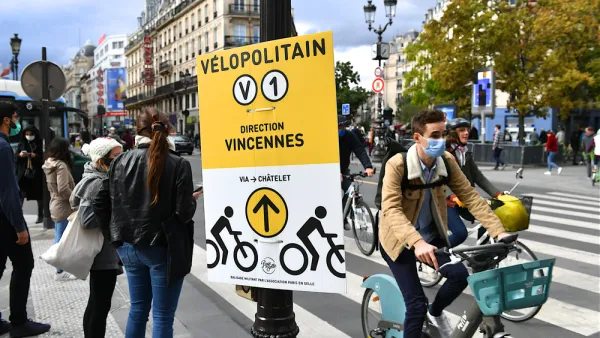
Paris Mayor Anne Hidalgo says the city will develop a plan to close 500 streets to car traffic and add new bike and pedestrian infrastructure after a referendum on the proposal passed with 66 percent of the vote.



Paris is continuing its transformation into a bike-centric city, with the city planning to close 500 streets to car traffic under a referendum supported by roughly two-thirds of voters.
“The plan involves interventions in each of Paris’s 20 arrondissements, with 6 to 8 streets closed per district and an estimated 10,000 parking spots to be removed,” writes Romina Totaro in Domus. The city will replace these areas with green space, bike lanes, and pedestrian infrastructure.
According to the article, the city lags behind other major European cities in tree canopy and green space. Since Mayor Anne Hidalgo took office, the city has aggressively promoted multimodal infrastructure and bike lanes, pledging to become a ‘100 percent cyclable city.’ Thanks in part to the rise in cycling as a mode share, between 2005 and 2024, the city’s air pollution levels (nitrogen dioxide and fine particulate matter) dropped by 50 percent and 55 percent.
FULL STORY: Paris is becoming a car-free city, with 500 streets closed to traffic

Where Pandemic Bike Improvements Won Out
While some cities are reverting back to pre-pandemic street configurations, others are taking advantage of the momentum for bike and pedestrian infrastructure to make pandemic-era projects permanent.

Battle Over San Francisco's Pedestrianized 'Great Highway'
Although the project has been hugely successful with local residents, the mayor and some county supervisors wanted to revert the road to vehicle use.

NYC Officials Announce Broadway Pedestrianization Project
Two blocks of the marquee street will become mostly car-free public spaces.

Planetizen Federal Action Tracker
A weekly monitor of how Trump’s orders and actions are impacting planners and planning in America.

The state-sanctioned urbicide of Austin
People don’t kill cities. Freeways do.

US to reduce Colorado River water deliveries to Mexico
A new Colorado Treaty amendment reduces Mexico’s Colorado River water allocation by 250,000 acre feet.

5 New England states march closer to 800 megawatt wind energy project
Securing federal approval for the project may be complicated under the Trump administration, which has historically been hostile towards domestic wind power.

Baltimore to break ground on $50 million Transit Priority Project
The project will bring faster bus trips, safer streets and better bike connections to Baltimore.

Airbnb launches $250 million 'last-dollar financing' housing accelerator, makes first investment in Austin
The company will put $6.4 million towards affordable housing development in Texas’ capital.

FREE Course: Walkable City 1: Why Walkability?
After describing his path towards focusing on walkability as the essence of good planning, Jeff Speck marches through his five principal reasons for making more walkable places.
Reinventing Malls: Planning Alchemy—Turning Gray Fields Into Gold
The course focuses on the opportunities and imperatives that shape reinvention of mall sites.

Eagle County Government
Harvard University Graduate School of Design
Nashville Planning Department
The Architects Foundation
University of Cincinnati Online
The Pocatello Development Authority
The Urban Renewal Agency of the City of Pocatello
Journal of the American Planning Association