A new memo rescinds Biden-era regulations that prioritized renewable energy, accessibility, and equity for historically disadvantaged communities.



As part of the new administration’s ongoing effort to “rescind woke policies,” the Department of Transportation (USDOT) announced it is removing environmental and social considerations for federally funded infrastructure projects.
Julie Strupp explains the action in Smart Cities Dive, noting that “The move rescinds two Federal Highway Administration memos, issued in 2021 and 2023, both titled ‘Policy on Using Bipartisan Infrastructure Law Resources to Build a Better America.’”
The Biden-era memos called for, among other things, promoting the safety of vulnerable road users, making transportation facilities compliant with the Americans with Disabilities Act (ADA), and accommodating “new and emerging technologies like electric vehicle charging stations, renewable energy generation and broadband deployment in transportation rights-of-way,” and reconnecting communities historically damaged by freeways.
Read the full story: DOT removes equity, environmental factors from IIJA funding decisions
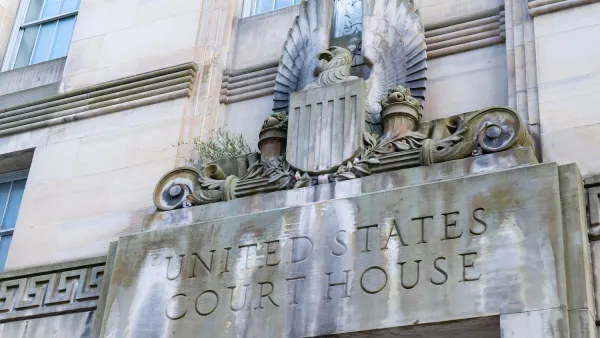
Judge Halts New Conditions for HUD, Transportation Grants
The Trump administration attempted to impose new restrictions on federal grants aimed at eliminating DEI programs and aligning with the administration’s immigration policy.

Congress Moves to End Reconnecting Communities and Related Grants
The House Transportation and Infrastructure Committee moved to rescind funding for the Neighborhood Equity and Access program, which funds highway removals, freeway caps, transit projects, pedestrian infrastructure, and more.

Forest Service Rescinds Tree Planting Grants
The $75 million program fell victim to the federal government’s purge of ‘DEI’-related projects.

Planetizen Federal Action Tracker
A weekly monitor of how Trump’s orders and actions are impacting planners and planning in America.

Eastern Nebraska is running out of electricity
Data centers and electrification are straining eastern Nebraska’s grid, throttling economic development.

Study reveals best places in the U.S. for cycling, walking
New research from Streetlight Data examines bicycle and pedestrian miles per capita in the 100 largest U.S. cities by population.

As development costs rise, Boston moves to lessen affordable housing requirements
The Boston Zoning Commission and the City Council still need to approve Boston Mayor Michelle Wu’s proposed changes

Washington state to fine drivers with fuel-efficient cars
Revenue from the fine will go towards supporting the state’s highways.

Strained electrical grid forces San Francisco to choose: housing, or data centers?
The city is approaching its maximum grid capacity, leaving leaders with tough choices about what projects to siphon energy toward.

FREE Course: Walkable City 1: Why Walkability?
After describing his path towards focusing on walkability as the essence of good planning, Jeff Speck marches through his five principal reasons for making more walkable places.
Reinventing Malls: Planning Alchemy—Turning Gray Fields Into Gold
The course focuses on the opportunities and imperatives that shape reinvention of mall sites.

City of Charlotte
City of Rosemead
Rutgers University, Edward J. Bloustein School of Planning and Public Policy
University of Michigan School for Environment and Sustainability (SEAS)
Hunter College, City University of New York (CUNY)
The Architects Foundation
City of Cambridge
The Pocatello Development Authority
The Urban Renewal Agency of the City of Pocatello