How a community planned in the 1920s has gracefully navigated change, offering a model for other places.


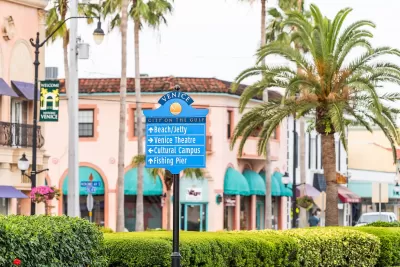
In a piece for Governing, William Fulton describes the growth of Venice, Florida, a planned community dating back to the 1920s designed by John Nolen. The community, as Fulton explains, “is one of the most famous and important town plans in American history” for urban planners and designers.
But for Fulton, the magic of Venice isn’t in its original plan; it’s in how the community has evolved and grown through the last century. “It helped me remember that the best places are those that evolve and reinvent themselves over time — a lesson that’s extremely important as we try to figure out the role of places, communities and downtowns in the wake of the pandemic.”
After the Great Depression, the town moved away from Nolen’s original Italianate architecture, adding more Modernist buildings. Since then, the community has embraced its diverse architectural history. Fulton concludes that “Sometimes it’s more valuable to lay down the pattern of public streets and public spaces upfront rather than trying to micromanage private development as today’s planners so often try to do.”
Fulton asks readers to keep Venice’s flexibility in mind as we navigate shifting urban patterns and make decisions about how to build and organize our cities.
Read the full story: What a Century-Old Planned Community Can Teach Us About Growth

Las Vegas-area development promises over 900 homes below market price
The master-planned Henderson community promises a variety of home types and parks, trails and other amenities.

San Francisco to Dismantle its Polarizing Brutalist Fountain
The Vaillancourt Fountain stands as a symbol of the tension between the city’s past and future.

What ‘The Brutalist’ Teaches Us About Modern Cities
How architecture and urban landscapes reflect the trauma and dysfunction of the post-war experience.

Planetizen Federal Action Tracker
A weekly monitor of how Trump’s orders and actions are impacting planners and planning in America.

Eastern Nebraska is running out of electricity
Data centers and electrification are straining eastern Nebraska’s grid, throttling economic development.

Study reveals best places in the U.S. for cycling, walking
New research from Streetlight Data examines bicycle and pedestrian miles per capita in the 100 largest U.S. cities by population.

DSA members accuse Mamdani of 'abandoning values' over housing redevelopment
New York City's mayor plans to replace about 2,000 units of public housing with private, mixed-income housing.

All sides of BRT debate unhappy with CDOT’s most recent move
The Colorado Department of Transportation is no longer considering center-running bus lanes for Colorado Boulevard.

Massachusetts bogs generate both power, and cranberries
Putting solar panels above farmland is one way Massachusetts is advancing toward its goal of net-zero carbon emissions by 2050.

FREE Course: Walkable City 1: Why Walkability?
After describing his path towards focusing on walkability as the essence of good planning, Jeff Speck marches through his five principal reasons for making more walkable places.
Reinventing Malls: Planning Alchemy—Turning Gray Fields Into Gold
The course focuses on the opportunities and imperatives that shape reinvention of mall sites.

City of Rosemead
Rutgers University, Edward J. Bloustein School of Planning and Public Policy
One Hundred Miles
University of Michigan School for Environment and Sustainability (SEAS)
Hunter College, City University of New York (CUNY)
The Architects Foundation
City of Cambridge
The Pocatello Development Authority
The Urban Renewal Agency of the City of Pocatello