Some residents of Philadelphia’s newly designated Washington Square West Historic District say the community was left out of the decision-making process that could impact housing costs and building requirements.


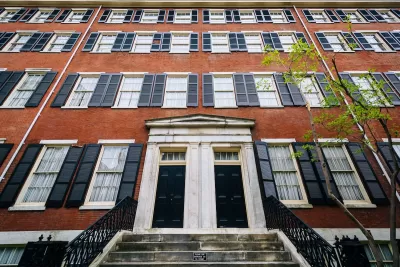
A newly created historic preservation district in Philadelphia is drawing backlash from local residents, reports Avalon Hinchman in 34th Street. “While many opponents agree that historic preservation is important, they consider the Washington Square West Historic District a case of serious overreach, with little regard for the good of the community.”
According to Hinchman, residents worry the designation will make it more difficult to make alterations to their properties and could raise housing values, pushing lower-income people and renters out of the area.
“In a letter of opposition, Washington Square West residents expressed their support for individual designation” of eight identified historic properties, but they argue that it “hardly justifies creating a historic district covering 1,441 [properties].” After all, in a city as historic as Philadelphia, it could be argued that the entire city is a historic landmark.
Some residents believe the designation is an effort to stop new development. Other opponents argue that historic designation will impede upgrades to buildings that improve quality of life, such as adding windows to homes that often lack good natural lighting or making buildings ADA compliant, and make it more onerous and expensive for homeowners to make changes.
The city could opt to create several smaller historic districts or let individual property owners participate in preservation programs on their own. “The PHC has designated historic districts in the past with little to no protest, but if the Washington Square West backlash is any indication, the historic preservation system in Philly can’t keep operating independent of the community.”
FULL STORY: No Historic Preservation without Representation

A Dirty Little Secret: Rising Property Values Are Incompatible With Affordability
Rising property values come with positive community development, but this shift can make neighborhoods inaccessible to low-income renters and fixed-income homeowners.
Proposed ‘Conservation Districts’ Could Change Preservation in Houston
The proposed model could be a new tool for preserving historic neighborhoods with more flexibility and with a focus on reducing displacement and addressing community concerns.
Is this the first wave of de-gentrification?
Valencia, Temescal, H Street and the fickle fortunes of the gentrified neighborhood.

Planetizen Federal Action Tracker
A weekly monitor of how Trump’s orders and actions are impacting planners and planning in America.

The state-sanctioned urbicide of Austin
People don’t kill cities. Freeways do.

US to reduce Colorado River water deliveries to Mexico
A new Colorado Treaty amendment reduces Mexico’s Colorado River water allocation by 250,000 acre feet.

5 New England states march closer to 800 megawatt wind energy project
Securing federal approval for the project may be complicated under the Trump administration, which has historically been hostile towards domestic wind power.

Baltimore to break ground on $50 million Transit Priority Project
The project will bring faster bus trips, safer streets and better bike connections to Baltimore.

Airbnb launches $250 million 'last-dollar financing' housing accelerator, makes first investment in Austin
The company will put $6.4 million towards affordable housing development in Texas’ capital.

FREE Course: Walkable City 1: Why Walkability?
After describing his path towards focusing on walkability as the essence of good planning, Jeff Speck marches through his five principal reasons for making more walkable places.
Reinventing Malls: Planning Alchemy—Turning Gray Fields Into Gold
The course focuses on the opportunities and imperatives that shape reinvention of mall sites.

Eagle County Government
Harvard University Graduate School of Design
Nashville Planning Department
The Architects Foundation
University of Cincinnati Online
The Pocatello Development Authority
The Urban Renewal Agency of the City of Pocatello
Journal of the American Planning Association