The project will test a technology that wirelessly charges vehicles driving or parked on the roadway.



The Indiana Department of Transportation broke ground on a segment of highway equipped with a system that can charge electric vehicles and heavy-duty trucks as they drive, idle, or park on the roadway. According to a press release from INDOT, “The project will use innovative magnetizable concrete – developed by German startup Magment GmbH – enabling wireless charging of electric vehicles as they drive.”
The technology could have a major impact on transportation emissions. As Susan Elizabeth Turek explains in The Cool Down, “Electrifying heavy-duty trucks would go a long way toward improving air quality by reducing pollution linked to health issues like asthma and rising global temperatures. The Environmental Protection Agency notes that medium- and heavy-duty vehicles account for 23% of heat-trapping gases generated by transportation in the United States.”
The project, designed by engineers at Purdue University, will begin with a testing phase during which “ charging benefits will only be available to vehicles with special transmitters, which draw power from the coils via magnetic fields.” The technology operates similarly to wireless cell phone chargers.
Read the full story: Public officials break ground on highway project that charges electric cars while driving: 'The possibilities are endless'

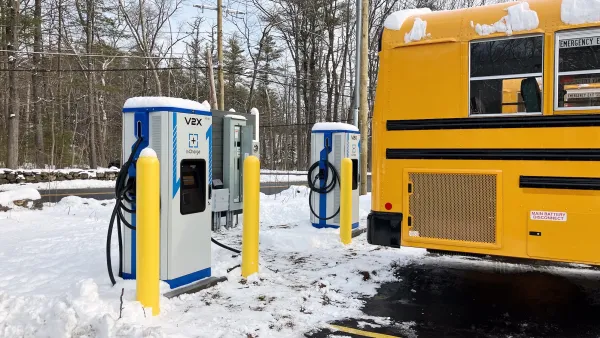
Massachusetts program pays EV owners to put power back into the grid
A pilot program could pave the way for more vehicle-to-grid installations in the United States.
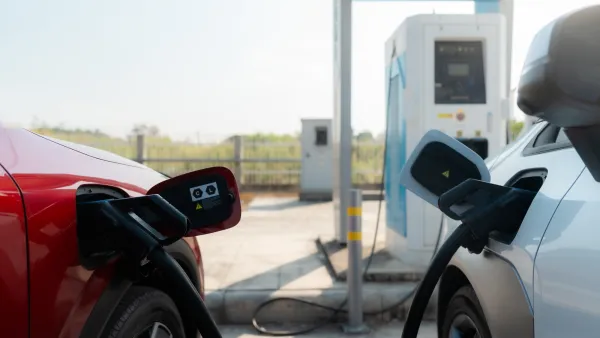
California launches $3,500 EV rebate
A new rebate program aims to maintain momentum for EV adoption as the federal government eliminates other incentives.
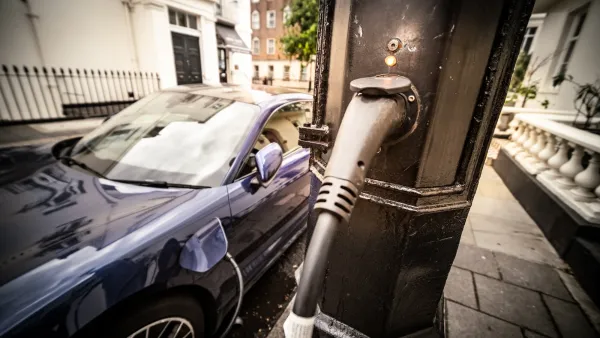
DC light poles will soon charge your electric car
The city awarded three grants to companies that will install more publicly available EV chargers.

Planetizen Federal Action Tracker
A weekly monitor of how Trump’s orders and actions are impacting planners and planning in America.

California plans to bury El Niño’s downpour
If the state plays its cards right, it may be able to store a billion acre-feet of El Niño’s water in aquifers.

Chicago breaks ground on $3 billion megadevelopment
The new neighborhood, titled Foundry Park, will one day host 3,700 residences.

Satanic place names
From streams and lakes to valleys and canyons, I mapped more than 1,000 places named after the Devil.

California High-Speed Rail Authority CEO resigns after $600,000 scandal
Under Ian Choudri, the authority used taxpayer dollars to fund first class flights and trips to nightclubs.

Want to study the Missouri River? Soon, you may need unanimous approval from 10 states
Legislation would require 10 governors’ permission to study or build projects moving water outside the basin.

FREE Course: Walkable City 1: Why Walkability?
After describing his path towards focusing on walkability as the essence of good planning, Jeff Speck marches through his five principal reasons for making more walkable places.
Reinventing Malls: Planning Alchemy—Turning Gray Fields Into Gold
The course focuses on the opportunities and imperatives that shape reinvention of mall sites.


City of Rosemead
Rutgers University, Edward J. Bloustein School of Planning and Public Policy
One Hundred Miles
Hunter College, City University of New York (CUNY)
The Architects Foundation
University of Cincinnati Online
City of Cambridge
Montrose County
The Pocatello Development Authority