A segment of California’s famous Highway 1 collapsed, leaving the area completely cut off for a day and the southbound lane of the road still closed.


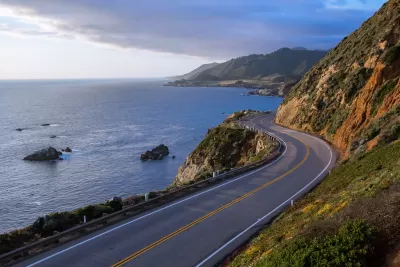
Roughly 1,600 people were stranded on California’s Big Sur coast when a segment of Highway 1, a road originally built in the 1930s that hugs the scenic coast, collapsed, cutting off the hamlet from the rest of the state.
According to a Los Angeles Times article by Jireh Deng and Thomas Curwen, “Officials discovered a slip-out on the southbound lane early Saturday evening and quickly closed the road to further vehicle travel to assess damage.”
Residents of the isolated coastal community are used to occasional landslides. “But the afternoon closure of Highway 1 at Rocky Creek Bridge — on a critical stretch connecting Big Sur with Carmel-By-the-Sea — caught visitors and businesses by surprise.”
Caltrans began escorting cars on the northbound lane on Sunday. “This weekend, officials are planning to install a 500-foot concrete barrier down the center line of the road to make an isolated channel for motorists, according to Kevin Drabinski, spokesperson for Caltrans District 5.”
Some residents believe the area needs another access point as coastal erosion and landslides become more common.
Read the full story: Big Sur tourism 'on standstill' after its connecting roadway crumbles into the sea -- again

Workers Returning, Carefully, to the Scene of Epic Landslide on the California Coast
Engineers are searching for solid ground along the California coast at the scene of a massive landslide that wiped out California Highway 1 near San Luis Obispo.
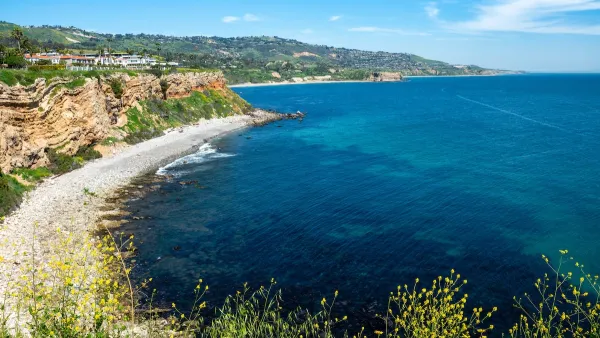
Southern California City Offers Buyout to Homeowners Facing Erosion Threat
Power and gas were shut off to dozens of homes in Rancho Palos Verdes as landslides threatened homes and infrastructure. Now, the city is offering to buy the homes to help residents relocate.
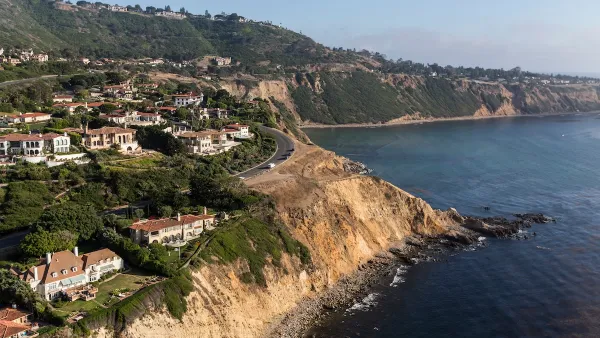
Southern California Utilities Cut Power, Gas to Hundreds of Households on Shifting Coastal Land
Slow but significant land movement is damaging infrastructure, prompting power shutoffs and calls for evacuation in Rancho Palos Verdes.

Planetizen Federal Action Tracker
A weekly monitor of how Trump’s orders and actions are impacting planners and planning in America.

Amtrak, CN end decades-long dispute with eight-year agreement
The new operating agreement establishes an updated framework for the companies to work together, including processes to resolve disputes.

Judges permit Denver to divert 77,000 acre feet from the Colorado River for reservoir expansion
Overuse and climate change have caused the Colorado River’s water levels to plummet.

Idaho may see an 18% drop in federal surface transit funding — the largest estimated cut in the US
Transit systems in rural communities are much more reliant on federal funding to provide their services.

How ‘post-disaster gentrification’ alters neighborhoods after natural calamities
After hurricanes, fires or other calamities, the original residents of a community are often replaced by younger, wealthier residents.

Maryland local governments examine if they should have more power to raise property taxes
Maryland’s housing market is out of reach for the majority of moderate-income residents.

FREE Course: Walkable City 1: Why Walkability?
After describing his path towards focusing on walkability as the essence of good planning, Jeff Speck marches through his five principal reasons for making more walkable places.
Reinventing Malls: Planning Alchemy—Turning Gray Fields Into Gold
The course focuses on the opportunities and imperatives that shape reinvention of mall sites.

Harvard University Graduate School of Design
KFH Group Inc.
Greater Baltimore Committee
The Architects Foundation
University of Cincinnati Online
The Pocatello Development Authority
The Urban Renewal Agency of the City of Pocatello