The 25-unit development is part of a growing ‘Yes in God’s Backyard’ movement to build housing on properties owned by faith-based organizations.


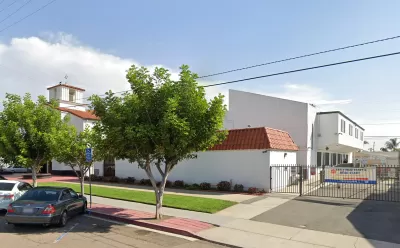
The first San Diego affordable housing development to begin construction after California’s new ‘Yes in God’s Backyard’ law passed is taking shape in the Logan Heights neighborhood, reports Andrew Bowen for KPBS. “San Diego adopted reforms in 2019 that streamlined permitting for affordable housing projects on church parking lots. The reforms also allow churches and nonprofits in the city's wealthiest neighborhoods to build affordable housing on their land, even when the underlying zoning doesn't allow it.”
“Bethel One will offer 25 one-bedroom apartments set aside for low-income seniors and veterans, with one additional unit reserved for an on-site property manager. It's being built by Bethel AME, a 136-year-old Black church.”
The project is replacing an aging duplex on a lot already owned by the church. As Planetizen has noted in other stories, faith leaders supporting the ‘Yes in God’s Backyard’ movement say helping with the housing and homelessness crisis is part of their responsibility to the community. “I really believe that churches have a tremendous responsibility to not just our congregation, but to the community in which our churches are located,” said Bethel AME senior pastor Rev. Harvey Vaughn III.
Read the full story: San Diego's first affordable housing project on church land under construction
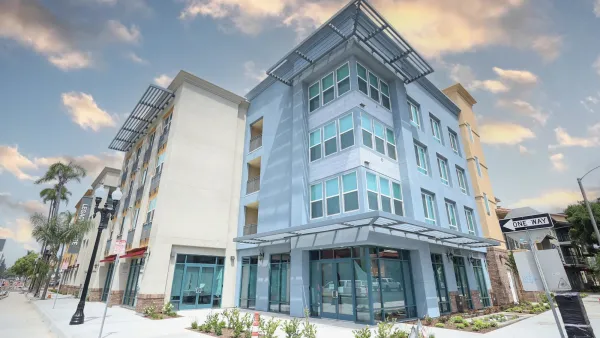
Church-to-housing trend grows in Southern California
Many faith leaders are eager to support housing construction on church land.
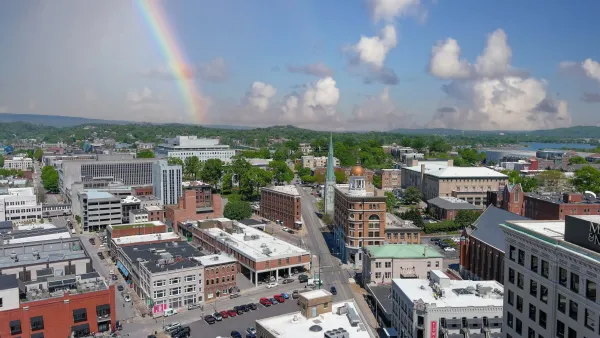
Chattanooga selects churches to build up to 400 affordable homes
Eight churches will move forward with plans to develop housing, from emergency shelter to single-family homes, on their properties.
Five simple zoning changes that any city can make to increase housing affordability
Zoning for more affordable housing is not rocket science, says Donald Elliot, author of "An Even Better Way to Zone." Here’s his five-step guide to getting started.

Planetizen Federal Action Tracker
A weekly monitor of how Trump’s orders and actions are impacting planners and planning in America.

California plans to bury El Niño’s downpour
If the state plays its cards right, it may be able to store a billion acre-feet of El Niño’s water in aquifers.

Desperate measures: Advocates weigh draining Lake Powell to fill Colorado River
Draining the reservoir could reduce evaporation losses by a couple hundred thousand acre-feet.

Mamdani’s pied-à-terre tax survives legal challenge
A panel of judges found that the plaintiffs failed to demonstrate injury as a result of New York City's implementation of the tax.

Eastern Nebraska is running out of electricity
Data centers and electrification are straining eastern Nebraska’s grid, throttling economic development.

Seattle passes record-breaking transit services expansion
Proposition 1 will double the city’s transit tax to add 95,000 more bus trips and preserve 180,000 bus trips annually.

FREE Course: Walkable City 1: Why Walkability?
After describing his path towards focusing on walkability as the essence of good planning, Jeff Speck marches through his five principal reasons for making more walkable places.
Reinventing Malls: Planning Alchemy—Turning Gray Fields Into Gold
The course focuses on the opportunities and imperatives that shape reinvention of mall sites.

City of Rosemead
Rutgers University, Edward J. Bloustein School of Planning and Public Policy
One Hundred Miles
University of Michigan School for Environment and Sustainability (SEAS)
Hunter College, City University of New York (CUNY)
The Architects Foundation
City of Cambridge
Montrose County
The Pocatello Development Authority