The park remains closed to the public as a court weighs a decision on the university’s proposed housing development.



The affordable housing portion of the University of California, Berkeley’s plan to build new housing in People’s Park still has no developer after the former developer walked out last year, reports Adhiti Bandlamudi for KQED.
“Resources for Community Development (RCD) left the project just months after an appellate court ruled UC Berkeley couldn’t move forward with construction until it evaluated other possible development sites and assessed potential noise impacts to students and other neighbors as part of its environmental review.” The decision came after a 2021 lawsuit that argued new housing would bring noise pollution that was not accounted for in the environmental review.
According to the article, “UC Berkeley is steadfast in its plan to build the 1,100-unit student housing and 125-unit supportive housing project. The university plans to develop the student housing itself. As for the supportive housing, it plans to offer the land, worth millions of dollars, to a third-party developer at no cost.” Dan Mogulof, assistant vice chancellor of the university, says “Supportive housing is an inseparable part of the project.”
Community members have protested the city’s decision to forcefully remove unhoused residents from the park, which was recently blocked off with shipping containers. “Now part of the National Register of Historic Places, People’s Park was the site of anti-war and environmental justice demonstrations in the 1960s and 1970s and has long been a place for homeless residents to camp and find services. Some Berkeley residents worry that history will be erased, despite the university’s promise to create permanent commemorations onsite.”
FULL STORY: UC Berkeley's Promised Supportive Housing in People's Park Still Doesn't Have a Developer

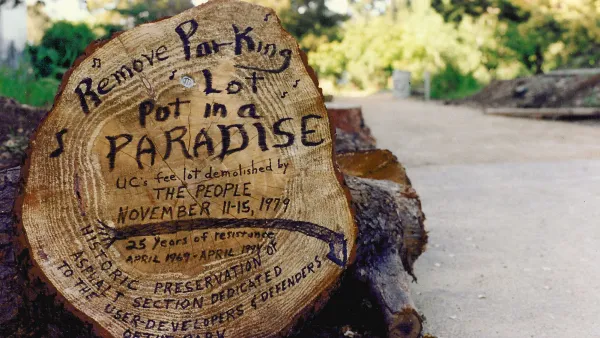
A Fight For the Future of People's Park
Community groups are fighting a plan to build student housing in the historic People's Park.
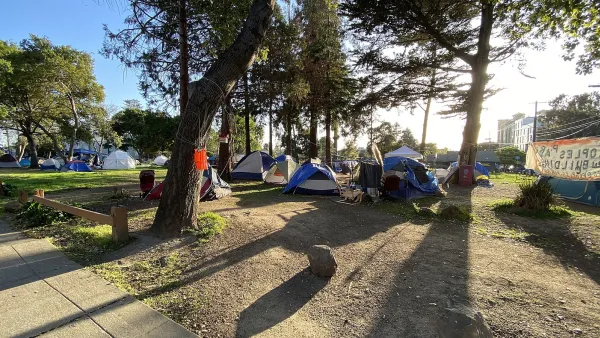
UC Berkeley Commits to Supportive Housing Project in People's Park
The university will work with the city and local nonprofits to provide 42 units of housing and supportive services to unhoused people living in Berkeley's iconic People's Park.
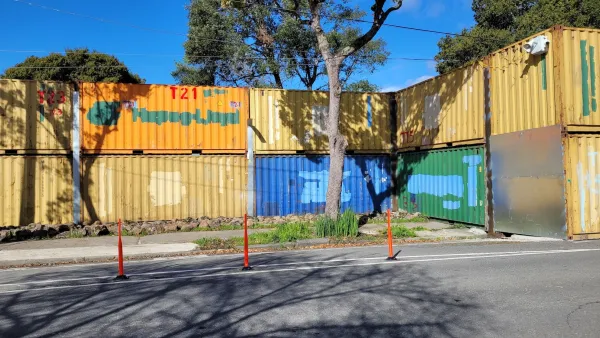
Berkeley promised to build supportive housing in People's Park. Where is it?
More than two years after People's Park was cordoned off, there is no word on a timeline for a promised affordable housing project.

Planetizen Federal Action Tracker
A weekly monitor of how Trump’s orders and actions are impacting planners and planning in America.

The state-sanctioned urbicide of Austin
People don’t kill cities. Freeways do.

US to reduce Colorado River water deliveries to Mexico
A new Colorado Treaty amendment reduces Mexico’s Colorado River water allocation by 250,000 acre feet.

Mamdani overhauls NYC's Vision Zero plan with 100 new policy goals
The overhaul aims to reduce traffic deaths and make streets safer for pedestrians, cyclists and drivers through lower speed limits, new safety infrastructure and more.

Amtrak not solely to blame for New Jersey commuter rail's unreliability, report finds
A new study from the Garden State Initiative found that NJ Transit’s budget grew 20% across a 4 year period, but reliability declined significantly over the same period.

EPA erases limits on planet-warming pollution from power plants
Under Monday’s plan, power plants would still have some limits on how much mercury, arsenic and other contaminants they can emit.

FREE Course: Walkable City 1: Why Walkability?
After describing his path towards focusing on walkability as the essence of good planning, Jeff Speck marches through his five principal reasons for making more walkable places.
Reinventing Malls: Planning Alchemy—Turning Gray Fields Into Gold
The course focuses on the opportunities and imperatives that shape reinvention of mall sites.

Eagle County Government
Harvard University Graduate School of Design
Nashville Planning Department
The Architects Foundation
University of Cincinnati Online
The Pocatello Development Authority
The Urban Renewal Agency of the City of Pocatello
Journal of the American Planning Association