A local legislator is asking for a plan to consolidate the region’s 27 separate transit agencies to improve financial stability and streamline service for riders.



According to an article by Megan Fan Munce in the San Francisco Chronicle, “A Bay Area legislator proposed legislation Wednesday to combine all of the region’s 27 public transit agencies into one in the wake of ongoing financial challenges to public transportation.”
The legislation asks the California State Transportation Agency to “develop a plan to consolidate all transit agencies that are located within the geographic jurisdiction of the Metropolitan Transportation Commission.” This follows a 2021 Bay Area Transit Transformation Plan developed by a Metropolitan Transportation Commission task force that includes recommendations to synchronize schedule changes and standardize maps across systems.
The idea has been around since at least 2013, when a UC Berkeley student survey found support for consolidation among transit officials. “In MTC polling conducted in March, 55% of respondents designated merging BART and Caltrain as a priority. Just over 60% said creating one regional agency responsible for setting fares, coordinating service schedules and creating consistent maps was a priority.”
FULL STORY: Bay Area legislator proposes combining all 27 local public transit agencies


A Second Transbay Tube for BART: Let the Planning Commence
BART passengers could someday see a second route across the San Francisco Bay, with a parallel but totally new alignment and crossing points on the either side of the bay.
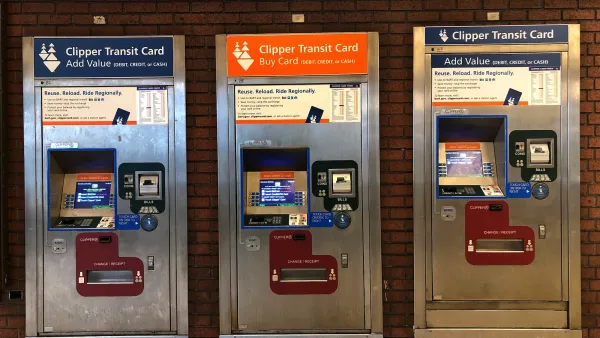
Bay Area transit loses $1M per month on credit card fees
As more people use mobile payments to pay their fares, transit agencies are spending more on transaction fees.
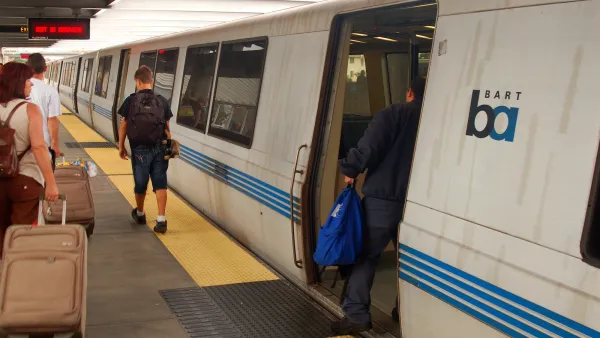
BART Service Cuts, Station Closures Could ‘Set Back the System 50 Years’
The agency could close dozens of stations and eliminate the Blue line between Daly City and Dublin-Pleasanton entirely.

Planetizen Federal Action Tracker
A weekly monitor of how Trump’s orders and actions are impacting planners and planning in America.

The state-sanctioned urbicide of Austin
People don’t kill cities. Freeways do.

US to reduce Colorado River water deliveries to Mexico
A new Colorado Treaty amendment reduces Mexico’s Colorado River water allocation by 250,000 acre feet.

5 New England states march closer to 800 megawatt wind energy project
Securing federal approval for the project may be complicated under the Trump administration, which has historically been hostile towards domestic wind power.

Baltimore to break ground on $50 million Transit Priority Project
The project will bring faster bus trips, safer streets and better bike connections to Baltimore.

Airbnb launches $250 million 'last-dollar financing' housing accelerator, makes first investment in Austin
The company will put $6.4 million towards affordable housing development in Texas’ capital.

FREE Course: Walkable City 1: Why Walkability?
After describing his path towards focusing on walkability as the essence of good planning, Jeff Speck marches through his five principal reasons for making more walkable places.
Reinventing Malls: Planning Alchemy—Turning Gray Fields Into Gold
The course focuses on the opportunities and imperatives that shape reinvention of mall sites.

Eagle County Government
Harvard University Graduate School of Design
Nashville Planning Department
The Architects Foundation
University of Cincinnati Online
The Pocatello Development Authority
The Urban Renewal Agency of the City of Pocatello
Journal of the American Planning Association