Sound Transit needs more cars to accommodate its ridership, particularly during special events and peak times.


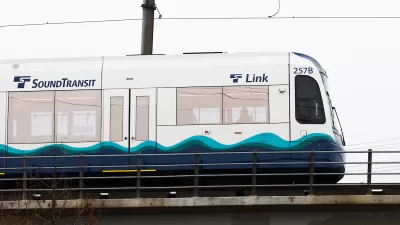
Seattle’s transit agency, Sound Transit, is running short on passenger space on its light rail vehicles, according to an article by Mike Lindblom in The Seattle Times. “More railcars are needed to provide the service quality promised to voters in 2008 and 2016 regional transit-tax measures.”
As Lindblom explains, “Sound Transit ordered 152 Siemens S70 vehicles in 2016-17, mainly to stock its Lynnwood, Bellevue, Redmond and Federal Way extensions, scheduled to open in 2024-26.” But “Those aren’t considered enough anymore, because slow conditions on the Seattle-SeaTac line are hamstringing train frequency, and therefore the route’s capacity to carry travelers.”
“Transit staff say that Siemens USA, which built the Seattle-Bellevue area’s newest railcar fleet, has only a short window in which managers can get parts from today’s tight supply chain, and assemble more Sound Transit railcars at its Sacramento, Calif., factory by 2027. Costs should range between $60 million and $100 million, says agency CEO Julie Timm.” If the agency orders 10 additional rail cars, they would add enough capacity to “provide a complete four-car train nearly all the time, instead of mixing in shorter three-car trains,” creating more space for wheelchairs and bikes as well as people.
FULL STORY: Sound Transit needs more railcars soon, so it won’t run out of room for riders

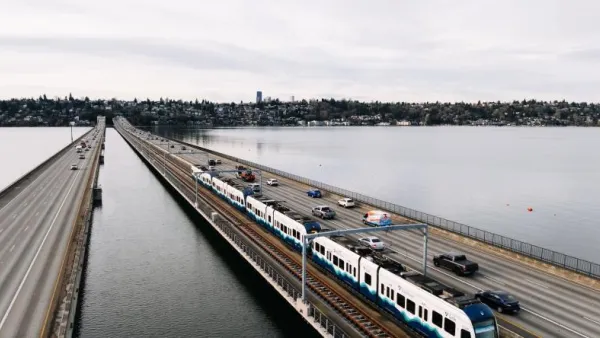
Seattle’s Floating Light Rail Bridge to Open March 28
The new East Link segment of King County’s light rail system crosses Lake Washington on a first-of-its-kind floating bridge.
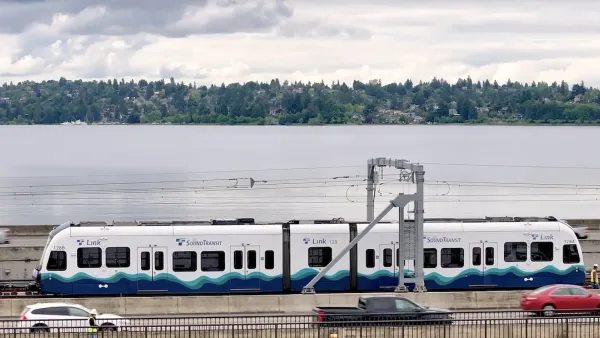
Floating Light Rail Bridge Crossing Marks Historic Moment for Seattle Transit
Once testing is complete, Sound Transit will open the world’s first light rail line that uses a floating bridge connecting downtown Seattle to the Eastside.

Seattle Mayor Addresses Soaring Light Rail Costs
As the cost for Sound Transit’s light rail expansion keeps growing, Mayor Bruce Harrell promised to streamline permitting and communication to ensure the project is finished sooner.

Planetizen Federal Action Tracker
A weekly monitor of how Trump’s orders and actions are impacting planners and planning in America.

The state-sanctioned urbicide of Austin
People don’t kill cities. Freeways do.

US to reduce Colorado River water deliveries to Mexico
A new Colorado Treaty amendment reduces Mexico’s Colorado River water allocation by 250,000 acre feet.

Colorado’s Largest Data Center Could Rise Next to Homes — Without a Public Hearing
The proposed campus would consume 11 times the power of Denver International Airport; as it has across the country, opposition mounts.

5 New England states march closer to 800 megawatt wind energy project
Securing federal approval for the project may be complicated under the Trump administration, which has historically been hostile towards domestic wind power.

Baltimore to break ground on $50 million Transit Priority Project
The project will bring faster bus trips, safer streets and better bike connections to Baltimore.

FREE Course: Walkable City 1: Why Walkability?
After describing his path towards focusing on walkability as the essence of good planning, Jeff Speck marches through his five principal reasons for making more walkable places.
Reinventing Malls: Planning Alchemy—Turning Gray Fields Into Gold
The course focuses on the opportunities and imperatives that shape reinvention of mall sites.

Eagle County Government
Harvard University Graduate School of Design
Nashville Planning Department
The Architects Foundation
University of Cincinnati Online
The Pocatello Development Authority
The Urban Renewal Agency of the City of Pocatello
Journal of the American Planning Association